Coda W
Coincident geometry
A nested two-way array in each cabinet. A physical left/right pair creates the stereo stage.
Explore Uni-Q ↑03 / COINCIDENT SOUND
Two drivers. One acoustic centre.
Explore the geometry behind KEF’s approach to stereo sound.
THE ACOUSTIC IDEA
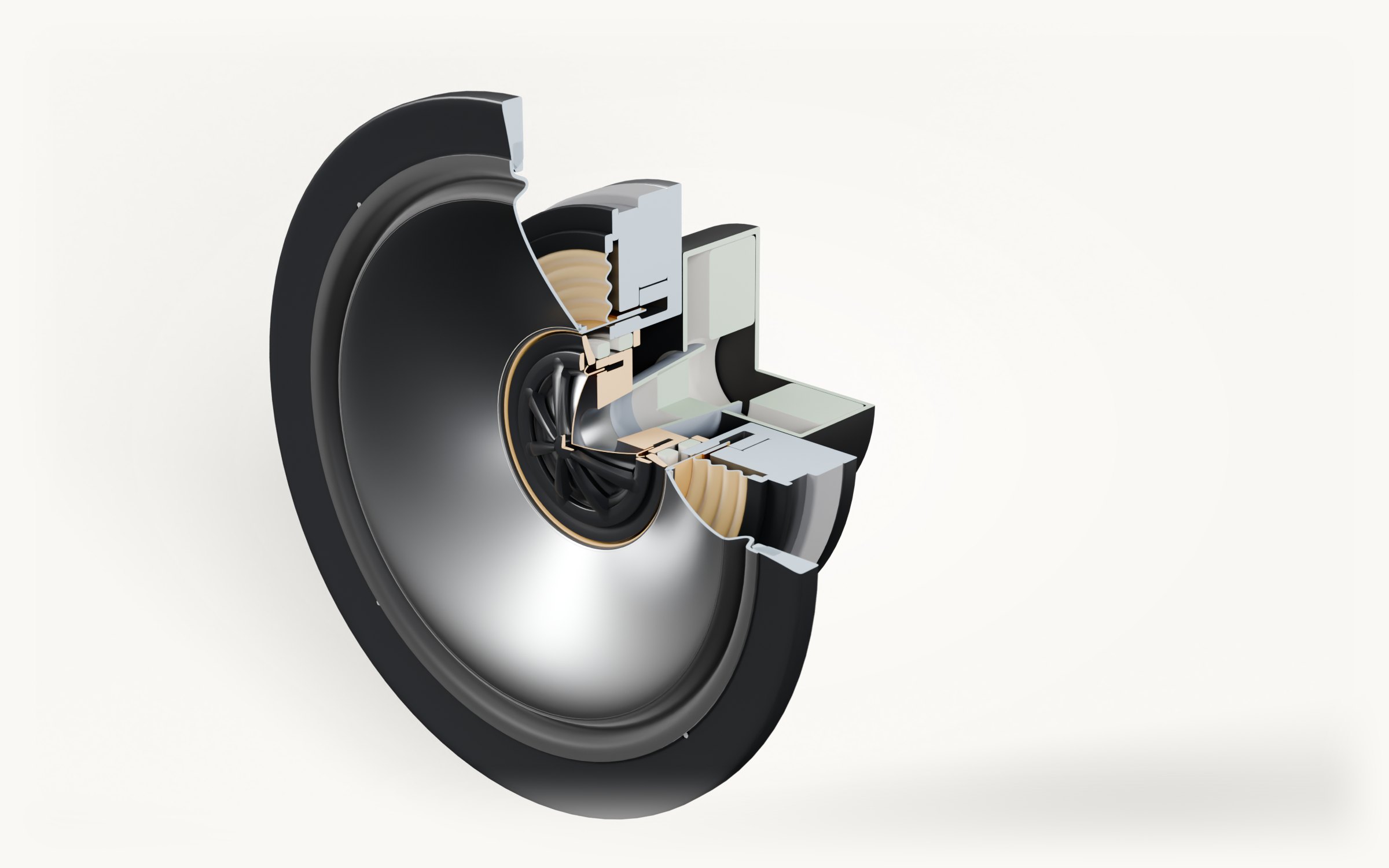
In a conventional two-way layout, the tweeter and bass/midrange driver occupy different positions. Around the frequencies they share, moving above or below the speaker changes the distance from each driver to your ears.
Uni-Q aims to bring their acoustic origins together. The surrounding cone also forms part of the tweeter’s waveguide. The intent is a smoother transition as you move away from the central listening position. KEF’s Uni-Q explanation ↗
Coincidence does not make a speaker omnidirectional, remove room reflections, or guarantee identical sound in every seat. Real performance still depends on driver directivity, crossover design, cabinet diffraction and the room.
THREE APPROACHES TO SPACE
Open the original 3D study ↗Coincident geometry
A nested two-way array in each cabinet. A physical left/right pair creates the stereo stage.
Explore Uni-Q ↑Room-aware rendering
Five beamforming tweeters surround the base. Microphones support room sensing and automatic bass correction.
Explore HomePod ↗Direct and reflected sound
Two forward drivers and an up-firing driver combine with TrueSpatial processing to add spatial scale.
Explore Bose ↗These are architectural distinctions, not a listening-test ranking. All three systems use signal processing.
EVIDENCE / SCOPE
Product specifications and architectural claims were checked against the primary sources listed here; acoustic performance was not independently measured. The speaker view is my own model, built from the published 285 × 168 × 268 mm cabinet and product photographs: no logo, a plain woven wrap, generic connectors. The driver view is a section reconstructed from KEF’s published descriptions of the Uni-Q architecture, not a teardown or a manufacturing drawing; dimensions KEF does not publish are representative. The path illustration is an idealised calculation, not a validated simulation or measured response.
KEF lists Coda W as 12th-generation Uni-Q; this study does not assume it includes MAT. KEF distinguishes 12th-generation Uni-Q from the later version with Metamaterial Absorption Technology, so the duct here ends in a plain damped chamber rather than MAT.