Axisymmetric, sealed, feedback-controlled
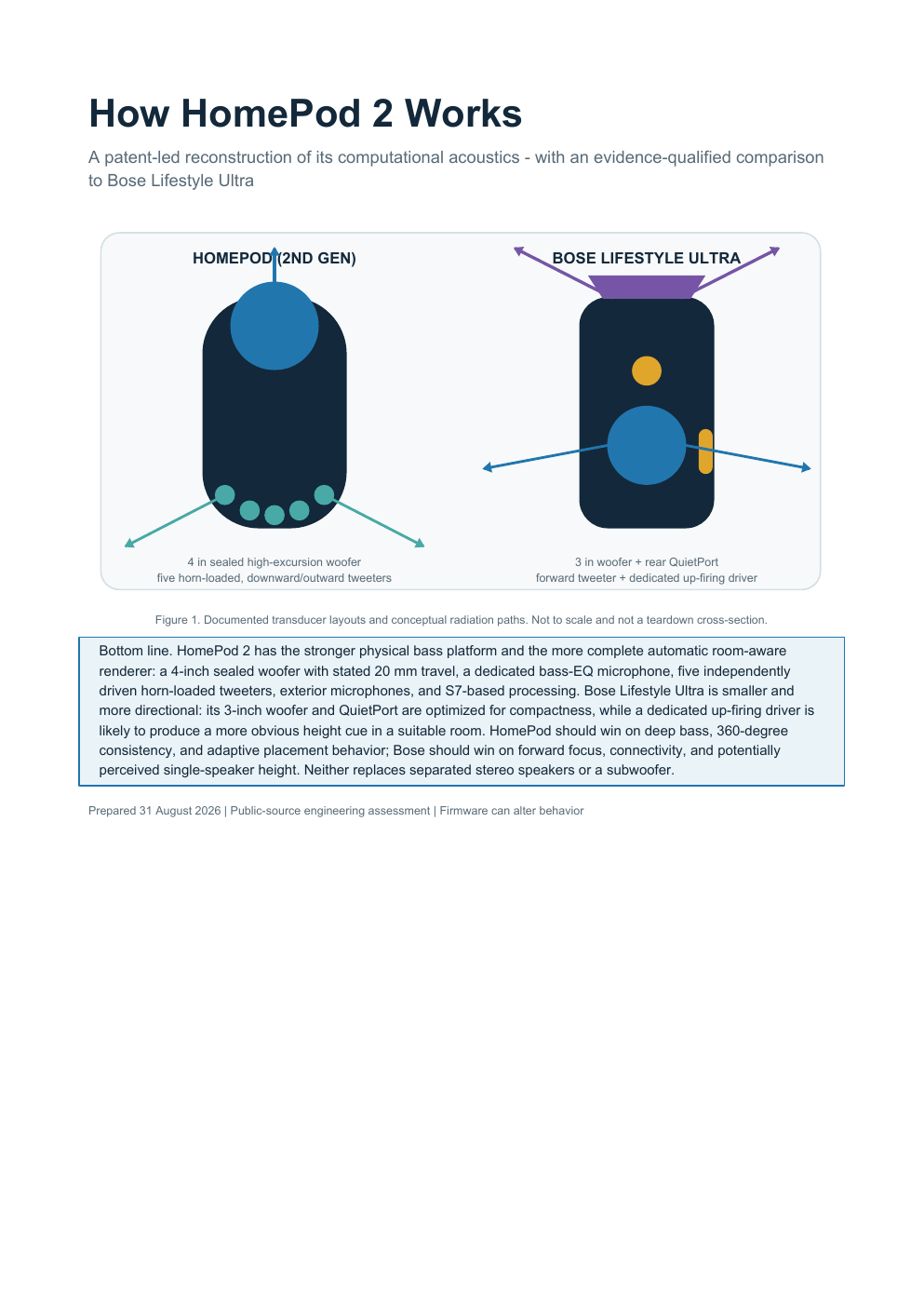
A 4-inch high-excursion woofer with stated 20 mm travel sits above five horn-loaded tweeters arranged around the base. A bass-EQ microphone and exterior microphone array feed continuous processing.
How Apple HomePod 2 and Bose Lifestyle Ultra use driver geometry, feedback, content analysis, and the room itself to create bass and spatial scale beyond their physical dimensions.
HomePod 2 is the more ambitious self-adapting full-range system. Bose Lifestyle Ultra is the more explicit direct-and-reflected spatial-effect speaker.
Deeper bass, near-360-degree consistency, native Atmos, and automatic wall/free-space adaptation.
Forward focus, broader inputs, and a dedicated up-firing path that can create a stronger height cue.
The products attack the same compact-speaker problem from opposite directions. Apple surrounds the cabinet with individually controlled tweeters; Bose assigns separate radiators to forward detail and reflected height.

A 4-inch high-excursion woofer with stated 20 mm travel sits above five horn-loaded tweeters arranged around the base. A bass-EQ microphone and exterior microphone array feed continuous processing.

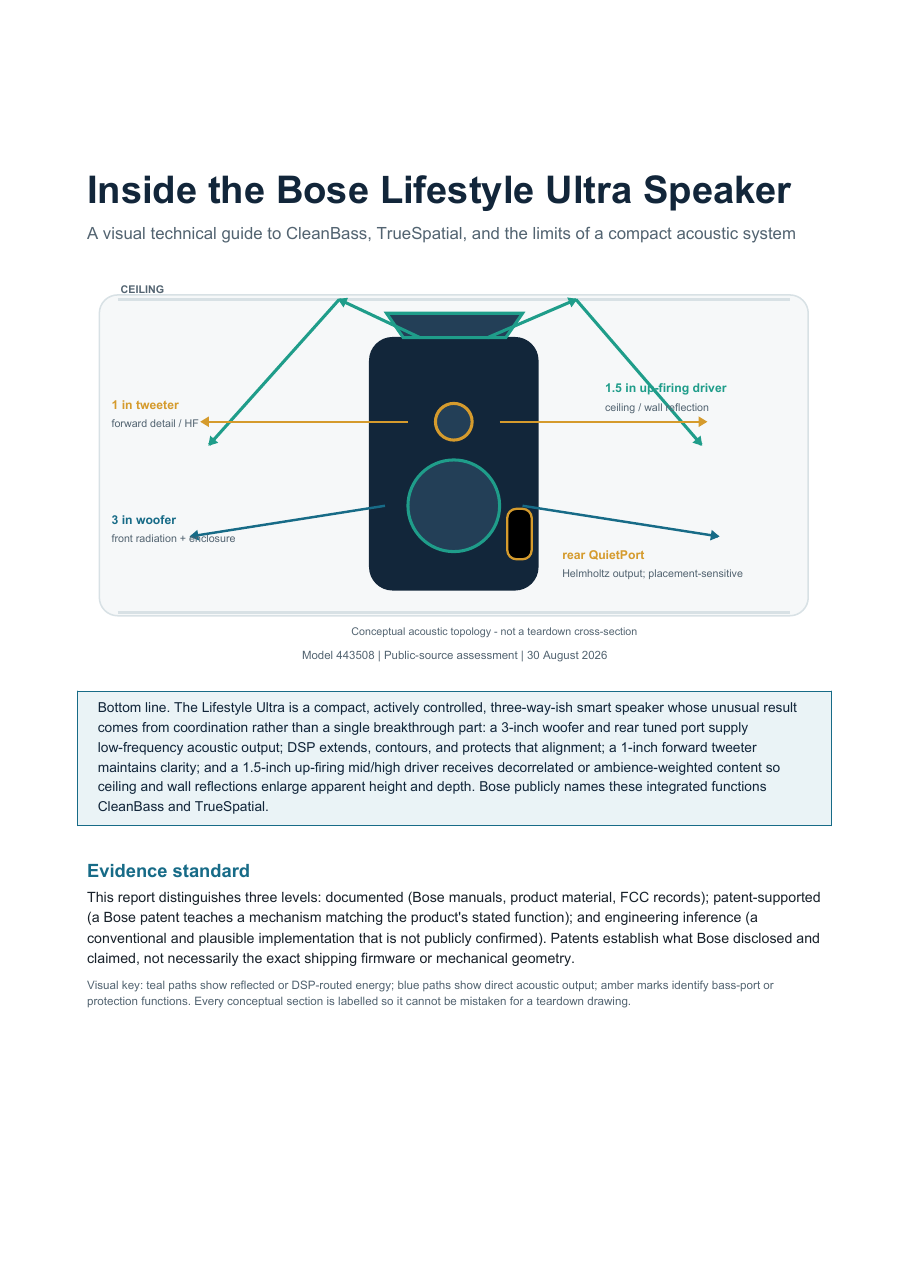
A forward 3-inch woofer and rear QuietPort form the bass system. A forward tweeter anchors detail while a dedicated 1.5-inch up-firing driver sends selected energy toward ceiling and walls.
Switch products and placement to see the conceptual direct, diffuse, reflected, and bass paths. The model explains documented relationships; it does not reproduce proprietary filter values.
HomePod has independent measurements and a mature patent trail. Bose is newer and lacks a shared laboratory comparison, so these are evidence-weighted expectations rather than invented scores.
Patents show mechanisms a company disclosed, not a definitive firmware bill of materials. These four disclosures have especially close functional or geometric links to the products.
APPLE US 10,244,314 B2Classifies wall, bookshelf, corner, or free space; corrects bass; aims ambient and direct material differently.
APPLE US 9,942,686 B1Separates correlated and uncorrelated content, then selects omnidirectional and higher-order beam patterns.
APPLE US 12,192,698 B2Places tilted horn-loaded ring drivers close to a support surface to reduce coloration and comb filtering.
BOSE US 12,008,998 B2Uses correlation, energy, pan preservation, and decorrelation to derive height material from conventional mixes.
The combined edition preserves both original studies and their source notes. Individual editions remain available for focused reading.
Both patent-led investigations in one printable technical volume.
Download combined PDF → 10 pagesArchitecture, feedback bass, room sensing, beamforming, patents, and comparative performance.
Download PDF → 10 pagesCleanBass, QuietPort, TrueSpatial, up-firing reflection, limitations, and patent lineage.
Download PDF →