Daily Mathematics / Solutions
Solutions for 24 October 2026
Two cards went out that day: a hard definite integral and an original Putnam-style problem. Try each one first; the solutions are folded away below.
Integral
A squared Lambert function at the reciprocal square
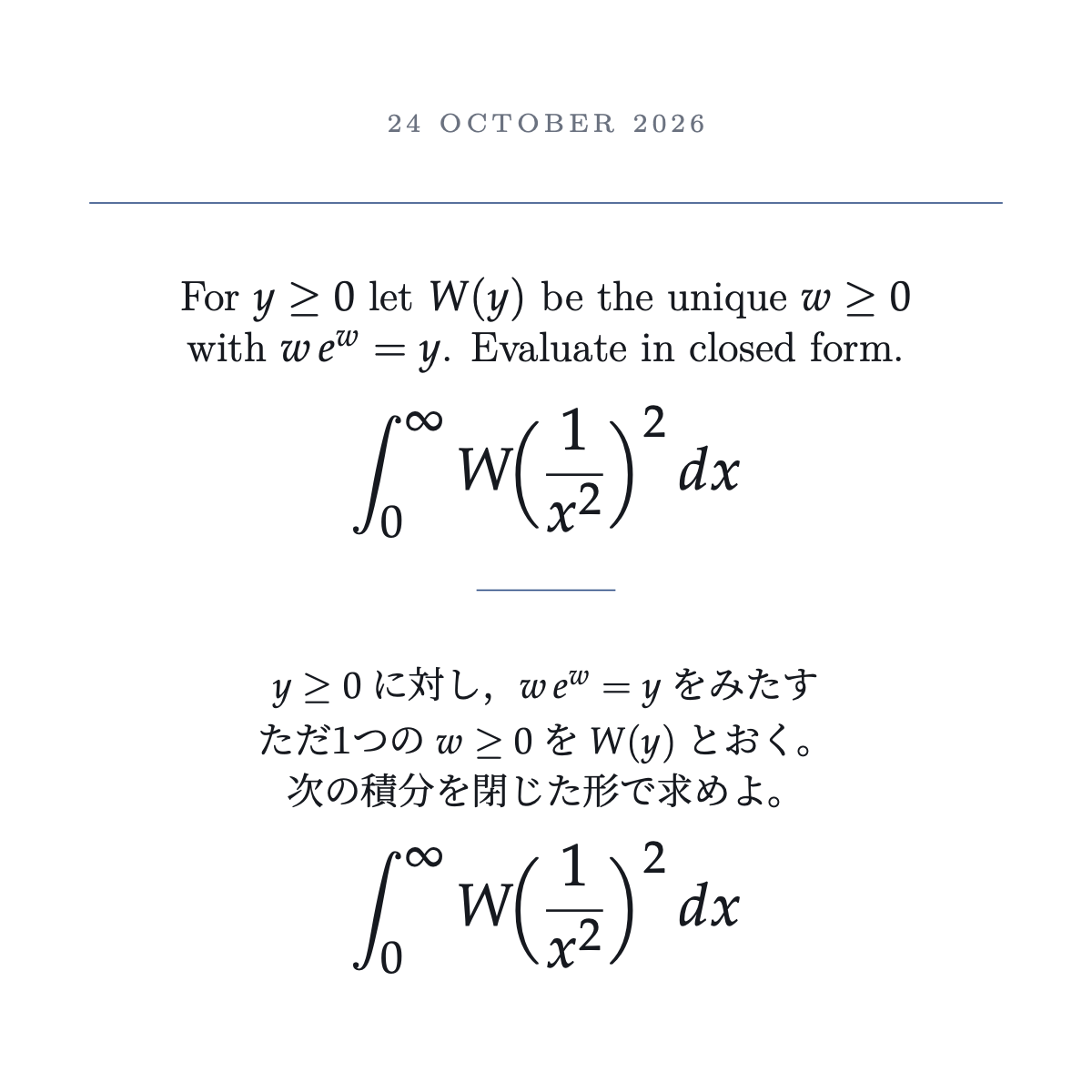
For \(y\ge 0\) let \(W(y)\) be the unique \(w\ge 0\) with \(we^{w}=y\). Evaluate in closed form.
\[\int_{0}^{\infty}W\!\Bigl(\frac{1}{x^{2}}\Bigr)^{2}\,dx\]
Show the solution
Call the integral \(I\). The map \(w\mapsto we^{w}\) is a smooth increasing bijection of \([0,\infty)\) onto itself, so \(W\) is well defined, continuous and increasing, with \(W(0)=0\). The integral converges: as \(x\to\infty\), \(W(x^{-2})\sim x^{-2}\); as \(x\to0^{+}\), \(W(x^{-2})\le\ln(x^{-2})\) for small \(x\) (since \(we^{w}\ge e^{w}\) once \(w\ge1\)), and \(\ln^{2}x\) is integrable at \(0\).
Why the obvious routes fail. \(W\) has no elementary closed form, and its Lagrange series \(W(y)=\sum_{k\ge1}\frac{(-k)^{k-1}}{k!}y^{k}\) converges only for \(|y|<1/e\), so it cannot be integrated over the whole range. The only usable information is the defining relation \(we^{w}=y\), and the integral has to be rewritten so that this relation does all the work.
Step 1: remove the decoy. Put \(y=x^{-2}\), so \(x=y^{-1/2}\) and \(dx=-\tfrac12y^{-3/2}\,dy\). The limits swap and \[I=\frac12\int_{0}^{\infty}W(y)^{2}\,y^{-3/2}\,dy.\]
Step 2: let \(W\) be the variable. Put \(y=we^{w}\), \(w\in(0,\infty)\). This is a legitimate change of variable because \(w\mapsto we^{w}\) is a smooth increasing bijection, and then \(W(y)=w\), \(dy=(1+w)e^{w}\,dw\) and \(y^{-3/2}=w^{-3/2}e^{-3w/2}\). Hence \[I=\frac12\int_{0}^{\infty}w^{2}\cdot w^{-3/2}e^{-3w/2}\cdot(1+w)e^{w}\,dw=\frac12\int_{0}^{\infty}\bigl(w^{1/2}+w^{3/2}\bigr)e^{-w/2}\,dw.\] The exponentials have combined into the single factor \(e^{-w/2}\), and the transcendental function has disappeared.
Step 3: two Gamma integrals. With \(\int_{0}^{\infty}w^{s-1}e^{-w/2}\,dw=2^{s}\Gamma(s)\), \[I=\frac12\Bigl(2^{3/2}\Gamma(\tfrac32)+2^{5/2}\Gamma(\tfrac52)\Bigr)=\frac12\Bigl(2\sqrt2\cdot\tfrac{\sqrt\pi}{2}+4\sqrt2\cdot\tfrac{3\sqrt\pi}{4}\Bigr)=\frac12\bigl(\sqrt{2\pi}+3\sqrt{2\pi}\bigr)=2\sqrt{2\pi}.\] The same computation gives \(\int_{0}^{\infty}W(x^{-2})\,dx=\sqrt{2\pi}\), so squaring \(W\) exactly doubles the value.
Numerical check. \(W\) was evaluated by Halley's iteration, and \(I\) was computed by composite 100-node Gauss-Legendre quadrature after \(x=e^{u}\) on \([-40,60]\) (40 and 200 panels per half), and independently in the \(w\)-form of Step 2. Both agree with \(2\sqrt{2\pi}=5.0132565492620\ldots\) to better than \(3\times10^{-14}\).
Competition problem
Polynomials whose roots are permuted by squaring
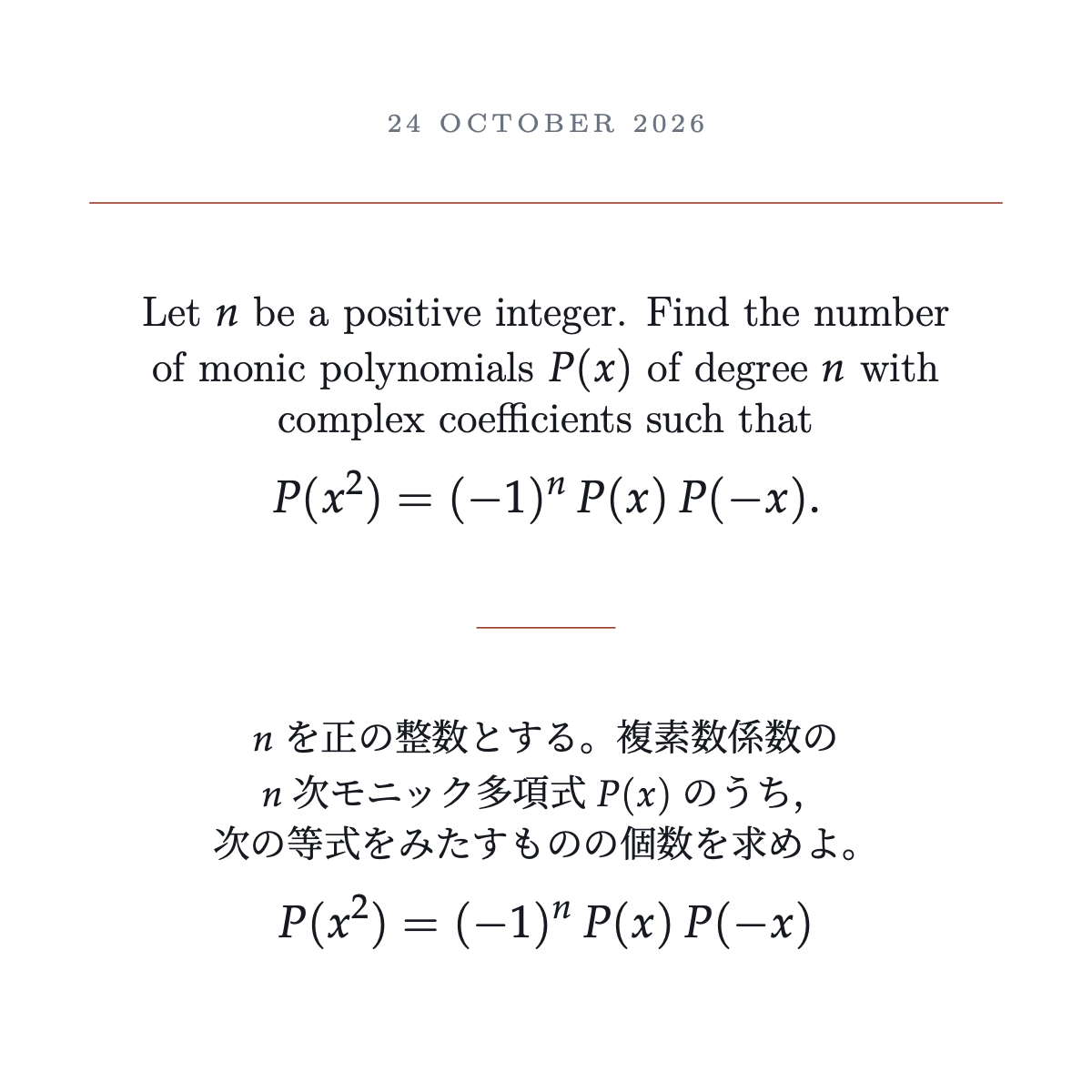
Let \(n\) be a positive integer. Find the number of monic polynomials \(P(x)\) of degree \(n\) with complex coefficients such that
\[P(x^{2})=(-1)^{n}\,P(x)\,P(-x).\]
Show the solution
Step 1: the equation is a statement about roots. Write \(P(x)=\prod_{i=1}^{n}(x-r_{i})\). Then \((-1)^{n}P(-x)=\prod_{i}(x+r_{i})\), so \((-1)^{n}P(x)P(-x)=\prod_{i}(x^{2}-r_{i}^{2})\). The equation therefore says \(P(x^{2})=\prod_{i}(x^{2}-r_{i}^{2})\); both sides are polynomials in \(y=x^{2}\), so it is equivalent to \(P(y)=\prod_{i}(y-r_{i}^{2})\). In words: the multiset of roots \(\{r_{1},\dots,r_{n}\}\) is unchanged when every root is squared. (This is the statement that \(P\) is a fixed point of Graeffe's root-squaring transformation.) Monic polynomials of degree \(n\) correspond bijectively to multisets of \(n\) complex numbers, so we must count such multisets.
Step 2: the shape of an invariant multiset. Let \(S\) be the set of distinct roots and \(m(z)\ge1\) the multiplicity of \(z\in S\). Invariance says that for every \(z\), \(m(z)=\sum_{w\in S,\ w^{2}=z}m(w)\). Taking \(z\in S\) shows that every element of \(S\) has a square root in \(S\), and taking \(z\notin S\) shows that squaring maps \(S\) into \(S\). So \(f(z)=z^{2}\) is a surjection of the finite set \(S\) onto itself, hence a bijection, and the relation becomes \(m(z)=m(f^{-1}(z))\): the multiplicity is constant along each cycle of \(f\). Since \(S\) is finite, every \(z\in S\) satisfies \(z^{2^{k}}=z\) for some \(k\ge1\), so \(z=0\) or \(z\) is a root of unity of odd order. Conversely, if \(T\) denotes the set consisting of \(0\) and all roots of unity of odd order, then \(f\) permutes \(T\) (squaring is invertible on odd-order roots of unity), and any finite union of \(f\)-cycles in \(T\), each counted with a constant multiplicity, is an invariant multiset. Hence the polynomials we want correspond exactly to families of nonnegative integers \(m_{C}\), one for each cycle \(C\) of \(f\) on \(T\), with \(\sum_{C}m_{C}|C|=n\).
Step 3: counting cycles. Let \(c_{L}\) be the number of cycles of length exactly \(L\). The points of \(T\) whose period divides \(L\) are the solutions of \(z^{2^{L}}=z\), namely \(0\) and the \(2^{L}-1\) distinct roots of \(z^{2^{L}-1}=1\): exactly \(2^{L}\) points. Counting them by cycles gives \[\sum_{d\mid L}d\,c_{d}=2^{L}\qquad(L\ge1).\] In particular each \(c_{L}\) is finite, so the count is finite.
Step 4: the generating function. The number of admissible multisets of total size \(n\) is the coefficient of \(t^{n}\) in \(F(t)=\prod_{L\ge1}(1-t^{L})^{-c_{L}}\). Taking logarithms, \[\ln F(t)=\sum_{L}c_{L}\sum_{j\ge1}\frac{t^{Lj}}{j}=\sum_{N\ge1}\frac{t^{N}}{N}\sum_{L\mid N}L\,c_{L}=\sum_{N\ge1}\frac{(2t)^{N}}{N}=-\ln(1-2t).\] So \(F(t)=1/(1-2t)\), and the number of polynomials of degree \(n\) is \(2^{n}\). (This is the cyclotomic identity, i.e. the Euler product for the dynamical zeta function of a map with \(2^{N}\) points of period dividing \(N\).) For example, for \(n=2\) the four polynomials are \(x^{2}\), \(x(x-1)\), \((x-1)^{2}\) and \(x^{2}+x+1\).
Checks run. The cycle counts \(c_{L}\) obtained from the divisor relation were compared with a direct enumeration of the doubling map modulo \(2^{L}-1\) for \(L\le6\); the coefficients of \(\prod(1-t^{L})^{-c_{L}}\) were expanded exactly and equal \(2^{n}\) for \(n\le14\); and, independently of the root argument, the coefficient equations of \(P(x^{2})=(-1)^{n}P(x)P(-x)\) were solved by Newton's method from 3000 random complex starting points for \(n=1,2,3,4\), finding exactly \(2,4,8,16\) distinct solutions.