Daily Mathematics / Solutions
Solutions for 23 October 2026
Two cards went out that day: a hard definite integral and an original Putnam-style problem. Try each one first; the solutions are folded away below.
Integral
A logarithmic double integral with a hidden geometry
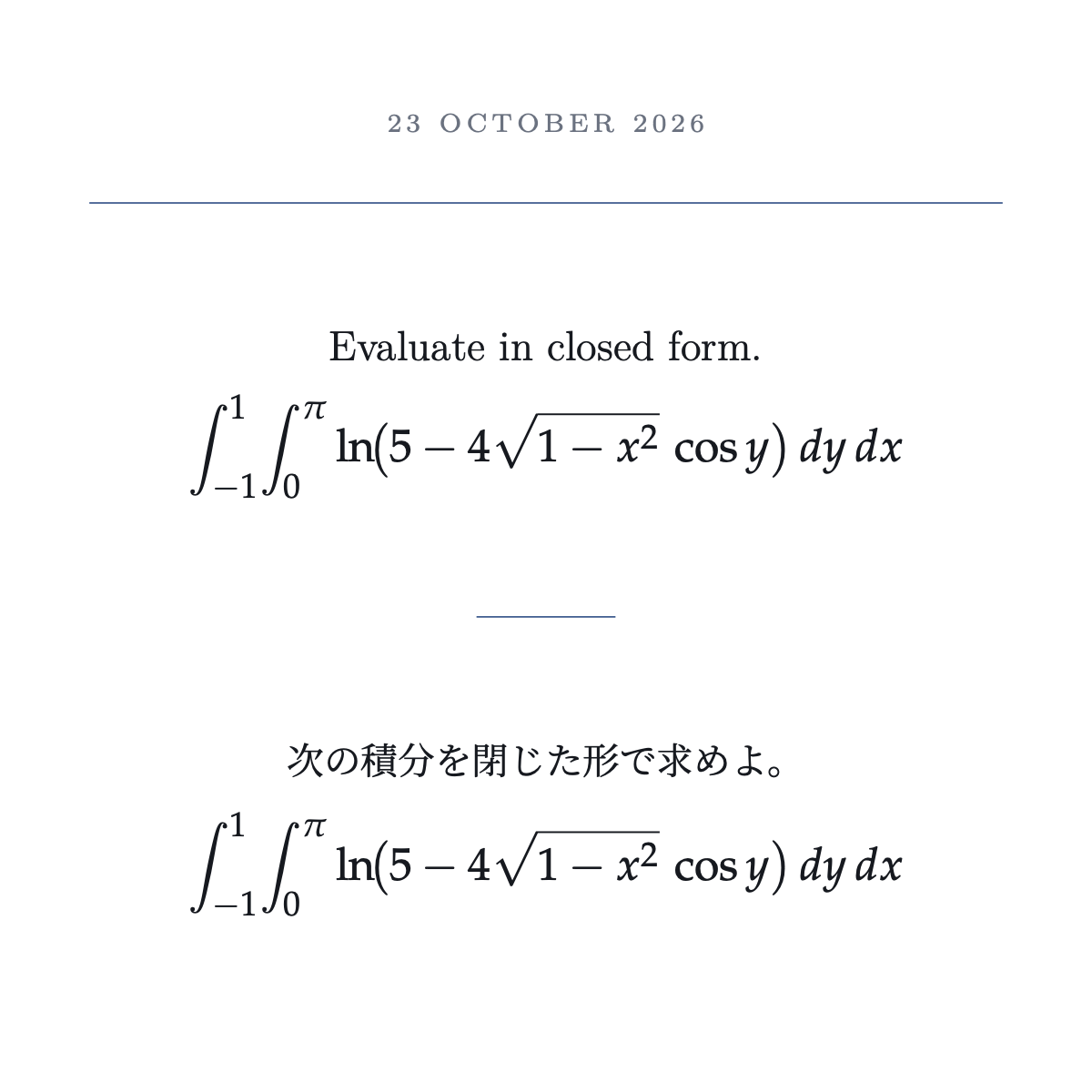
Evaluate in closed form.
\[\int_{-1}^{1}\!\int_{0}^{\pi}\ln\!\bigl(5-4\sqrt{1-x^{2}}\,\cos y\bigr)\,dy\,dx\]
Show the solution
Call the integral \(I\). The integrand is smooth, since \(5-4\sqrt{1-x^{2}}\cos y\ge 1\) on the whole rectangle.
Why the direct route is unpleasant. The inner integral can be done with the classical formula \(\int_{0}^{\pi}\ln(a-b\cos y)\,dy=\pi\ln\frac{a+\sqrt{a^{2}-b^{2}}}{2}\) for \(a>b\ge 0\). With \(a=5\), \(b=4\sqrt{1-x^{2}}\) we get \(a^{2}-b^{2}=9+16x^{2}\), so \(I=\pi\int_{-1}^{1}\ln\frac{5+\sqrt{9+16x^{2}}}{2}\,dx\). This is finite work, but it leads to an inverse hyperbolic mess that hides how simple the answer is. The structure of the integrand suggests a better reading.
Step 1: the hidden sphere. For \((x,y)\in[-1,1]\times[0,2\pi)\) put \(P(x,y)=\bigl(\sqrt{1-x^{2}}\cos y,\ \sqrt{1-x^{2}}\sin y,\ x\bigr)\). This is a point of the unit sphere \(S^{2}\), and the map is the usual parametrisation by height \(x\) and longitude \(y\). Writing \(x=\cos\theta\), the area element is \(dA=\sin\theta\,d\theta\,dy=dx\,dy\). In other words, \(dx\,dy\) is exactly surface measure: this is Archimedes' hat-box theorem. Hence, for any continuous \(g\) on the sphere, \(\int_{S^{2}}g\,dA=\int_{-1}^{1}\int_{0}^{2\pi}g(P(x,y))\,dy\,dx\).
Step 2: the integrand is a distance. Let \(Q=(2,0,0)\). Since \(|P|=1\), \(|P-Q|^{2}=|P|^{2}-2P\cdot Q+|Q|^{2}=5-4P_{1}=5-4\sqrt{1-x^{2}}\cos y\). The integrand is \(\ln|P-Q|^{2}\). Because \(\cos(2\pi-y)=\cos y\), the integral over \(y\in[\pi,2\pi]\) equals the one over \([0,\pi]\), so \(2I=J\), where \(J=\int_{S^{2}}\ln|P-Q|^{2}\,dA\).
Step 3: rotate. Surface measure is invariant under rotations. A rotation \(R\) with \(Re_{1}=e_{3}\) gives \(|RP-RQ|=|P-Q|\) and \(RQ=(0,0,2)\), so \(J=\int_{S^{2}}\ln|P-(0,0,2)|^{2}\,dA=\int_{S^{2}}\ln(5-4P_{3})\,dA\). Now the integrand depends only on the height \(P_{3}=x\), and by Step 1 \(J=\int_{-1}^{1}\int_{0}^{2\pi}\ln(5-4x)\,dy\,dx=2\pi\int_{-1}^{1}\ln(5-4x)\,dx\). The height of a uniform point on the sphere is uniform on \([-1,1]\): that is the whole content of the trick.
Step 4: one variable. With \(u=5-4x\), \(\int_{-1}^{1}\ln(5-4x)\,dx=\frac14\int_{1}^{9}\ln u\,du=\frac14\bigl[u\ln u-u\bigr]_{1}^{9}=\frac14(9\ln 9-8)=\frac{9\ln 3-4}{2}\). Therefore \(J=\pi(9\ln 3-4)\) and \(I=J/2=\frac{\pi}{2}(9\ln 3-4)\approx 9.2480800213\).
Remark. The same computation gives \(\int_{S^{2}}\ln|P-Q|\,dA\) for every point \(Q\) outside the sphere in terms of \(|Q|\) alone, a logarithmic cousin of Newton's shell theorem.
Check. The double integral was evaluated numerically with composite Gauss-Legendre quadrature (120 nodes per panel, 40 by 40 panels), after the substitution \(x=\sin t\) to remove the square-root endpoint behaviour. It agrees with \(\frac{\pi}{2}(9\ln 3-4)=9.248080021324826\) to all printed digits (difference below \(10^{-14}\)).
Competition problem
One-sided approximation of the square root of 3
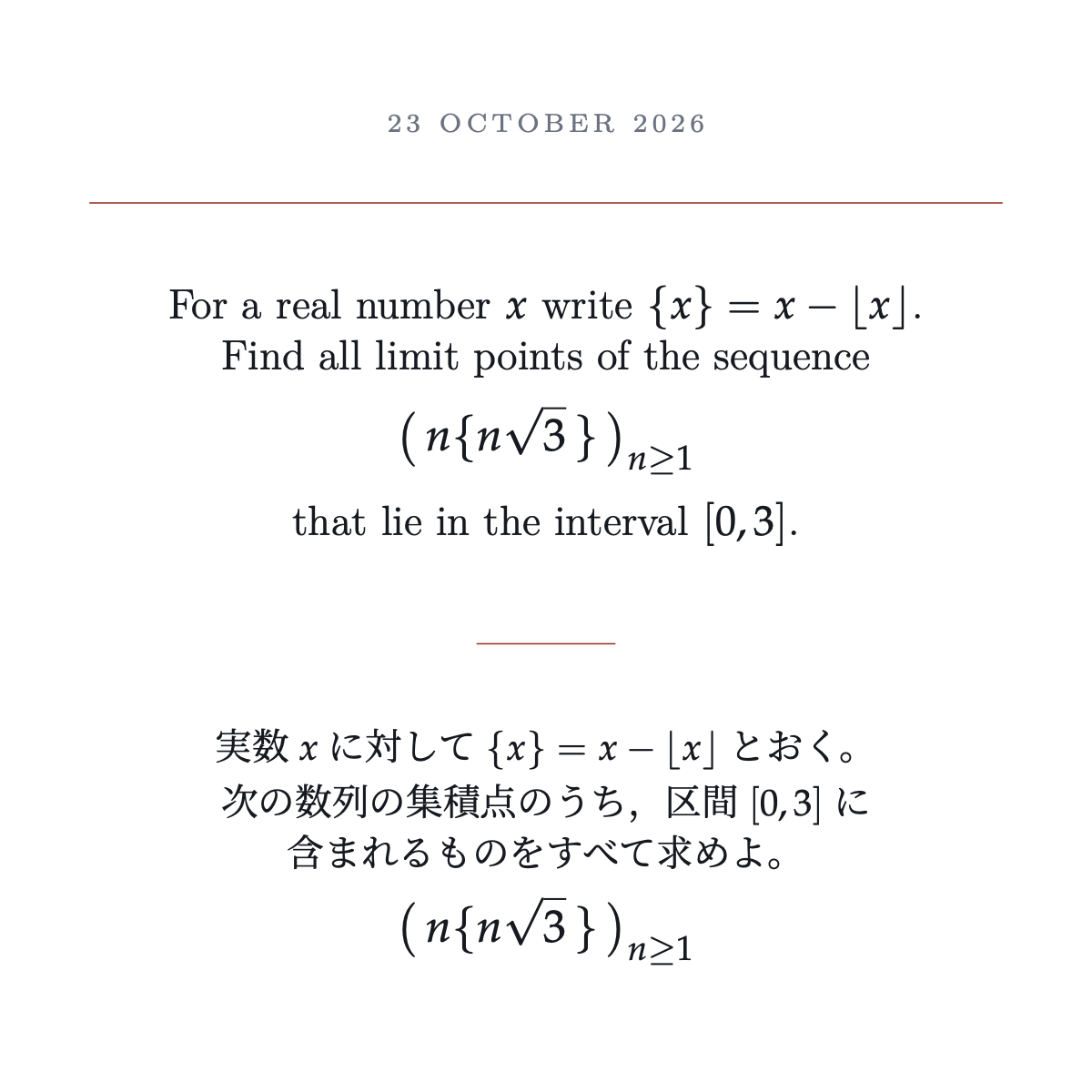
For a real number \(x\) write \(\{x\}=x-\lfloor x\rfloor\). Find all limit points of the sequence \[\bigl(n\{n\sqrt{3}\}\bigr)_{n\ge 1}\] that lie in the interval \([0,3]\).
Show the solution
Answer. Exactly three: \(\frac{1}{\sqrt3}\), \(\frac{\sqrt3}{2}\) and \(\frac{4}{\sqrt3}\).
The natural first idea is the continued fraction \(\sqrt3=[1;\overline{1,2}]\) and Hurwitz-type bounds. They control the distance from \(n\sqrt3\) to the nearest integer, but this problem is one-sided: \(\{n\sqrt3\}\) is small only when \(n\sqrt3\) lies just above an integer, and the two sides of \(\sqrt3\) behave differently. The right tool is the norm form \(3n^{2}-m^{2}\).
Step 1: an exact formula. Fix \(n\ge1\), let \(m=\lfloor n\sqrt3\rfloor\) and \(\delta=\{n\sqrt3\}\in(0,1)\) (\(\sqrt3\) is irrational). Put \(k_{n}=3n^{2}-m^{2}\), an integer. Since \(k_{n}=(n\sqrt3-m)(n\sqrt3+m)=\delta(n\sqrt3+m)>0\), \(k_{n}\) is a positive integer and \[n\{n\sqrt3\}=\frac{k_{n}\,n}{n\sqrt3+m}=\frac{k_{n}}{\sqrt3+m/n}.\qquad(*)\] Because \(m<n\sqrt3\), this gives \(n\{n\sqrt3\}>k_{n}/(2\sqrt3)\) for every \(n\).
Step 2: every finite limit point is \(k/(2\sqrt3)\) for some \(k\in K\), where \(K\) is the set of positive integers \(k\) such that \(3n^{2}-m^{2}=k\) has infinitely many solutions in positive integers. Let \(n_{j}\to\infty\) with \(n_{j}\{n_{j}\sqrt3\}\to L<\infty\). By Step 1, \(k_{n_{j}}<2\sqrt3(L+1)\) eventually, so the \(k_{n_{j}}\) are bounded and we may pass to a subsequence on which \(k_{n_{j}}=k\) is constant; then \(k\in K\). From \(3-(m/n)^{2}=k/n^{2}\to0\) we get \(m/n\to\sqrt3\), and \((*)\) gives \(L=k/(2\sqrt3)\).
Step 3: every \(k\in K\) gives the limit point \(k/(2\sqrt3)\); in fact one solution is enough. If \(3n^{2}-m^{2}=k\) with \(m,n>0\), multiply \(m+n\sqrt3\) by the unit \(2+\sqrt3\) (norm \(4-3=1\)): \((m+n\sqrt3)(2+\sqrt3)=(2m+3n)+(m+2n)\sqrt3\). So \((n,m)\mapsto(m+2n,\,2m+3n)\) preserves \(3n^{2}-m^{2}\) and strictly increases \(n\), giving infinitely many solutions. For each of them \(n\sqrt3-m=k/(n\sqrt3+m)\) lies in \((0,1)\) once \(n\) is large, so \(m=\lfloor n\sqrt3\rfloor\) and \(k_{n}=k\); since \(m/n\to\sqrt3\), \((*)\) gives \(n\{n\sqrt3\}\to k/(2\sqrt3)\).
Step 4: which \(k\) matter. A limit point in \([0,3]\) needs \(k\le 6\sqrt3\approx10.39\), so \(1\le k\le10\). We decide which of these are values of \(3n^{2}-m^{2}\).
Mod 3: \(m^{2}\equiv-k\pmod 3\) and squares are \(0,1\pmod 3\), so \(k\not\equiv1\pmod3\). This removes \(k=1,4,7,10\).
Mod 4: \(n^{2},m^{2}\in\{0,1\}\pmod 4\), so \(3n^{2}-m^{2}\in\{0,2,3\}\pmod4\), never \(1\). This removes \(k=5\).
\(k=6\): then \(3\mid m\); writing \(m=3m'\) gives \(n^{2}-3m'^{2}=2\), so \(n^{2}\equiv2\pmod3\), impossible.
\(k=9\): again \(m=3m'\) and \(n^{2}-3m'^{2}=3\), so \(3\mid n\); with \(n=3n'\) this becomes \(3n'^{2}-m'^{2}=1\), already excluded.
The survivors are represented: \(k=2\) by \((n,m)=(1,1)\), \(k=3\) by \((2,3)\), \(k=8\) by \((2,2)\). By Step 3 they lie in \(K\).
Conclusion. The limit points in \([0,3]\) are \(\frac{2}{2\sqrt3}=\frac{1}{\sqrt3}\), \(\frac{3}{2\sqrt3}=\frac{\sqrt3}{2}\) and \(\frac{8}{2\sqrt3}=\frac{4}{\sqrt3}\). As a by-product, \(n\{n\sqrt3\}>1/\sqrt3\) for every \(n\), so nothing below \(1/\sqrt3\) (in particular \(0\)) is a limit point; the next limit point after \(4/\sqrt3\) is \(11/(2\sqrt3)\approx3.18\), outside the interval. On the other side of \(\sqrt3\) the Pell equation \(m^{2}-3n^{2}=1\) is solvable, which is why \(n(1-\{n\sqrt3\})\) gets down to about \(1/(2\sqrt3)\): the asymmetry is real.
Check. Using exact integer square roots, \(n\{n\sqrt3\}\) was computed for all \(n\le 3\cdot10^{6}\). For \(n>1000\), every value at most \(3.2\) had \(k_{n}\in\{2,3,8,11\}\), clustering at \(0.5773502\), \(0.8660254\), \(2.3094010\) and \(3.1754264\). An exhaustive search over a box confirmed that \(3x^{2}-y^{2}\) takes the values \(2,3,8\) and none of \(1,4,5,6,7,9,10\).