Daily Mathematics / Solutions
Solutions for 17 October 2026
Two cards went out that day: a hard definite integral and an original Putnam-style problem. Try each one first; the solutions are folded away below.
Integral
A rational weight against a hyperbolic secant
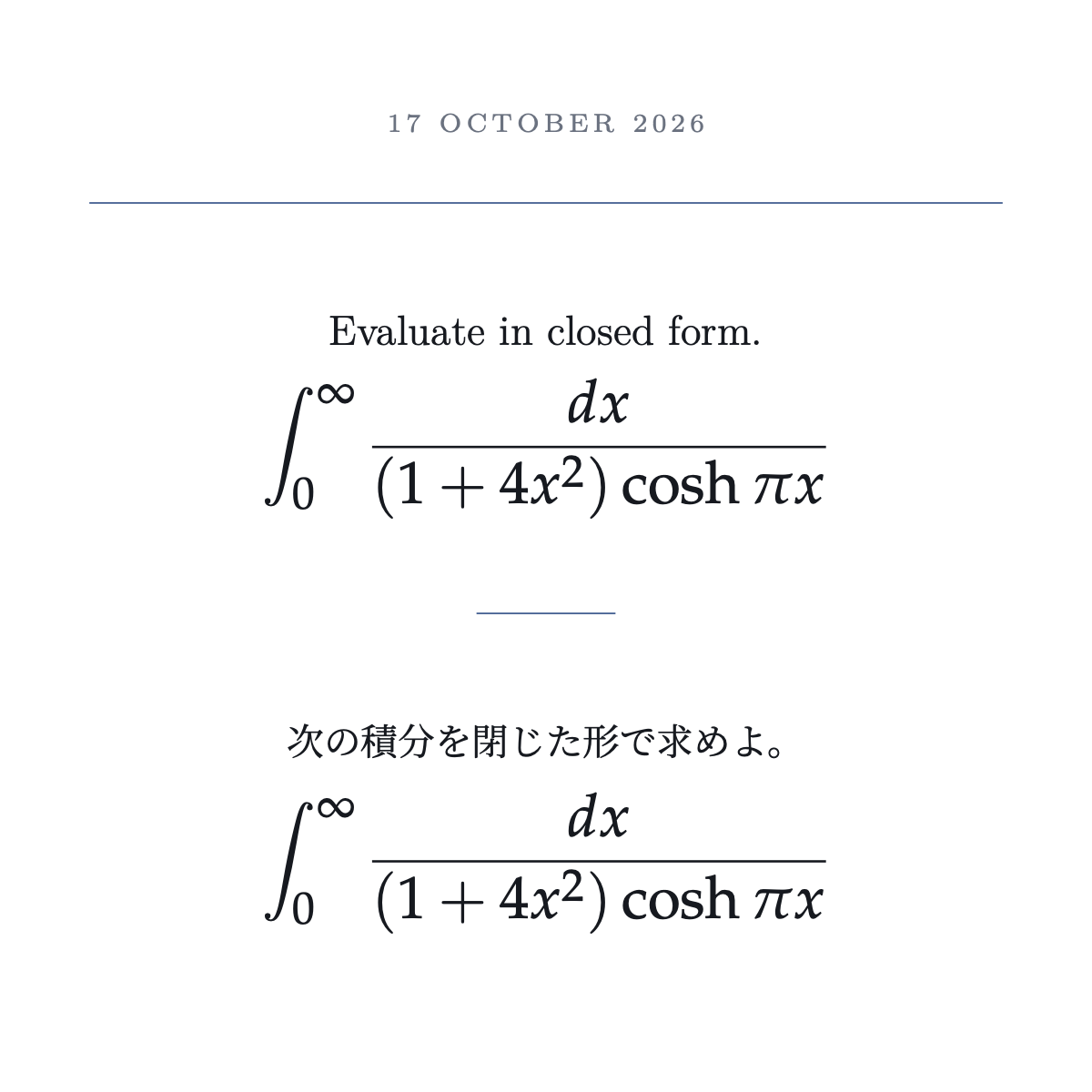
Evaluate in closed form.
\[\int_{0}^{\infty}\frac{dx}{(1+4x^{2})\cosh \pi x}\]Show the solution
Why the obvious routes are awkward. Residues are possible but unpleasant: \(1+4x^{2}\) and \(\cosh \pi x\) both vanish at \(x=i/2\), so that pole is double, and \(\operatorname{sech}\pi x\) has infinitely many further poles at \(x=i(k+\tfrac12)\). Expanding \(\operatorname{sech}\pi x=2\sum_{k\ge0}(-1)^{k}e^{-(2k+1)\pi x}\) leaves integrals \(\int_0^\infty e^{-bx}\,dx/(1+4x^{2})\), which are not elementary. The clean route is to notice that both factors have simple Fourier transforms.
Step 1: the whole line. The integrand is even, so \(I=\tfrac12\int_{-\infty}^{\infty}f(x)g(x)\,dx\) with \(f(x)=\dfrac{1}{1+4x^{2}}\) and \(g(x)=\operatorname{sech}\pi x\). Both lie in \(L^{1}\cap L^{2}\).
Step 2: the two transforms. Write \(\hat h(\omega)=\int_{-\infty}^{\infty}h(x)e^{-i\omega x}\,dx\). From \(\int e^{-i\omega x}\,dx/(1+x^{2})=\pi e^{-|\omega|}\) and the scaling \(x\mapsto 2x\), \(\hat f(\omega)=\tfrac{\pi}{2}e^{-|\omega|/2}\). For the secant, put \(u=e^{2t}\): for real \(|s|<1\),
\[\int_{-\infty}^{\infty}\frac{2e^{st}}{e^{t}+e^{-t}}\,dt=\int_{0}^{\infty}\frac{u^{(s-1)/2}}{1+u}\,du=\frac{\pi}{\sin\frac{\pi(s+1)}{2}}=\frac{\pi}{\cos\frac{\pi s}{2}}.\]Both sides are analytic in the strip \(|\operatorname{Re}s|<1\), so the identity holds there, and \(s=-i\xi\) gives \(\int e^{-i\xi t}\operatorname{sech}t\,dt=\pi\operatorname{sech}(\pi\xi/2)\). Substituting \(t=\pi x\) yields \(\hat g(\omega)=\operatorname{sech}(\omega/2)\).
Step 3: Parseval. Both transforms are real and even, so
\[\int_{-\infty}^{\infty}f g\,dx=\frac{1}{2\pi}\int_{-\infty}^{\infty}\hat f(\omega)\,\hat g(\omega)\,d\omega=\frac{1}{2\pi}\cdot 2\int_{0}^{\infty}\frac{\pi}{2}e^{-\omega/2}\operatorname{sech}\frac{\omega}{2}\,d\omega=\frac12\int_{0}^{\infty}e^{-\omega/2}\operatorname{sech}\frac{\omega}{2}\,d\omega.\]Step 4: the last integral. Put \(u=e^{-\omega/2}\), so \(d\omega=-2\,du/u\) and \(\operatorname{sech}(\omega/2)=2u/(1+u^{2})\):
\[\frac12\int_{0}^{1}u\cdot\frac{2u}{1+u^{2}}\cdot\frac{2\,du}{u}=2\int_{0}^{1}\frac{u\,du}{1+u^{2}}=\ln 2.\]Hence the full-line integral is \(\ln 2\) and \(I=\tfrac12\ln 2\).
Check. Composite 100-node Gauss-Legendre quadrature on \([0,30]\) (the tail beyond is below \(e^{-90}\)) with 40 and with 200 panels agrees with \(\tfrac12\ln 2=0.346573590279972\ldots\) to within \(3\times10^{-16}\).
Competition problem
A product over the squares modulo 2027
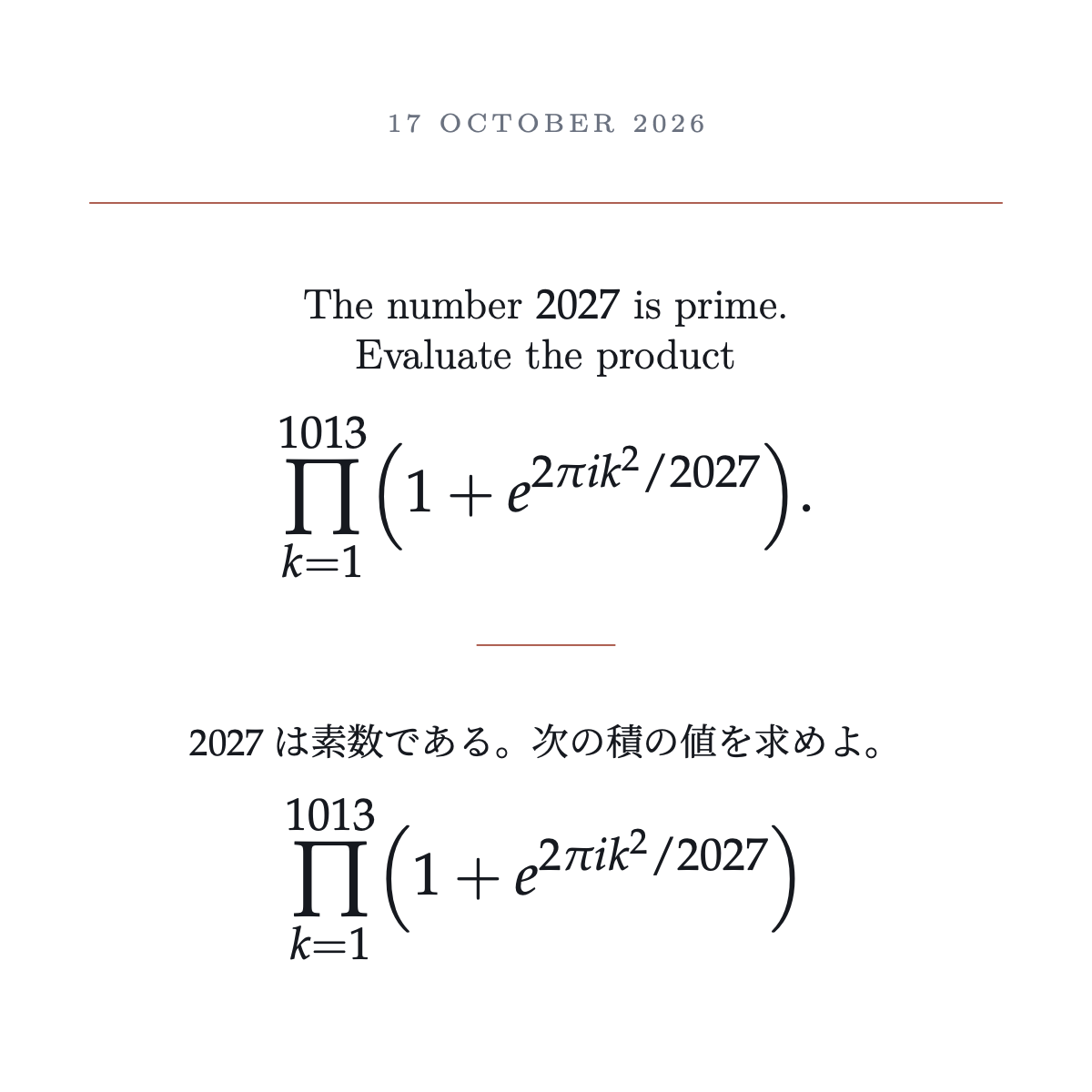
The number \(2027\) is prime. Evaluate the product
\[\prod_{k=1}^{1013}\Bigl(1+e^{2\pi i k^{2}/2027}\Bigr).\]Show the solution
Let \(p=2027\), \(h=(p-1)/2=1013\) and \(\zeta=e^{2\pi i/p}\). Note that \(p\equiv 3\pmod 8\), since \(2024=8\cdot 253\).
Step 1: the exponents are the residues. If \(k^{2}\equiv j^{2}\pmod p\) with \(1\le j,k\le h\), then \(p\mid (k-j)(k+j)\) and \(2\le k+j\le p-1\), so \(k=j\). Thus \(k^{2}\) runs over the \(h\) nonzero quadratic residues exactly once. Writing \(R\) for the residues and \(N\) for the non-residues (both of size \(h\)), the product is \(P=\prod_{r\in R}(1+\zeta^{r})\).
Step 2: duplication. For \(p\nmid r\), \(1+\zeta^{r}=\dfrac{1-\zeta^{2r}}{1-\zeta^{r}}\), with nonzero denominator. Because \(p\equiv 3\pmod 8\), \(2\) is a non-residue, so \(r\mapsto 2r\) is a bijection from \(R\) onto \(N\). Hence
\[P=\frac{B}{A},\qquad A=\prod_{r\in R}(1-\zeta^{r}),\quad B=\prod_{n\in N}(1-\zeta^{n}).\]Step 3: conjugation. Because \(p\equiv 3\pmod 4\), \(-1\) is a non-residue, so \(N=-R\) and \(B=\prod_{r\in R}(1-\zeta^{-r})=\overline{A}\). Therefore \(P=\overline{A}/A\) has modulus \(1\), and only the argument of \(A\) matters.
Step 4: the phase. Choose representatives \(r\in\{1,\dots,p-1\}\). Since \(1-e^{i\theta}=-2i\sin(\theta/2)\,e^{i\theta/2}\) and \(\sin(\pi r/p)>0\),
\[A=(-2i)^{h}\Bigl(\prod_{r\in R}\sin\frac{\pi r}{p}\Bigr)e^{i\pi S/p},\qquad S=\sum_{r\in R}r,\]so \(\overline{A}/A=\bigl(\overline{-2i}/(-2i)\bigr)^{h}e^{-2\pi i S/p}=(-1)^{h}e^{-2\pi i S/p}\).
Step 5: the residue sum. The representatives are congruent to \(1^{2},\dots,h^{2}\) in some order, so \(S\equiv\sum_{k=1}^{h}k^{2}=\dfrac{h(h+1)(2h+1)}{6}=\dfrac{h(h+1)p}{6}\pmod p\). As \(\gcd(6,p)=1\), \(6\) divides \(h(h+1)\), so \(p\mid S\) and \(e^{-2\pi i S/p}=1\).
Conclusion. \(h=1013\) is odd, so \(P=(-1)^{1013}=-1\). The same argument shows that for every prime \(p\equiv 3\pmod 4\), \(p>3\), the product equals the Legendre symbol \((2/p)\): when \(2\) is a residue, Step 2 gives \(P=1\) directly.
Check. The product was multiplied out in floating point for \(p=2027\) and for every prime \(p\equiv 3\pmod 4\) below \(200\); in every case it equals \((2/p)\) to within \(10^{-9}\), and for \(p=2027\) it is \(-1\).