Daily Mathematics / Solutions
Solutions for 11 October 2026
Two cards went out that day: a hard definite integral and an original Putnam-style problem. Try each one first; the solutions are folded away below.
Integral
A logarithm of a trigonometric cubic over a half period
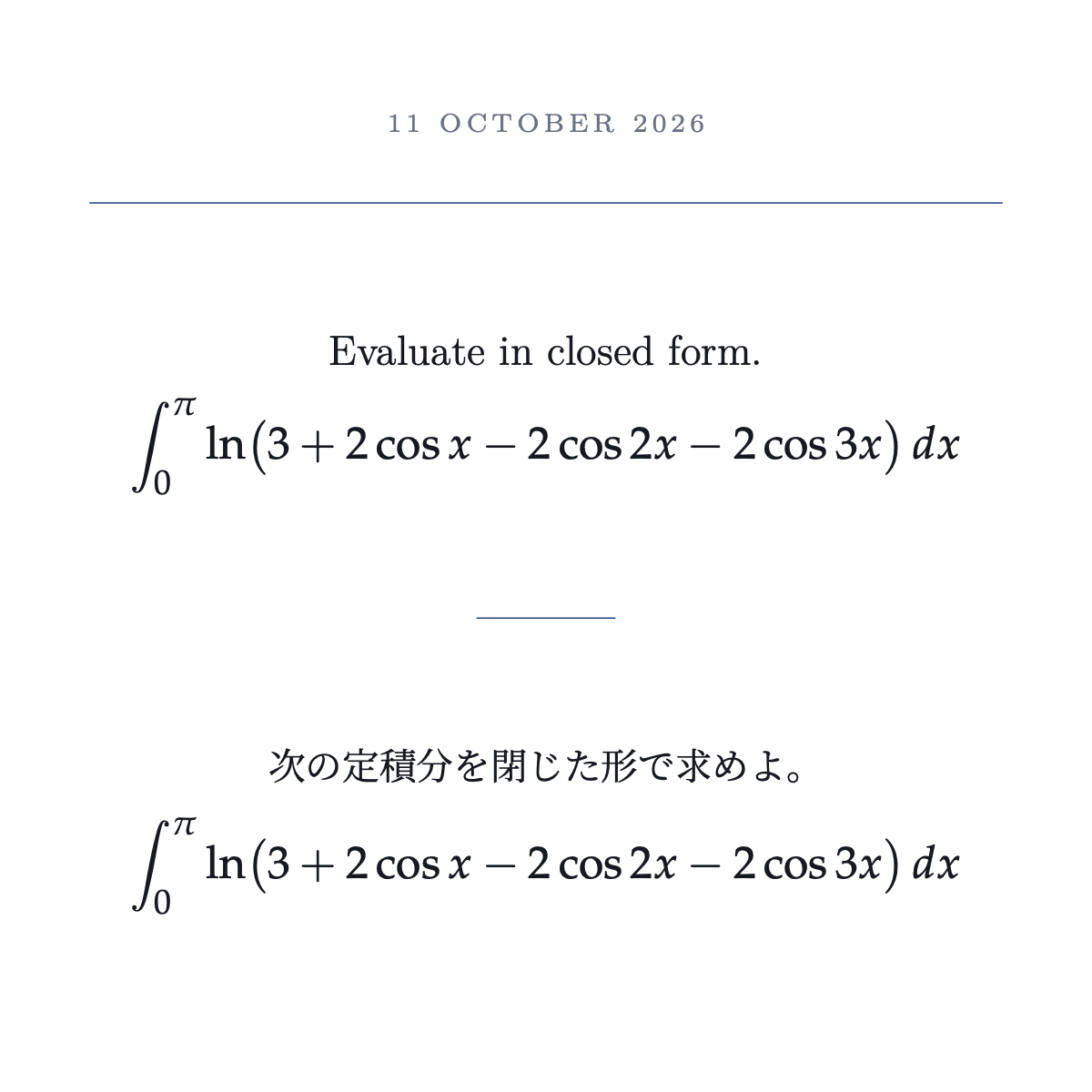
Evaluate in closed form.
\[\int_{0}^{\pi}\ln\bigl(3+2\cos x-2\cos 2x-2\cos 3x\bigr)\,dx\]Show the solution
Write \(I\) for the integral and \(\rho\approx1.3247\) for the unique real root of \(t^{3}=t+1\) (the plastic number). We show \(I=2\pi\ln\rho\).
Why the direct route stalls. The argument of the logarithm is a trigonometric polynomial with no visible factorisation in real terms, so neither a substitution nor a Fourier expansion of the logarithm gets started. The key is to see it as a squared modulus on the unit circle.
Step 1: a hidden squared modulus. Let \(P(z)=z^{3}-z-1\) and \(z=e^{ix}\), so \(\bar z=z^{-1}\). Then
\[|P(z)|^{2}=(z^{3}-z-1)(z^{-3}-z^{-1}-1)=3+(z+z^{-1})-(z^{2}+z^{-2})-(z^{3}+z^{-3}),\]which is \(3+2\cos x-2\cos 2x-2\cos 3x\). The integrand never vanishes: if \(|z|=1\) and \(z^{3}=z+1\), then \(|z+1|=1\), which forces \(z=e^{\pm 2\pi i/3}\); but then \(z^{3}=1\) while \(z+1=e^{\pm i\pi/3}\neq1\). So \(I=\int_{0}^{\pi}2\ln|P(e^{ix})|\,dx\).
Step 2: the full circle. Since \(P\) has real coefficients, \(|P(e^{-ix})|=|\overline{P(e^{ix})}|=|P(e^{ix})|\), so the integrand is even about \(x=\pi\) on \([0,2\pi]\) and
\[I=\int_{0}^{2\pi}\ln|P(e^{ix})|\,dx.\]Step 3: Jensen's formula for one linear factor. For a complex number \(r\) with \(|r|\neq1\) we claim \(\int_{0}^{2\pi}\ln|e^{ix}-r|\,dx=2\pi\ln\max(1,|r|)\). If \(|r|<1\), then \(|e^{ix}-r|=|1-re^{-ix}|\) and \(\ln|1-re^{-ix}|=-\operatorname{Re}\sum_{n\ge1}r^{n}e^{-inx}/n\), a uniformly convergent series each of whose terms has mean zero, so the integral is \(0\). If \(|r|>1\), write \(|e^{ix}-r|=|r|\,|1-e^{ix}/r|\) and apply the same argument to \(1/r\), which gives \(2\pi\ln|r|\).
Step 4: locate the roots. Let \(f(t)=t^{3}-t-1\). Its derivative vanishes at \(t=\pm1/\sqrt3\), and the local maximum \(f(-1/\sqrt3)=-1+\tfrac{2}{3\sqrt3}\) is negative, so \(f\) has exactly one real root \(\rho\), and \(f(1)=-1<0<5=f(2)\) gives \(1<\rho<2\). The other two roots \(w,\bar w\) satisfy \(\rho\,|w|^{2}=1\) (the product of the roots is \(1\)), so \(|w|=\rho^{-1/2}<1\).
Step 5: assemble. \(P(z)=(z-\rho)(z-w)(z-\bar w)\), so by Step 3 only the root outside the unit circle contributes:
\[I=2\pi\ln\rho,\qquad \rho=\sqrt[3]{\tfrac{9+\sqrt{69}}{18}}+\sqrt[3]{\tfrac{9-\sqrt{69}}{18}}\]by Cardano's formula. In the language of number theory, \(I/(2\pi)\) is the logarithmic Mahler measure of \(t^{3}-t-1\), the smallest Mahler measure of any non-cyclotomic polynomial of degree \(3\).
Check. Composite 100-node Gauss-Legendre quadrature on \([0,\pi]\) with 40 and with 200 panels gives \(1.766829033771188\dots\), agreeing with \(2\pi\ln\rho\) to within \(10^{-15}\); the identity of Step 1 was checked on a grid of \(2\times10^{5}\) points to \(6\times10^{-15}\), and the integrand stays above \(0.12\).
Competition problem
Vanishing power sums modulo a prime
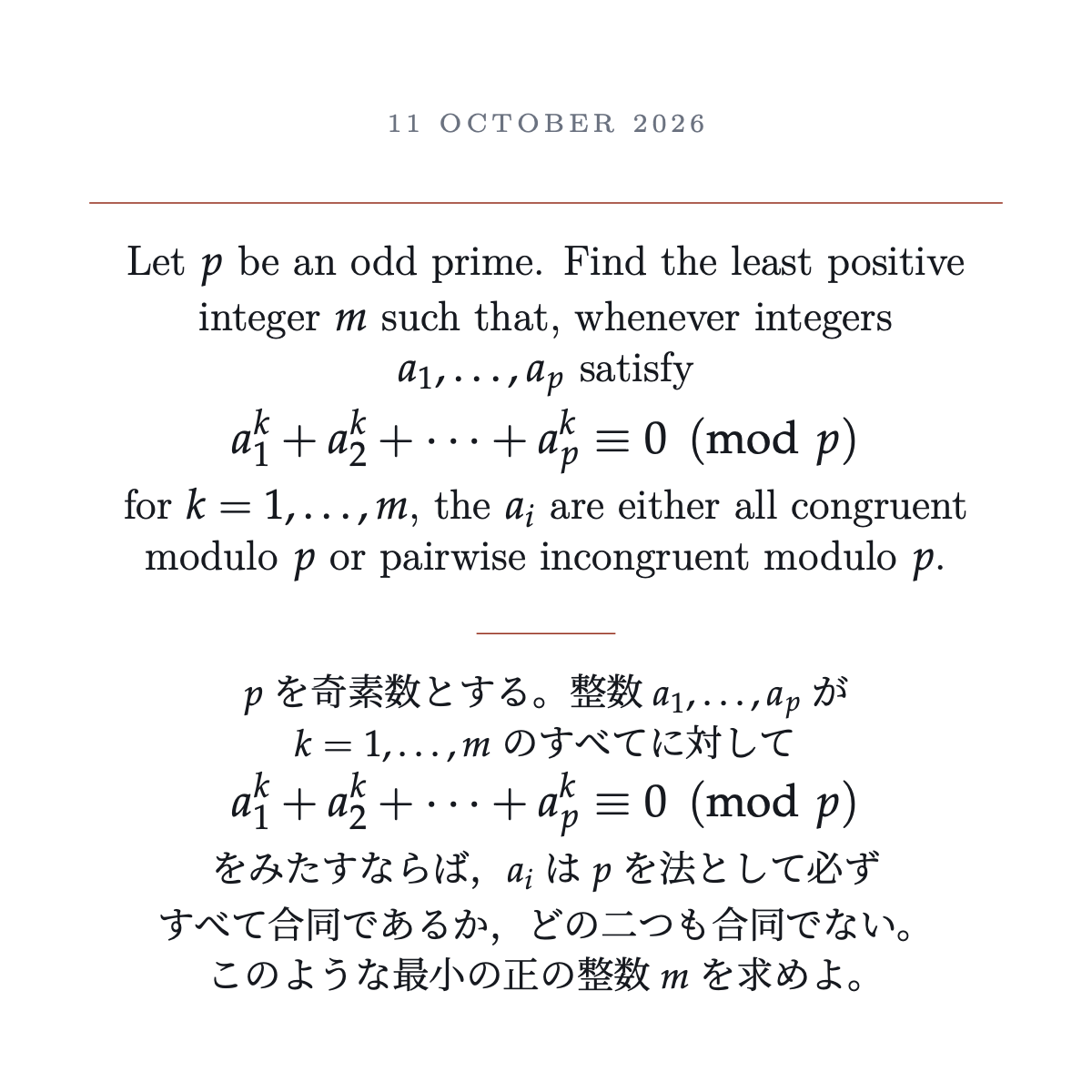
Let \(p\) be an odd prime. Find the least positive integer \(m\) such that, whenever integers \(a_1,\dots,a_p\) satisfy
\[a_1^k+a_2^k+\cdots+a_p^k\equiv 0 \pmod{p}\]for \(k=1,\dots,m\), the \(a_i\) are either all congruent modulo \(p\) or pairwise incongruent modulo \(p\).
Show the solution
The answer is \(m=\tfrac{p-1}{2}\). Throughout we work in \(\mathbb F_p\) and write \(s_k=a_1^k+\cdots+a_p^k\).
Why the direct route stalls. If \(n_v\) is the number of \(i\) with \(a_i\equiv v\), the conditions read \(\sum_v n_v v^{k}=0\) for \(1\le k\le m\), together with \(\sum_v n_v=p\equiv0\). With \(m=p-2\) this is a full Vandermonde system and forces all \(n_v\) to be congruent modulo \(p\), which is the classical statement. For smaller \(m\) the linear system in the \(n_v\) has a large solution space, so linear algebra on the multiplicities alone cannot decide anything; one has to use that the \(n_v\) are nonnegative integers adding up to exactly \(p\). The polynomial \(\prod(t-a_i)\) packages this information.
Step 1: Newton's identities. Let \(F(t)=\prod_{i=1}^{p}(t-a_i)=t^{p}-e_1t^{p-1}+e_2t^{p-2}-\cdots\). Newton's identities \(ke_k=\sum_{j=1}^{k}(-1)^{j-1}e_{k-j}s_j\) hold for \(1\le k\le p\). Suppose \(s_1=\cdots=s_m=0\) with \(m=\tfrac{p-1}{2}\). For \(1\le k\le m\) the integer \(k\) is invertible modulo \(p\), so induction gives \(e_1=\cdots=e_m=0\). Hence
\[F(t)=t^{p}+g(t),\qquad \deg g\le p-m-1=\tfrac{p-1}{2}.\]Step 2: few distinct residues. Every residue \(v\) occurring among the \(a_i\) is a root of \(F\), and \(v^{p}=v\) in \(\mathbb F_p\), so \(v\) is a root of \(h(t)=t+g(t)\). If \(h\) is the zero polynomial, then \(F(t)=t^{p}-t=\prod_{v\in\mathbb F_p}(t-v)\), so the \(a_i\) run through every residue exactly once: they are pairwise incongruent. Otherwise \(h\) is a nonzero polynomial of degree at most \(\tfrac{p-1}{2}\), so at most \(\tfrac{p-1}{2}\) distinct residues occur.
Step 3: Vandermonde. Let \(b_1,\dots,b_r\) be the distinct nonzero residues that occur, with multiplicities \(c_1,\dots,c_r\in\{1,\dots,p\}\); by Step 2, \(r\le m\). Residues equal to \(0\) contribute nothing to \(s_k\), so \(\sum_{j=1}^{r}c_jb_j^{k}=0\) for \(k=1,\dots,r\). The matrix \((b_j^{k})_{1\le k,j\le r}\) is a Vandermonde matrix times \(\operatorname{diag}(b_1,\dots,b_r)\), hence invertible, so every \(c_j\equiv0\pmod p\), that is \(c_j=p\). Thus either \(r=0\) and every \(a_i\equiv0\), or \(r=1\) and every \(a_i\equiv b_1\). In both cases the \(a_i\) are all congruent. So \(m=\tfrac{p-1}{2}\) has the property.
Step 4: sharpness. For \(p=3\) the value \(\tfrac{p-1}{2}=1\) is already the least positive integer. For \(p\ge5\) take \(a_i=i^{2}\) for \(i=1,\dots,p\). For \(1\le k\le\tfrac{p-3}{2}\) we have \(0<2k<p-1\), and \(\sum_{x\in\mathbb F_p}x^{j}=0\) whenever \(0<j<p-1\) (with \(g\) a generator, the sum is \(\sum_{i=0}^{p-2}(g^{j})^{i}\), a geometric sum with ratio \(g^{j}\neq1\)). So \(s_1=\cdots=s_{(p-3)/2}=0\), yet \(1^{2}\equiv(p-1)^{2}\) while \(1^{2}\not\equiv p^{2}\): the \(a_i\) are neither all congruent nor pairwise incongruent. Hence no \(m\le\tfrac{p-3}{2}\) works, since a smaller \(m\) is a weaker hypothesis.
Therefore the least \(m\) is \(\tfrac{p-1}{2}\).
Check. For \(p=5,7,11,13\) every multiplicity vector \((n_v)\) with \(\sum n_v=p\) was enumerated exhaustively. When the power sums vanish for \(k\le\tfrac{p-1}{2}\), the only survivors are the constant and the bijective patterns (the number of functions \(\mathbb F_p\to\mathbb F_p\) is exactly \(p!+p\)), while for \(k\le\tfrac{p-3}{2}\) other patterns appear, among them the squares.