Daily Mathematics / Solutions
Solutions for 9 October 2026
Two cards went out that day: a hard definite integral and an original Putnam-style problem. Try each one first; the solutions are folded away below.
Integral
A squared logarithm against a Beta kernel
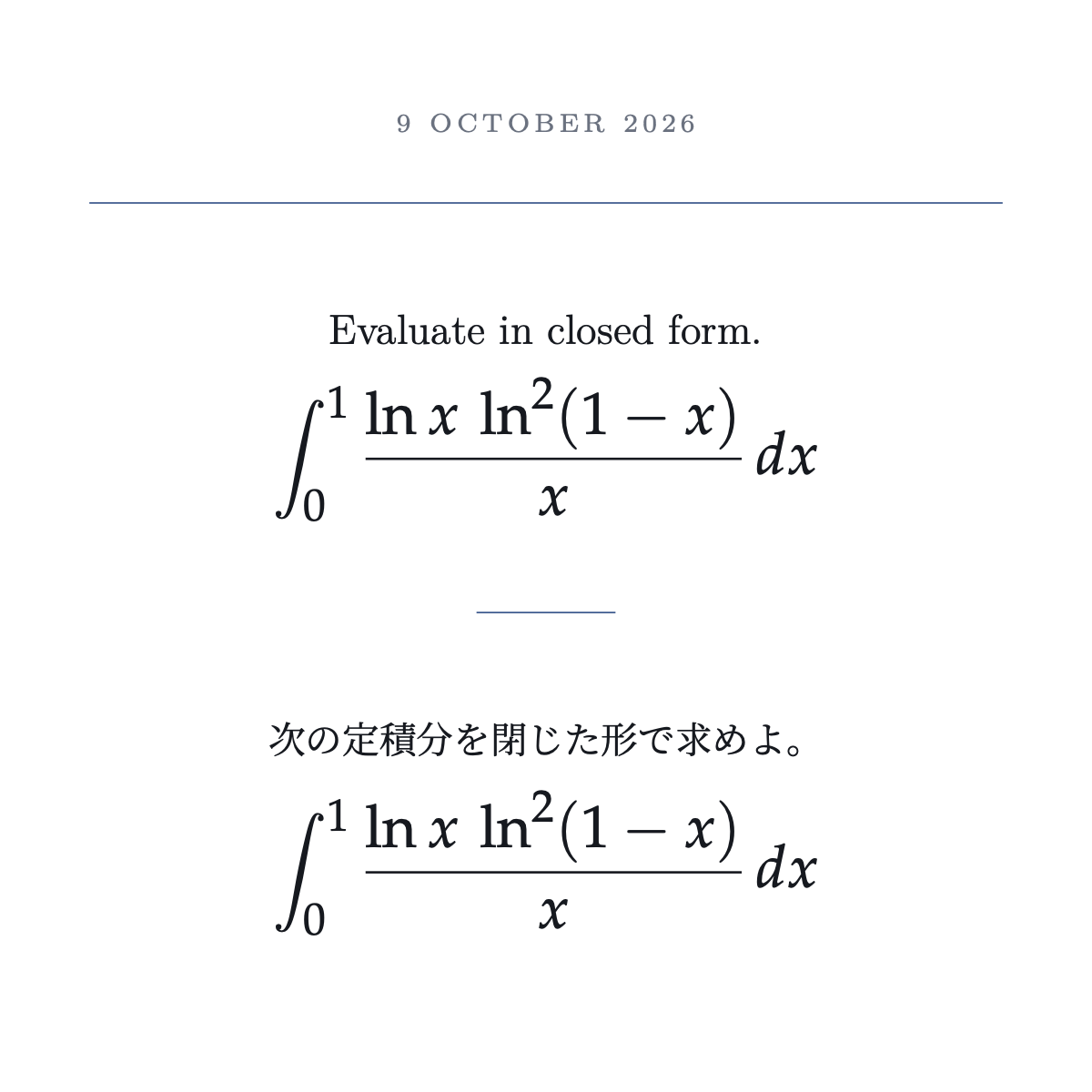
Evaluate in closed form.
\[\int_{0}^{1}\frac{\ln x\,\ln^{2}(1-x)}{x}\,dx\]Show the solution
We show that the integral equals \(-\dfrac{\pi^{4}}{180}=-\dfrac{\zeta(4)}{2}\). Call it \(I\). It converges: near \(0\) the integrand behaves like \(x\ln x\), and near \(1\) like \(\ln^{2}(1-x)\).
Why the direct route stalls. Expanding \(\ln^{2}(1-x)=2\sum_{n\ge2}\frac{H_{n-1}}{n}x^{n}\) and using \(\int_0^1x^{n-1}\ln x\,dx=-1/n^{2}\) gives \(I=-2\sum_{n\ge2}H_{n-1}/n^{3}\), an Euler sum. Evaluating that sum is the whole difficulty, so the series only restates the problem. Instead we let the Beta function do the bookkeeping.
Step 1: a Beta function with its pole removed. For \(a>-1\) and \(b>-1\) put
\[G(a,b)=\int_{0}^{1}x^{a-1}\bigl((1-x)^{b}-1\bigr)\,dx .\]This converges, because \((1-x)^{b}-1=O(x)\) near \(0\) and \((1-x)^{b}\) is integrable near \(1\). For \(a>0\) we may split the integral, so \(G(a,b)=B(a,b+1)-\frac1a\). Differentiating under the integral sign (the derivatives are dominated by integrable functions on a neighbourhood of \((0,0)\)), \(\partial_a\) brings down \(\ln x\) and \(\partial_b^{2}\) brings down \(\ln^{2}(1-x)\), and the \(-1\) disappears. Hence
\[I=\partial_a\partial_b^{2}G(0,0),\]so \(I\) is \(1!\,2!=2\) times the coefficient of \(ab^{2}\) in the Taylor expansion of \(G\) at the origin.
Step 2: pass to Gamma functions. Since \(\Gamma(a)=\Gamma(1+a)/a\),
\[G(a,b)=\frac{1}{a}\left(\frac{\Gamma(1+a)\Gamma(1+b)}{\Gamma(1+a+b)}-1\right)=\frac{e^{L(a,b)}-1}{a},\qquad L=\ln\Gamma(1+a)+\ln\Gamma(1+b)-\ln\Gamma(1+a+b).\]So the coefficient of \(ab^{2}\) in \(G\) is the coefficient of \(a^{2}b^{2}\) in \(e^{L}-1\).
Step 3: expand the log-Gamma. For \(|z|<1\) we have \(\ln\Gamma(1+z)=-\gamma z+\sum_{k\ge2}\frac{(-1)^{k}\zeta(k)}{k}z^{k}\). The linear terms cancel in \(L\), and
\[L(a,b)=\sum_{k\ge2}\frac{(-1)^{k}\zeta(k)}{k}\bigl(a^{k}+b^{k}-(a+b)^{k}\bigr)=-\zeta(2)\,ab+\zeta(3)\,(a^{2}b+ab^{2})-\frac{\zeta(4)}{4}\bigl(4a^{3}b+6a^{2}b^{2}+4ab^{3}\bigr)+\cdots\]where the omitted terms have total degree at least \(5\).
Step 4: read off the coefficient. In \(e^{L}-1=L+\frac{L^{2}}{2}+\cdots\), every term of \(L\) has degree at least \(2\), so \(L^{3}\) and beyond have degree at least \(6\) and cannot contribute to \(a^{2}b^{2}\). From \(L\) we get \(-\frac32\zeta(4)\). From \(\frac{L^{2}}{2}\) only the square of the degree-two term contributes, giving \(\frac12\zeta(2)^{2}\). Since \(\zeta(2)^{2}=\frac{\pi^{4}}{36}=\frac52\zeta(4)\), the coefficient of \(a^{2}b^{2}\) is
\[-\frac32\zeta(4)+\frac54\zeta(4)=-\frac{\zeta(4)}{4}.\]Conclusion. Therefore \(I=2\cdot\left(-\frac{\zeta(4)}{4}\right)=-\frac{\zeta(4)}{2}=-\frac{\pi^{4}}{180}\). Comparing with the series in the first paragraph, the same computation proves Euler's evaluation \(\sum_{n\ge1}H_n/n^{3}=\frac54\zeta(4)\).
Numerical check. We split the interval at \(\frac12\), substituted \(x=t^{2}\) on \([0,\frac12]\) and \(x=1-s^{4}\) on \([\frac12,1]\) to remove both endpoint singularities, and ran composite 100-node Gauss-Legendre quadrature with 40 and with 200 panels. Both gave \(-0.5411616168555691\), agreeing with \(-\pi^{4}/180\) to within \(2\times10^{-16}\).
Competition problem
Alternating reciprocals of subset sums
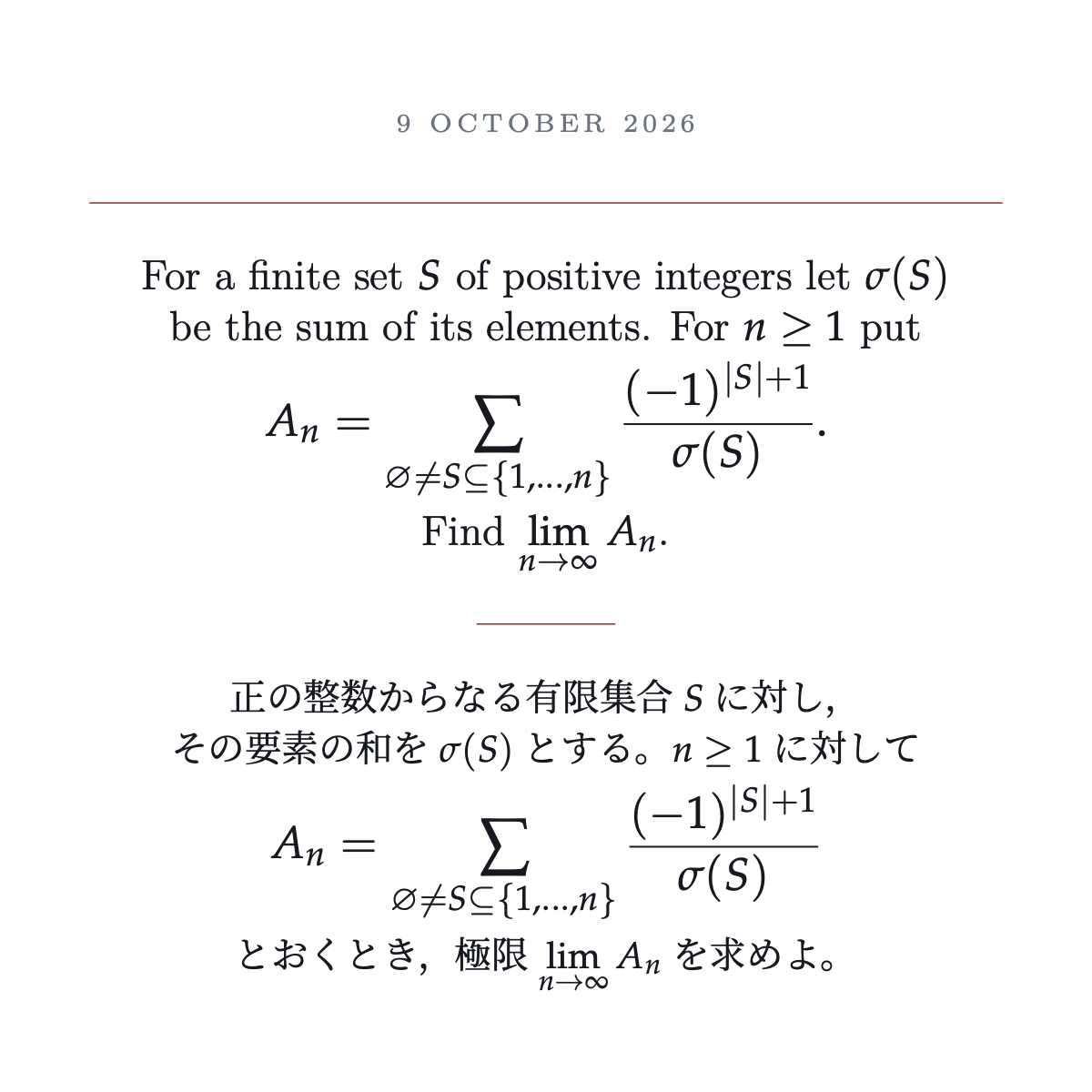
For a finite set \(S\) of positive integers let \(\sigma(S)\) be the sum of its elements. For \(n\ge1\) put
\[A_n=\sum_{\varnothing\ne S\subseteq\{1,\dots,n\}}\frac{(-1)^{|S|+1}}{\sigma(S)}\]Find \(\displaystyle\lim_{n\to\infty}A_n\).
Show the solution
We show that the limit is \(\dfrac{4\pi}{\sqrt3}-6\approx1.2551974569\).
Why the direct route stalls. The finite sums have no visible pattern: \(A_1=1\), \(A_2=\frac76\), \(A_3=\frac{73}{60}\), and the denominators grow quickly because every subset sum up to \(n(n+1)/2\) occurs. Grouping subsets by size or by largest element gives nothing that telescopes. The reciprocals \(1/\sigma(S)\) are the obstacle, so we first turn them into something multiplicative.
Step 1: an integral representation. For every integer \(s\ge1\), \(\frac1s=\int_0^1x^{s-1}\,dx\). Summing over subsets, and using \(\sum_{S\subseteq\{1,\dots,n\}}(-1)^{|S|}x^{\sigma(S)}=\prod_{k=1}^{n}(1-x^{k})\), where the empty set contributes the term \(1\), we get
\[A_n=\int_{0}^{1}\frac{1-P_n(x)}{x}\,dx,\qquad P_n(x)=\prod_{k=1}^{n}(1-x^{k}).\]Step 2: the limit. For \(0\le x<1\) each factor lies in \((0,1]\), so \(P_n(x)\) decreases in \(n\) to \(P(x)=\prod_{k\ge1}(1-x^{k})\) and the integrand \((1-P_n)/x\ge0\) increases. By monotone convergence \(A_n\to\int_0^1\frac{1-P(x)}{x}\,dx\), a priori possibly infinite.
Step 3: Euler's pentagonal number theorem. It states \(P(x)=\sum_{m\in\mathbb Z}(-1)^{m}x^{e_m}\) with \(e_m=\frac{m(3m-1)}{2}\). The exponents are distinct and \(e_m\ge1\) for \(m\ne0\), so \(\frac{1-P(x)}{x}=\sum_{m\ne0}(-1)^{m+1}x^{e_m-1}\). Since \(\sum_{m\ne0}\int_0^1x^{e_m-1}\,dx=\sum_{m\ne0}\frac1{e_m}<\infty\), Fubini lets us integrate term by term, and the limit is finite:
\[L=\lim_{n\to\infty}A_n=\sum_{m\ne0}\frac{2(-1)^{m+1}}{m(3m-1)}.\]Step 4: summing the series. The series converges absolutely, so we may pair \(m=k\) with \(m=-k\). Since \((-k)(-3k-1)=k(3k+1)\), and \(\frac1{k(3k-1)}=\frac3{3k-1}-\frac1k\), \(\frac1{k(3k+1)}=\frac1k-\frac3{3k+1}\),
\[L=\sum_{k\ge1}(-1)^{k+1}\left(\frac{2}{k(3k-1)}+\frac{2}{k(3k+1)}\right)=6\sum_{k\ge1}(-1)^{k+1}\left(\frac1{3k-1}-\frac1{3k+1}\right).\]Now \(\frac1{3k-1}-\frac1{3k+1}=\int_0^1t^{3k-2}(1-t^{2})\,dt\). The partial sums \(\sum_{k\le K}(-1)^{k+1}t^{3k-2}(1-t^{2})=\frac{t(1-t^{2})\bigl(1-(-t^{3})^{K}\bigr)}{1+t^{3}}\) are bounded by \(2\) on \([0,1]\), so by dominated convergence
\[L=6\int_{0}^{1}\frac{t(1-t^{2})}{1+t^{3}}\,dt=6\int_{0}^{1}\frac{t(1-t)}{t^{2}-t+1}\,dt=6\int_{0}^{1}\left(\frac{1}{t^{2}-t+1}-1\right)dt.\]Finally \(\int_0^1\frac{dt}{(t-\frac12)^{2}+\frac34}=\frac{2}{\sqrt3}\Bigl[\arctan\frac{2t-1}{\sqrt3}\Bigr]_0^1=\frac{2}{\sqrt3}\cdot\frac{\pi}{3}\), hence
\[L=6\left(\frac{2\pi}{3\sqrt3}-1\right)=\frac{4\pi}{\sqrt3}-6.\]Numerical check. We computed \(A_n\) exactly in rational arithmetic by a signed subset-sum count, confirmed it against brute force over all subsets for \(n\le10\), and followed it to \(n=200\): \(A_{20}=1.25516508\), \(A_{80}=1.2551974566\), and \(A_{200}\) agrees with \(4\pi/\sqrt3-6=1.2551974569368713\) to within \(5\times10^{-16}\). The paired pentagonal series was also summed directly and agrees.