Daily Mathematics / Solutions
Solutions for 5 October 2026
Two cards went out that day: a hard definite integral and an original Putnam-style problem. Try each one first; the solutions are folded away below.
Integral
A doubly logarithmic integral against a squared denominator
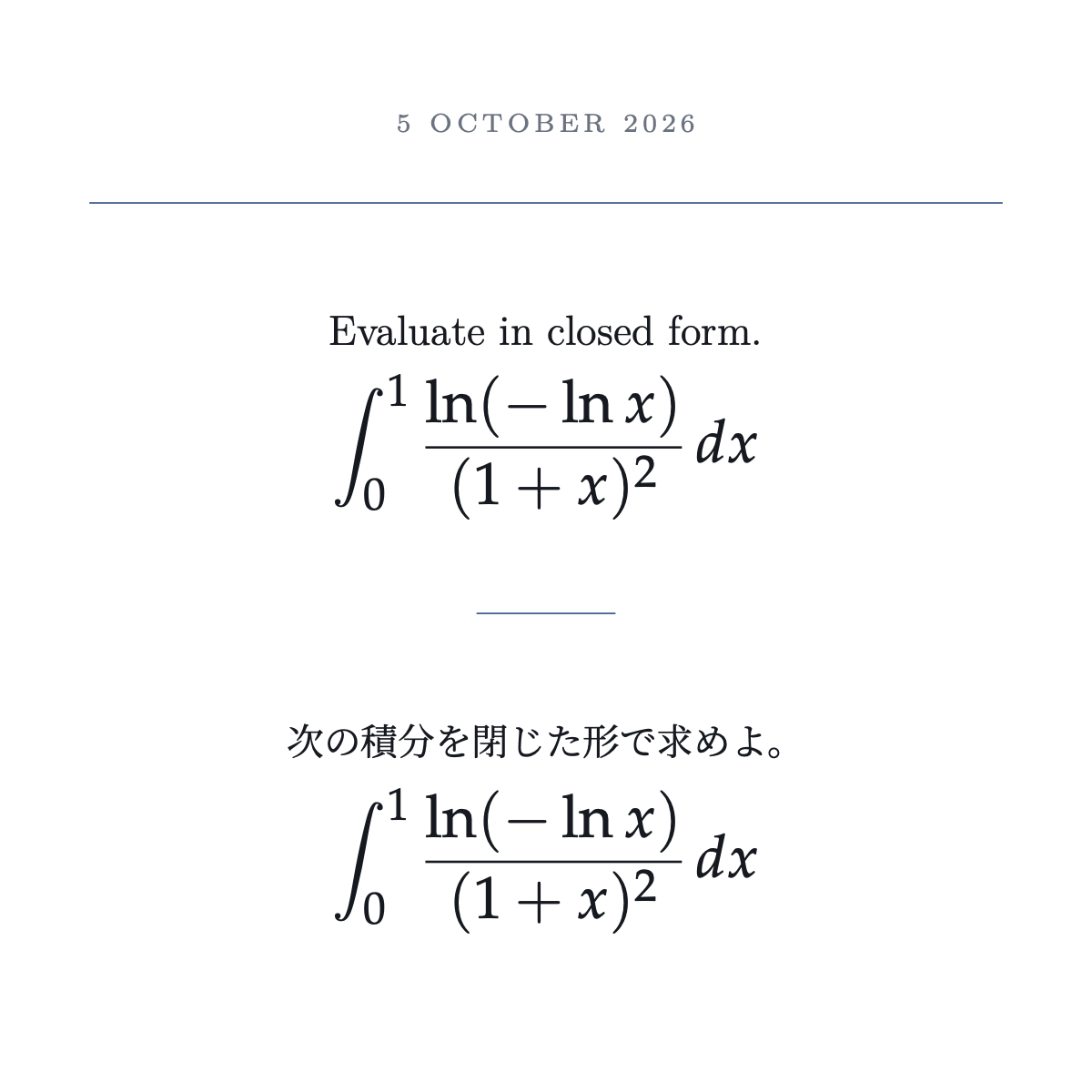
Evaluate in closed form.
\[\int_0^1 \frac{\ln(-\ln x)}{(1+x)^2}\,dx\]Show the solution
Call the integral \(I\). It converges: near \(x=0\) the numerator grows only like \(\ln\ln(1/x)\), and near \(x=1\) we have \(-\ln x\sim 1-x\), so the integrand behaves like \(\tfrac14\ln(1-x)\), which is integrable.
Step 1: remove the inner logarithm. Put \(x=e^{-t}\), so \(dx=-e^{-t}\,dt\) and \(t\) runs from \(\infty\) down to \(0\):
\[I=\int_0^\infty \ln t\,\frac{e^{-t}}{(1+e^{-t})^2}\,dt .\]The weight is an exact derivative: \(\dfrac{e^{-t}}{(1+e^{-t})^2}=\dfrac{e^{t}}{(e^t+1)^2}=-\dfrac{d}{dt}\,\dfrac{1}{e^t+1}\). The obvious move is to integrate by parts against \(-1/(e^t+1)\), but that antiderivative equals \(-\tfrac12\) at \(t=0\), so the boundary term \(-\tfrac12\ln t\) blows up. The cure is to subtract off the part of \(1/(e^t+1)\) that does not vanish at \(0\).
Step 2: a corrected integration by parts. Let \(\psi(t)=\dfrac{1}{e^t+1}-\dfrac{e^{-t}}{2}\). Expanding at \(0\) gives \(\psi(t)=\big(\tfrac12-\tfrac t4+\cdots\big)-\big(\tfrac12-\tfrac t2+\cdots\big)=\tfrac t4+O(t^2)\), and \(\psi(t)=O(e^{-t})\) as \(t\to\infty\). Since \(\dfrac{d}{dt}\dfrac{1}{e^t+1}=\psi'(t)-\tfrac12e^{-t}\), the weight equals \(-\psi'(t)+\tfrac12e^{-t}\), and
\[I=\frac12\int_0^\infty e^{-t}\ln t\,dt-\int_0^\infty \ln t\,\psi'(t)\,dt .\]The first integral is \(\Gamma'(1)=-\gamma\). In the second, integrate by parts: the boundary term \(\ln t\,\psi(t)\) tends to \(0\) at both ends (it behaves like \(\tfrac t4\ln t\) at \(0\) and decays exponentially at \(\infty\)). Hence
\[I=-\frac{\gamma}{2}+K,\qquad K=\int_0^\infty\frac{\psi(t)}{t}\,dt .\]Step 3: \(K\) as an alternating chain of Frullani integrals. For \(t>0\), \(\dfrac{1}{e^t+1}=\sum_{n\ge1}(-1)^{n-1}e^{-nt}\). Writing \(S\) for this sum, one checks
\[\frac12\sum_{n\ge1}(-1)^{n-1}\big(e^{-nt}-e^{-(n+1)t}\big)=\frac12S+\frac12\big(S-e^{-t}\big)=S-\frac{e^{-t}}{2}=\psi(t).\]Put \(\varphi_n(t)=\big(e^{-nt}-e^{-(n+1)t}\big)/t=e^{-nt}(1-e^{-t})/t\). For fixed \(t\) these are positive and decrease in \(n\), so the alternating series for \(\psi(t)/t\) has every tail bounded by its first omitted term: \(\big|\psi(t)/t-\tfrac12\sum_{n\le N}(-1)^{n-1}\varphi_n(t)\big|\le\tfrac12\varphi_{N+1}(t)\). By Frullani's theorem (with the function \(e^{-t}\)), \(\int_0^\infty\varphi_n(t)\,dt=\ln\frac{n+1}{n}\), and the error bound integrates to \(\tfrac12\ln\frac{N+2}{N+1}\to0\). Therefore termwise integration is legitimate and
\[K=\frac12\sum_{n\ge1}(-1)^{n-1}\ln\frac{n+1}{n}=\frac12\ln\lim_{N\to\infty}\prod_{k=1}^{N}\frac{2k}{2k-1}\cdot\frac{2k}{2k+1} .\]Step 4: Wallis. The product is \(\prod_{k\ge1}\frac{(2k)^2}{(2k-1)(2k+1)}=\frac{\pi}{2}\), Wallis's product. So \(K=\tfrac12\ln\frac{\pi}{2}\) and
\[I=\frac12\Big(\ln\frac{\pi}{2}-\gamma\Big)\approx-0.0628164798 .\]Equivalently, \(K=\eta'(0)\) for the Dirichlet eta function and \(I=\frac{d}{ds}\big[\Gamma(s)\,\eta(s-1)\big]_{s=1}\), which is the Malmsten-style reading of the same computation. Check. After the further substitution \(t=e^v\) the integrand is smooth and decays fast at both ends; composite Gauss-Legendre quadrature (100 nodes on 40 and on 200 panels over \(v\in[-60,6]\)) agrees with \(\tfrac12(\ln(\pi/2)-\gamma)\) to about \(4\times10^{-17}\), and a second quadrature with \(t=u^2\) agrees to \(4\times10^{-12}\).
Competition problem
A three-term scaling equation
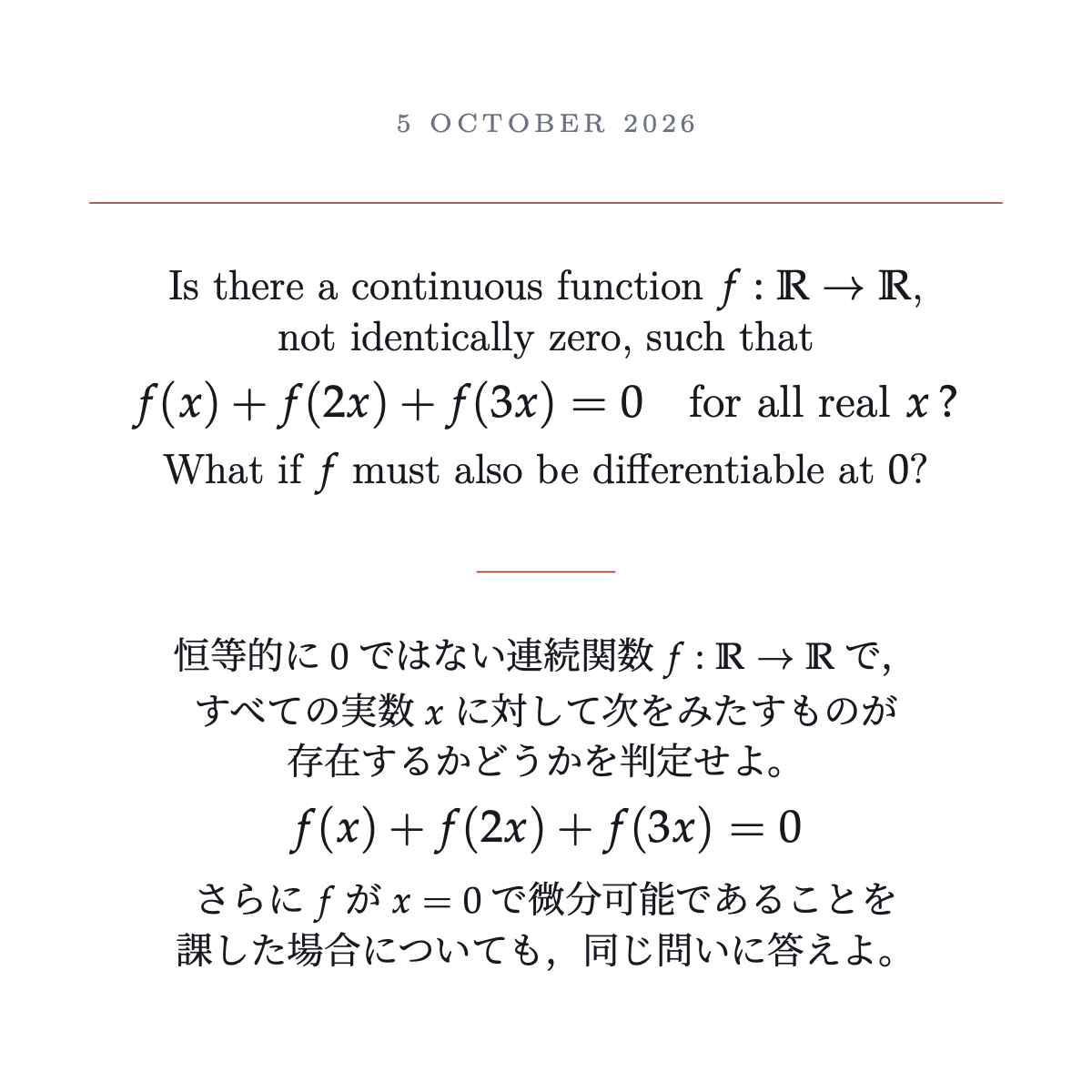
Is there a continuous function \(f:\mathbb{R}\to\mathbb{R}\), not identically zero, such that
\[f(x)+f(2x)+f(3x)=0\quad\text{for all real }x\,?\]What if \(f\) must also be differentiable at \(0\)?
Show the solution
Answer in brief. A continuous nonzero solution exists, but no nonzero solution is differentiable at \(0\).
Why the first instinct fails. Putting \(x=0\) gives \(f(0)=0\), and one is tempted to push the relation \(f(x)=-f(x/3)-f(2x/3)\) towards \(0\) to force \(f\equiv0\). But the coefficients have absolute values summing to \(2\), so nothing contracts, and continuity at \(0\) gives no rate of decay. The right viewpoint is multiplicative: the equation only compares \(f\) at \(x\), \(2x\), \(3x\), so look for solutions of power type \(|x|^s\).
Part 1: reduction to a root. Suppose \(s=a+ib\) with \(a>0\) satisfies \(1+2^s+3^s=0\). Define \(f(0)=0\) and, for \(x\ne0\),
\[f(x)=\operatorname{Re}\big(|x|^s\big)=|x|^a\cos\big(b\ln|x|\big).\]Then \(|f(x)|\le|x|^a\to0\), so \(f\) is continuous; \(f(1)=1\), so \(f\not\equiv0\); and for \(x\ne0\), \(f(x)+f(2x)+f(3x)=\operatorname{Re}\big(|x|^s(1+2^s+3^s)\big)=0\). No real \(s\) works (all three terms would be positive), so the root must be genuinely complex.
Part 1: a triangle. Fix \(a\in(0,1)\). The function \((1/3)^a+(2/3)^a\) is strictly decreasing and equals \(1\) at \(a=1\), so \(3^a<1+2^a\); the other two triangle inequalities are clear. Hence there is a nondegenerate triangle with sides \(1,2^a,3^a\). Concretely, let \(\theta(a)\in(0,\pi)\) satisfy \(\cos\theta=\dfrac{9^a-1-4^a}{2\cdot2^a}\), put \(u=2^ae^{i\theta}\) and \(v=-1-u\). Then \(|v|^2=1+4^a+2\cdot2^a\cos\theta=9^a\) and \(\operatorname{Im}v=-\operatorname{Im}u<0\), so \(v=3^ae^{i\psi}\) with \(\psi(a)\in(-\pi,0)\). Both \(\theta\) and \(\psi\) depend continuously on \(a\), and \(1+u+v=0\). As \(a\to0^+\): \(\theta\to2\pi/3\) and \(\psi\to-2\pi/3\) (the equilateral case). As \(a\to1^-\): \(\theta\to0\) and \(\psi\to-\pi\) (the degenerate case \(1+2=3\)).
Part 1: matching the angles. We need one real \(b\) with \(b\ln2\equiv\theta\) and \(b\ln3\equiv\psi\pmod{2\pi}\): two conditions on one unknown, which is why \(a\) must also move. Take \(b=(\theta+4\pi)/\ln2\), so the first condition holds, and with \(\lambda=\log_2 3\) the second holds exactly when
\[F(a)=\frac{(\theta(a)+4\pi)\lambda-\psi(a)}{2\pi}\]is an integer. \(F\) is continuous on \((0,1)\), with \(F(0^+)=\tfrac73\lambda+\tfrac13\) and \(F(1^-)=2\lambda+\tfrac12\). From \(2^{11}=2048<2187=3^7\) and \(3^4=81<128=2^7\) we get \(\tfrac{11}{7}<\lambda<\tfrac74\), hence \(F(0^+)>4>F(1^-)\). By the intermediate value theorem \(F(a)=4\) for some \(a\in(0,1)\), and then \(2^s=u\), \(3^s=v\), so \(1+2^s+3^s=0\) with \(0<\operatorname{Re}s<1\). This proves that a continuous nonzero solution exists.
Part 2: differentiability at \(0\) kills every solution. Let \(f\) be continuous, differentiable at \(0\), and satisfy the equation. Then \(f(0)=0\), and dividing \(f(x)+f(2x)+f(3x)=0\) by \(x\) and letting \(x\to0\) gives \(6f'(0)=0\). So \(g(x)=f(x)/x\) (for \(x\ne0\)) is continuous and tends to \(0\) as \(x\to0\). For \(r>0\) put \(M(r)=\sup_{0<|x|\le r}|g(x)|\), which is finite, nondecreasing in \(r\), and tends to \(0\) as \(r\to0\). Replacing \(x\) by \(x/3\) in the equation and dividing by \(x\) gives
\[g(x)=-\tfrac13\,g(x/3)-\tfrac23\,g(2x/3).\]So for \(0<|x|\le r\) we get \(|g(x)|\le\tfrac13M(r/3)+\tfrac23M(2r/3)\le M(2r/3)\), that is \(M(r)\le M(2r/3)\). Iterating, \(M(r)\le M\big((2/3)^nr\big)\to0\). Hence \(g\equiv0\) and \(f\equiv0\). The weights \(\tfrac13,\tfrac23\) sum to exactly \(1\), which is why the bound propagates without loss, and why the first part needs \(\operatorname{Re}s<1\): every root of \(1+2^s+3^s\) has real part below \(1\).
Check. Newton's method locates the roots with \(0<\operatorname{Re}s<1\) of smallest positive imaginary part near \(0.94059+8.23071i\) and \(0.13262+20.97964i\); bisecting \(F(a)=4\) reproduces the second one, with \(|1+2^s+3^s|<10^{-14}\). The function \(f\) built from the first root was tested at \(10^4\) random points, where \(f(x)+f(2x)+f(3x)\) vanished to within \(3\times10^{-14}\,|x|^a\).