Mitsubishi Pencil launched uni NanoDia in 2009 as a mechanical pencil lead with nanodiamond mixed into the core. The whole pitch fits in one sentence on the Japanese product page: 芯にナノダイヤを配合することで、筆圧を高めても折れにくく、なめらかにくっきり書ける. Mixing nanodiamond into the core, it says, makes the lead hard to break even under heavy pressure, and lets it write smoothly and crisply. I wanted to know what a diamond particle can physically do inside a stick of graphite, and whether the result actually beats the other premium leads.
Section oneWhat a polymer lead is made of
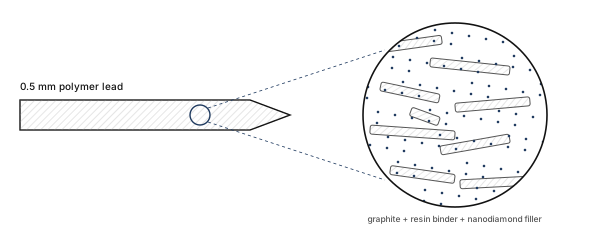
A modern fine lead is not the clay and graphite of a wooden pencil. It is graphite platelets bound in a resin, extruded, then fired in an inert atmosphere so that the resin carbonises into a rigid glassy-carbon skeleton, and finally impregnated with oil so it glides. The skeleton is what lets a 0.3 mm stick survive at all.
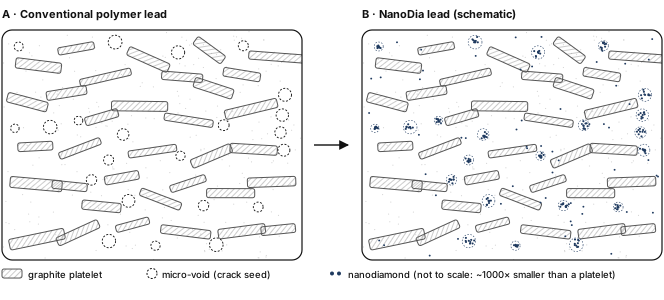
Firing has a cost. Driving the volatiles out of the resin leaves micro-voids scattered through the skeleton. A lead is a brittle solid, and brittle solids fail at their largest flaw: Griffith's criterion says the stress needed to propagate a crack falls with the square root of the flaw size. So the pores left by firing set the snapping strength far more than the average properties of the material do.
Section twoWhere the diamond goes
Detonation nanodiamond is made by setting off explosives in a closed chamber, and comes out as particles typically around 5 nm across, under 10 nm in any case. That is small enough to sit in the binder between platelets and pack into the pores that firing would otherwise leave open.
Section threeWhy that stops a lead snapping
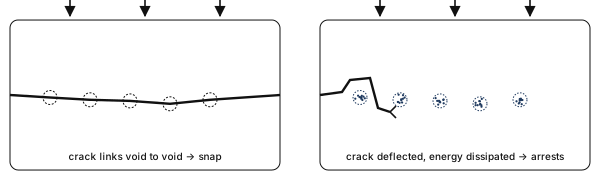
Under writing load the protruding lead bends, and the tensile side opens any flaw it finds. In an unfilled lead a crack can run from pore to pore along the shortest path. Diamond is among the stiffest materials known, with a Young's modulus of roughly 1,000 GPa, so a rigid particle in the crack's path forces it to deflect or pin at the tip. Each detour costs fracture energy, and more of the cracks that start die out before they cross the lead.
Section fourThe scale gap
It helps to see how small the additive is. On a log scale, a nanodiamond particle is about a thousand times smaller than a graphite platelet and around a hundred thousand times smaller than the lead itself. That gap is why it can fill voids without making the line gritty: the particles are far below anything paper or fingertip could resolve.

Section fiveSmoothness: diamonds as ball bearings
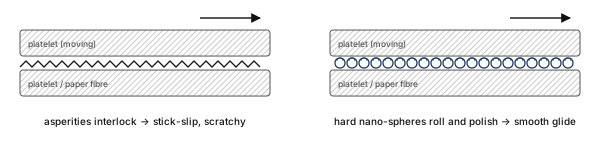
The smoothness claim has independent support from tribology. Nanodiamond is sold commercially as an additive for lubricating oils, where it lowers friction and wear under boundary lubrication, the regime in which the surfaces are close enough for their asperities to touch. Near-spherical, extremely hard particles turn part of the sliding contact into rolling contact and polish the asperities down.
A pencil line is a boundary-lubricated contact of exactly this kind: graphite platelets shearing against each other and against paper fibres, with the impregnated oil as the lubricant. The mechanism transfers cleanly, which is more than I can say for most marketing chemistry.
Section sixThe line, the range and the price
A denser, more uniform core should shed graphite more evenly, so tone ought to stay steady as the lead wears rather than blotching. In practice darkness is set far more by grade than by any additive, so I would not buy a lead for this claim alone.
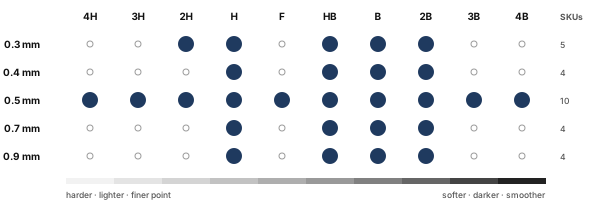
The practical advantages are plainer. There are five diameters, a full 4H to 4B spread in 0.5 mm, and every tube costs the same ¥220. It is Eco Mark certified and compliant with Japan's Green Purchasing Law. There is also an erasable colour NanoDia line, which is useful for annotation.
Section sevenClaims against an independent test
Mitsubishi publishes no quantitative data for NanoDia: no bending strength, no friction coefficient, no wear rate. The most-cited independent comparison is a 2009 head-to-head on Dave's Mechanical Pencils against Pentel Ain, the other premium Japanese polymer lead.
| Property | Mitsubishi says | Independent test, against Pentel Ain | Edge |
|---|---|---|---|
| Break strength | Resists breaking even under high pressure | "There was a clear winner, and it was not Uni Nano Dia" | Ain |
| Wear and lead life | Reduced wear | "Uni Nano Dia never won a single match. Every pair of sets of lines was won by Pentel Ain" | Ain |
| Darkness | Crisp, clear lines | "Both are quite similar in their darkness" | Even |
| Smoothness | Smooth writing | No real difference from Ain; B felt smoother than HB | Even |
Availability is also a question. One Western retailer lists NanoDia as being phased out in favour of uni's Smudge-Proof lead, while Mitsubishi's Japanese catalogue still lists all 27 black-lead SKUs.
Section eightMy verdict
What holds up
The mechanism is sound. Void filling and crack pinning, together with nanodiamond's record as a lubricant additive, give each of the three claims a real physical basis. It is clearly a high-quality lead: smooth, dark and less breakable than generic leads, and user reports agree.
What does not
With no published numbers, "nano-diamond" is partly a marketing story. The only public head-to-head found no edge over Pentel Ain, and Ain won on both strength and wear.
Against ordinary lead, NanoDia's advantages are real and the physics behind each one is sound. Against the other premium polymer leads, the diamond is a good idea that has not been shown to buy a measurable lead. I would choose it for the 0.3 mm size, the full 0.5 mm grade range or the erasable colours. If snapping and wear are the only concern, Pentel Ain is at least as good on the only public evidence.
Sources and what was verified
Mitsubishi Pencil, ユニ ナノダイヤ product page (mpuni.co.jp): the product claim, the five diameters, the grade list per diameter, the ¥220 price and the Eco Mark and Green Purchasing Law certifications. Read directly on 25 September 2026.
Dave's Mechanical Pencils, "Uni Nano Dia Mechanical Pencil Leads" (October 2009): the launch year and the head-to-head results against Pentel Ain, quoted verbatim.
Tokyo Pen Shop, Nano Dia listing: the note that the lead is being phased out in favour of Smudge-Proof. A retailer's statement, not confirmed by Mitsubishi.
Junkatsu Net 21 / Daicel, on nanodiamond as a lubricating-oil additive giving low friction and wear resistance under boundary lubrication. ナノダイヤモンド, Japanese Wikipedia: detonation synthesis and particle size under 10 nm.
Not verified. Mitsubishi does not disclose the nanodiamond grade, particle size or loading used in NanoDia, and publishes no strength, friction or wear figures. Figures 2, 3 and 5 are explanatory schematics of the mechanism, not measurements, and the graphite platelet size in Figure 4 is a typical value rather than a NanoDia specification. I did not run strength or wear tests myself.