Daily Mathematics / Solutions
Solution for 4 November 2026
The card that day was an original math olympiad problem. Try it first; the solution is folded away below.
Math Olympiad problem
Bounded solutions of a weighted cubic equation
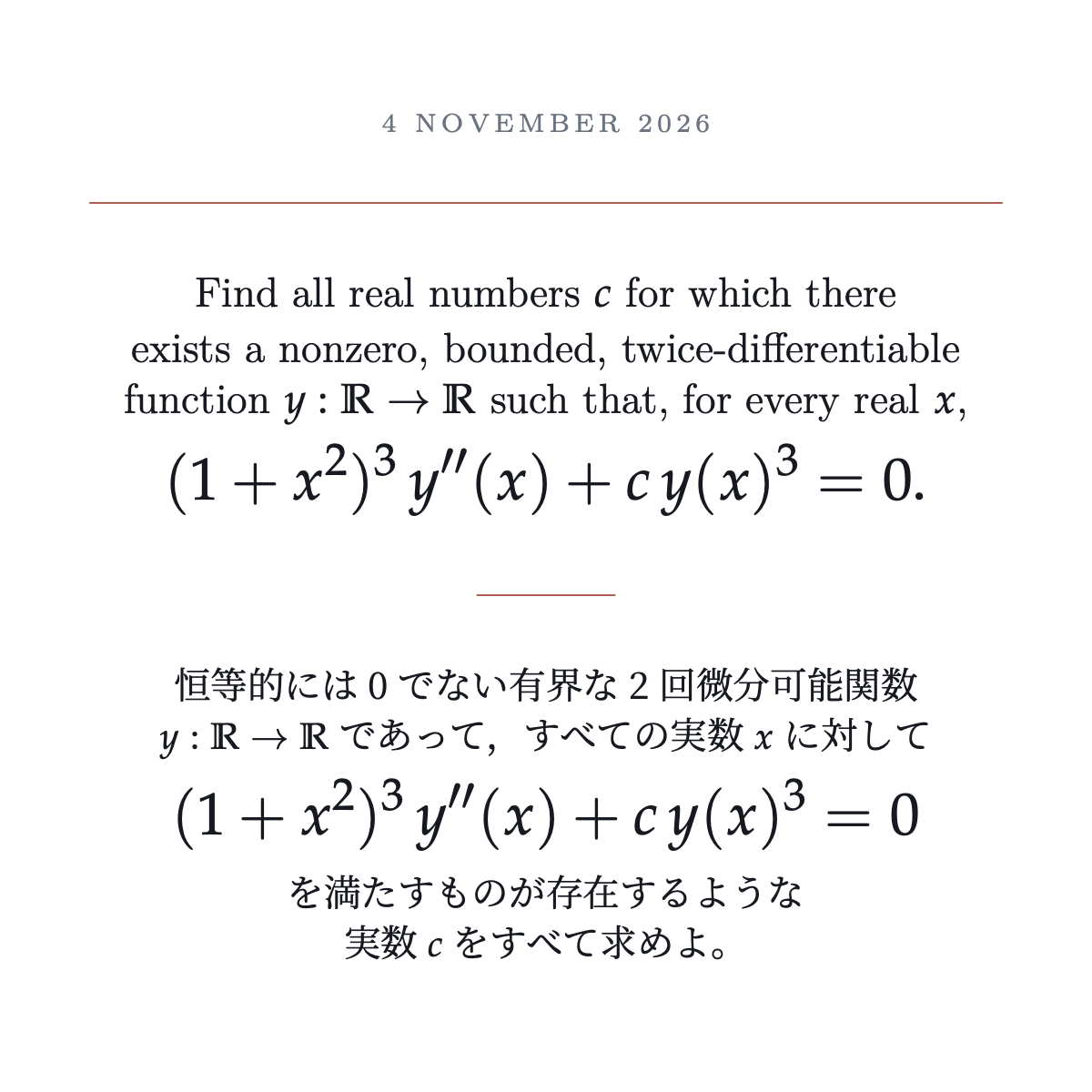
Find all real numbers \(c\) for which there exists a nonzero, bounded, twice-differentiable function \(y:\mathbb{R}\to\mathbb{R}\) such that, for every real \(x\),
\[(1+x^2)^3\,y''(x)+c\,y(x)^3=0.\]Show the solution
The answer is \(c\ge 0\).
Why a direct attack stalls. In the variable \(x\) the equation has no conserved energy, because the weight \((1+x^2)^{-3}\) depends on \(x\), and it is invariant neither under scalings \(x\mapsto\lambda x\) nor under \(x\mapsto 1/x\). For \(c<0\) one can still argue by convexity, but for \(c>0\) we must produce a solution that stays bounded at both \(-\infty\) and \(+\infty\), a two-ended condition that cannot be imposed by choosing initial data at one point. The right move is a change of variables that removes the weight completely.
Step 1: the substitution. Put \(x=\tan\theta\) with \(\theta\in(-\pi/2,\pi/2)\) and \(y(x)=u(\theta)/\cos\theta\), that is \(u(\theta)=y(\tan\theta)\cos\theta\). Then \(u\) is twice differentiable exactly when \(y\) is. Since \(d\theta/dx=\cos^2\theta\),
\[\frac{dy}{dx}=\cos^2\theta\,\frac{d}{d\theta}\Big(\frac{u}{\cos\theta}\Big)=u'\cos\theta+u\sin\theta,\qquad \frac{d^2y}{dx^2}=\cos^2\theta\,(u''\cos\theta-u'\sin\theta+u'\sin\theta+u\cos\theta)=\cos^3\theta\,(u''+u).\]As \((1+x^2)^3=\sec^6\theta\) and \(y^3=\sec^3\theta\,u^3\), the equation becomes \(\sec^3\theta\,(u''+u+cu^3)=0\), that is
\[u''+u+c\,u^3=0\quad\text{on }(-\pi/2,\pi/2).\tag{*}\]The weight and the cube are matched exactly: this is why the problem has \((1+x^2)^3\) together with \(y^3\).
Step 2: boundedness becomes a boundary condition. If \(|y|\le M\) then \(|u(\theta)|\le M\cos\theta\), so \(u\to0\) at \(\pm\pi/2\). Moreover \(u\) is bounded, hence so is \(u''=-u-cu^3\), so \(u'\) is bounded and uniformly continuous and \(u\) extends to a \(C^1\) function on \([-\pi/2,\pi/2]\) with \(u(\pm\pi/2)=0\). Conversely, let \(u\) solve \((*)\) on an open interval containing \([-\pi/2,\pi/2]\) with \(u(\pm\pi/2)=0\), and let \(L=\max|u'|\) there. By the mean value theorem \(|u(\theta)|\le L(\pi/2-|\theta|)\), and \(\cos\theta=\sin(\pi/2-|\theta|)\ge\frac{2}{\pi}(\pi/2-|\theta|)\), so \(|y|=|u|/\cos\theta\le L\pi/2\): the function \(y\) is bounded.
Step 3: no solution for \(c<0\). Write \(c=-d\) with \(d>0\) and suppose \(y\) is a nonzero bounded solution, so \(|u|\le M\cos\theta\) and \(u'\) is bounded. Multiply \((*)\) by \(u\) and integrate over \([-\pi/2+\varepsilon,\pi/2-\varepsilon]\); the boundary term \(uu'\) tends to \(0\), so
\[\int_{-\pi/2}^{\pi/2}u'^2\,d\theta=\int_{-\pi/2}^{\pi/2}u^2\,d\theta-d\int_{-\pi/2}^{\pi/2}u^4\,d\theta.\]On the other hand, expanding a square and integrating \(2uu'\tan\theta\) by parts gives
\[\int_{-\pi/2}^{\pi/2}\big(u'+u\tan\theta\big)^2\,d\theta=\int_{-\pi/2}^{\pi/2}u'^2\,d\theta-\int_{-\pi/2}^{\pi/2}u^2\,d\theta,\]where the boundary term \(u^2\tan\theta\) vanishes because \(|u^2\tan\theta|\le M^2\cos\theta\,|\sin\theta|\to0\). (This is Wirtinger's inequality on an interval of length \(\pi\).) Hence \(\int u'^2\ge\int u^2\), and comparing with the previous identity gives \(d\int u^4\le 0\). So \(u\equiv0\) and \(y\equiv0\), a contradiction. (A second route: for \(c<0\) we have \(yy''\ge0\), so \(y\) is convex wherever it is positive, and a bounded function with this property on all of \(\mathbb{R}\) is forced to vanish.)
Step 4: \(c=0\). The constant \(y\equiv1\) works.
Step 5: a solution for \(c>0\). Let \(u\) solve \((*)\) with \(u(0)=0\), \(u'(0)=a>0\). The energy \(u'^2+u^2+\frac c2u^4=a^2\) is conserved, so \(u\) is bounded and exists on all of \(\mathbb{R}\); by uniqueness \(-u(-\theta)\) is the same solution, so \(u\) is odd. Let \(m>0\) satisfy \(m^2+\frac c2m^4=a^2\). The derivative \(u'\) can vanish only where \(u=\pm m\), so \(u\) increases from \(0\) and first reaches its maximum \(m\) at
\[\tau=\int_0^m\frac{dv}{\sqrt{a^2-v^2-\frac c2v^4}}=\int_0^1\frac{ds}{\sqrt{(1-s^2)\,\big(1+k(1+s^2)\big)}},\qquad k=\frac{cm^2}{2},\]using the factorisation \(a^2-v^2-\frac c2v^4=(m^2-v^2)\big(1+\frac c2(m^2+v^2)\big)\) and \(v=ms\). As \(a\) runs over \((0,\infty)\), \(k\) runs over \((0,\infty)\). The integrand is dominated by \(1/\sqrt{1-s^2}\), so \(\tau(k)\) is continuous, strictly decreasing, tends to \(\int_0^1 ds/\sqrt{1-s^2}=\pi/2\) as \(k\to0\), and satisfies \(\tau(k)\le\frac{\pi}{2\sqrt{1+k}}\to0\) as \(k\to\infty\). Choose \(k\) with \(\tau=\pi/4\). At \(\theta=\pi/4\) we have \(u=m\), \(u'=0\); since \((*)\) is autonomous and of second order, \(u(\pi/2-t)=u(t)\) for all \(t\), so \(u(\pi/2)=u(0)=0\), and by oddness \(u(-\pi/2)=0\). By Step 2,
\[y(x)=\sqrt{1+x^2}\;u(\arctan x)\]is a nonzero bounded solution. (It is odd, vanishes only at \(x=0\), and tends to \(\pm a\) as \(x\to\pm\infty\).) If one prefers, it suffices to do this for \(c=1\): if \(y\) solves the equation with \(c=1\), then \(y/\sqrt c\) solves it for \(c\).
Conclusion. A nonzero bounded solution exists exactly when \(c\ge0\).
Check. For \(c=1\), a numerical root-find gives \(k\approx2.0662\), amplitude \(m\approx2.0328\), \(a\approx3.5596\), and a Runge-Kutta integration of \((*)\) returns \(u(\pi/2)\approx3\times10^{-14}\). Integrating the original equation directly in \(x\) from \(y(0)=0\), \(y'(0)=a\) out to \(x=10^4\) keeps \(y\) bounded (it settles at \(3.5596\) with slope \(6\times10^{-12}\)) and matches \(\sqrt{1+x^2}\,u(\arctan x)\) to \(10^{-11}\) at \(x=3\); changing \(a\) by \(1\%\) produces linear growth, and for \(c=-1\) random initial data always grow linearly.