Daily Mathematics / Solutions
Solution for 28 October 2026
The card that day was an original math olympiad problem. Try it first; the solution is folded away below.
Math Olympiad problem
Pairwise sums that equal pairwise products
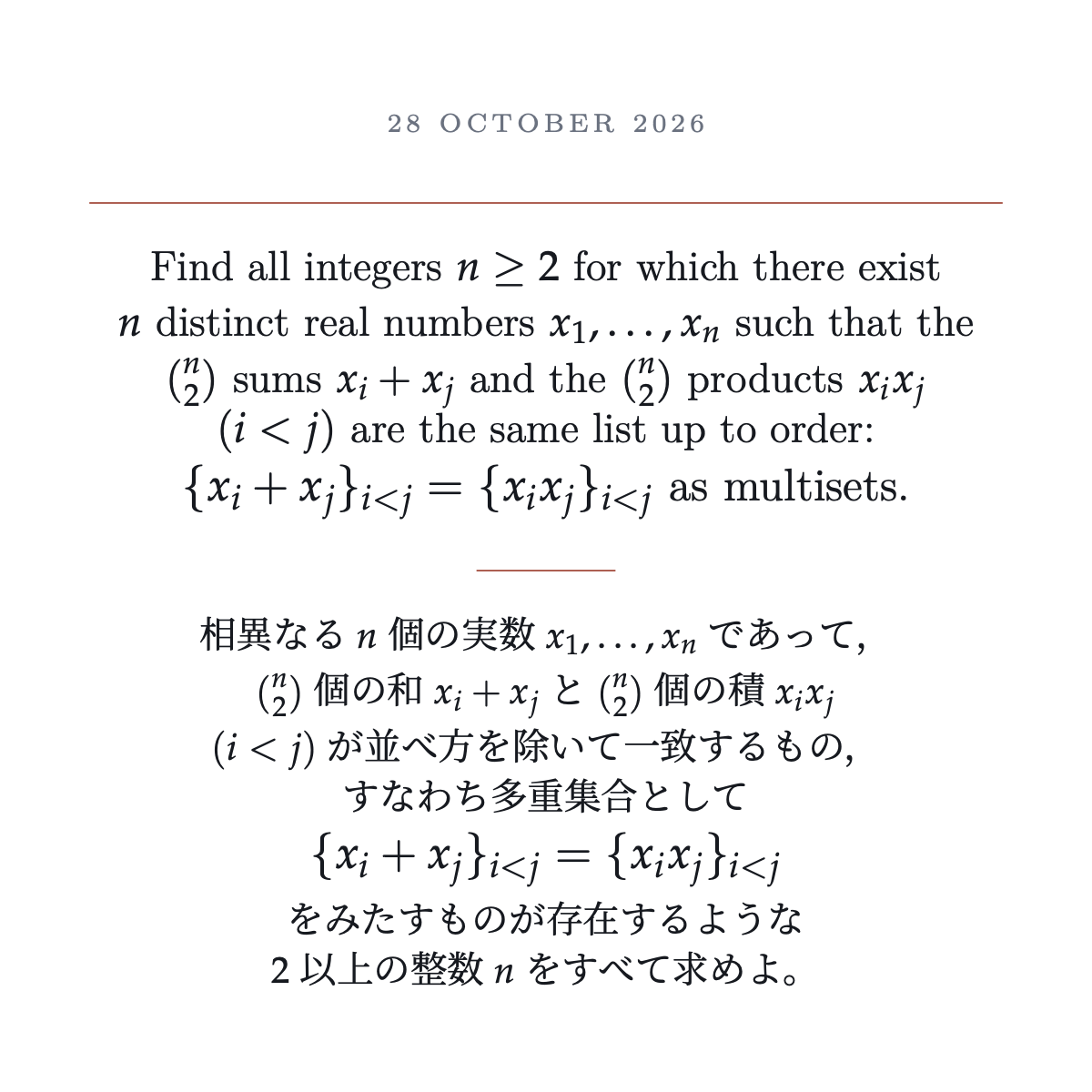
Find all integers \(n\ge 2\) for which there exist \(n\) distinct real numbers \(x_1,\dots,x_n\) such that the \(\binom{n}{2}\) sums \(x_i+x_j\) and the \(\binom{n}{2}\) products \(x_ix_j\) \((i<j)\) are the same list up to order:
\[\{x_i+x_j\}_{i<j}=\{x_ix_j\}_{i<j}\quad\text{as multisets.}\]
Show the solution
Answer. Every integer \(n\ge 2\) works.
Why the first instincts mislead. Products of large numbers grow quadratically while sums grow linearly, which suggests an impossibility proof for large \(n\). It cannot be completed, because suitable numbers exist for every \(n\). The numbers cannot all be positive once \(n\ge 3\): if \(0<x_1<x_2<\dots<x_n\), the smallest sum and the smallest product are \(x_1+x_2\) and \(x_1x_2\), and the second smallest are \(x_1+x_3\) and \(x_1x_3\), so \(x_1=\tfrac{x_2}{x_2-1}=\tfrac{x_3}{x_3-1}\), forcing \(x_2=x_3\). So a construction has to mix signs, and an unstructured search through \(\binom{n}{2}!\) possible matchings goes nowhere.
The case \(n=2\). We need \(x+y=xy\) with \(x\ne y\), for instance \(x=3\), \(y=\tfrac32\). This case is also covered by the general construction below.
Construction. Put \(m=2n+1\) and, for every integer \(r\), let \(c(r)=2\cos\tfrac{2\pi r}{m}\). Take \(x_k=c(k)\) for \(k=1,\dots,n\). These are distinct, because \(\tfrac{2\pi k}{m}\) lies in \((0,\pi)\), where cosine is strictly decreasing. The value \(c(r)\) depends only on \(r\) modulo \(m\), and \(c(-r)=c(r)\). Call \(\{r,-r\}\subset\mathbb{Z}_m\) the class \([r]\). Since \(m\) is odd, the nonzero classes are exactly \([1],\dots,[n]\), and \(c\) is constant on each class, with value \(x_k\) on \([k]\).
Products become sums. The product-to-sum formula \(2\cos\alpha\cdot 2\cos\beta=2\cos(\alpha+\beta)+2\cos(\alpha-\beta)\) reads
\[x_ax_b=c(a+b)+c(a-b).\]
So the product of the pair indexed by \(\{[a],[b]\}\) is the sum of the pair indexed by \(\{[a+b],[a-b]\}\). It remains to show that this re-indexing permutes the pairs.
A bijection on pairs of classes. Let \(\Pi\) be the set of unordered pairs of distinct nonzero classes; it has \(\binom{n}{2}\) elements and indexes the pairs \(i<j\). Define \(\varphi(\{[a],[b]\})=\{[a+b],[a-b]\}\).
(i) It is well defined: replacing \(b\) by \(-b\) swaps the two entries, replacing \(a\) by \(-a\) gives \([-(a-b)]=[a-b]\) and \([-(a+b)]=[a+b]\), and swapping \(a\) and \(b\) gives \([b+a]\) and \([b-a]=[a-b]\).
(ii) It lands in \(\Pi\): \([a]\ne[b]\) means \(a\not\equiv\pm b\), so \(a+b\) and \(a-b\) are nonzero modulo \(m\). If \([a+b]=[a-b]\), then \(a+b\equiv a-b\) or \(a+b\equiv b-a\), that is \(2b\equiv 0\) or \(2a\equiv 0\). Since \(m\) is odd, \(2\) is invertible modulo \(m\), so \(a\equiv 0\) or \(b\equiv 0\), which is excluded.
(iii) It is injective: let \(h=n+1\), the inverse of \(2\) modulo \(m\). The map \(\psi(\{[u],[v]\})=\{[h(u+v)],[h(u-v)]\}\) is well defined and lands in \(\Pi\) by the same checks, and \(\psi(\varphi(\{[a],[b]\}))=\{[a],[b]\}\). An injective map from the finite set \(\Pi\) to itself is a bijection.
Conclusion. As \(\{[a],[b]\}\) runs over \(\Pi\), the products \(x_ax_b\) run over the values \(c(u)+c(v)\) with \(\{[u],[v]\}=\varphi(\{[a],[b]\})\), and since \(\varphi\) is a bijection of \(\Pi\), these are exactly the pairwise sums, each taken once. Hence the multiset of products equals the multiset of sums, for every \(n\ge 2\).
Example. For \(n=3\) the numbers are \(2\cos\tfrac{2\pi}{7}\), \(2\cos\tfrac{4\pi}{7}\), \(2\cos\tfrac{6\pi}{7}\), the roots of \(t^3+t^2-2t-1\). With \(c(4)=c(3)\) and \(c(5)=c(2)\) the formula gives \(x_1x_2=x_3+x_1\), \(x_1x_3=x_3+x_2\) and \(x_2x_3=x_2+x_1\). This is also how the construction is found by hand: solving \(n=3\) produces the heptagon cubic, and \(n=4\) produces \(2\cos\tfrac{2\pi k}{9}\).
Check. For every \(n\) from \(2\) to \(60\) the sorted lists of sums and products agree to within \(3\cdot 10^{-15}\), and an exact computation confirms that \(\varphi\) is a bijection of \(\Pi\) for every \(n\le 200\).