Daily Mathematics / Solutions
Solution for 25 October 2026
The card that day was an original math olympiad problem. Try it first; the solution is folded away below.
Math Olympiad problem
A circle through B and C tangent to the incircle
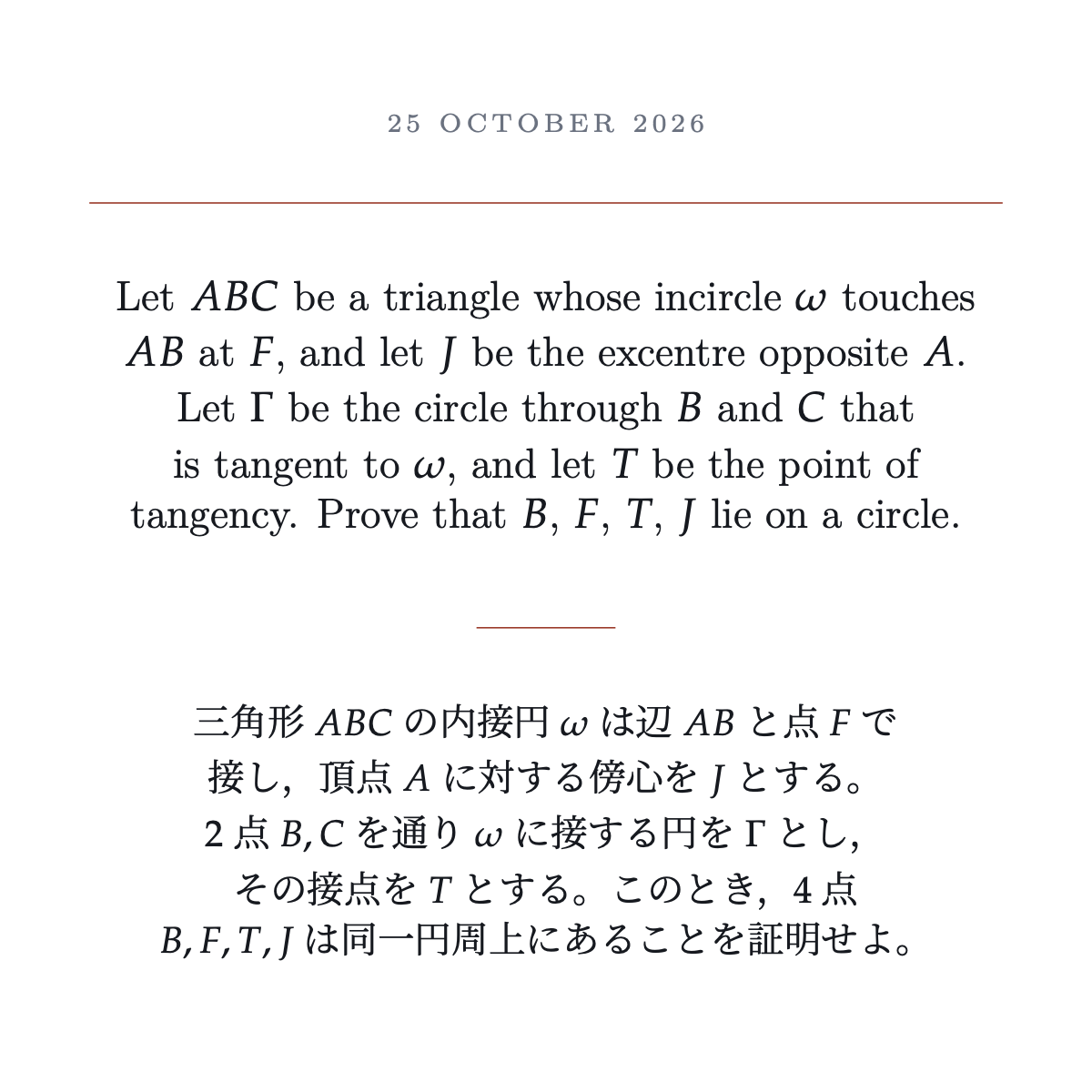
Let \(ABC\) be a triangle whose incircle \(\omega\) touches \(AB\) at \(F\), and let \(J\) be the excentre opposite \(A\). Let \(\Gamma\) be the circle through \(B\) and \(C\) that is tangent to \(\omega\), and let \(T\) be the point of tangency. Prove that \(B\), \(F\), \(T\), \(J\) lie on a circle.
Show the solution
Notation. Let \(I\) be the incentre and \(r\) the inradius, and let \(\omega\) touch \(BC\) and \(CA\) at \(D\) and \(E\). We write \(\measuredangle(\ell,m)\) for the directed angle between lines \(\ell\) and \(m\), taken modulo \(180^\circ\); this makes every step independent of the shape of the triangle.
Why not attack \(T\) directly. The tangency condition is hard to use: the standard consequence is that \(TD\) bisects \(\angle BTC\), but that says nothing about \(J\) or \(F\). Instead we build a point \(T'\) that is easy to control, show that it has all the properties we want, prove that the circle through \(B\), \(C\), \(T'\) is tangent to \(\omega\), and finally show that there is only one circle through \(B\) and \(C\) tangent to \(\omega\). Then \(T=T'\).
Step 1: two parallels. Since \(BD=BF\), the bisector \(BI\) is the perpendicular bisector of \(DF\), so \(DF\perp BI\). The external bisector \(BJ\) is also perpendicular to \(BI\). Hence \(BJ\parallel DF\). In the same way \(CJ\parallel DE\).
Step 2: the phantom point. The line \(DJ\) is not \(BC\) (as \(J\notin BC\)), and \(BC\) is the tangent to \(\omega\) at \(D\), so \(DJ\) meets \(\omega\) at a second point \(T'\ne D\). Also \(T'\ne J\), because \(J\) lies on the other side of \(BC\) from \(\omega\), and \(T'\ne F\): otherwise \(J\) would lie on line \(DF\), which is parallel to \(BJ\) and different from it (it does not pass through \(B\)). Likewise \(T'\ne E\). Now, using \(\omega\), then the tangent-chord angle at \(F\) (the tangent there is \(AB\)), then Step 1:
\[\measuredangle(T'J,T'F)=\measuredangle(T'D,T'F)=\measuredangle(ED,EF)=\measuredangle(FD,AB)=\measuredangle(BJ,BF).\]
Therefore \(B,F,T',J\) are concyclic. The same chase at \(C\), with \(CJ\parallel DE\) and the tangent \(AC\) at \(E\), shows that \(C,E,T',J\) are concyclic.
Step 3: \(T'J\) bisects \(\angle BT'C\). \(T'\) is not on \(BC\) (the only point of \(\omega\) on \(BC\) is \(D\)), so \(B,C,T'\) determine a circle \(\Gamma'\). From the two circles of Step 2, \(\measuredangle(T'B,T'J)=\measuredangle(FB,FJ)\) and \(\measuredangle(T'J,T'C)=\measuredangle(EJ,EC)\). The reflection in the line \(AI\) fixes \(J\), swaps \(F\) and \(E\) (as \(AF=AE\)) and swaps the lines \(AB\) and \(AC\); a reflection reverses directed angles, so \(\measuredangle(EC,EJ)=-\measuredangle(FB,FJ)\), that is \(\measuredangle(FB,FJ)=\measuredangle(EJ,EC)\). Hence \(\measuredangle(T'B,T'J)=\measuredangle(T'J,T'C)\): the line \(T'J\), which is the line \(T'D\), is one of the two bisectors of the angle \(BT'C\).
Step 4: \(\Gamma'\) is tangent to \(\omega\) at \(T'\). The point \(D\) lies strictly between \(B\) and \(C\), so it is inside \(\Gamma'\); hence the line \(T'D\) meets \(\Gamma'\) again at a point \(W\ne T'\), with \(D\) between \(T'\) and \(W\). By Step 3, \(T'W\) bisects \(\angle BT'C\) (internally or externally), so \(W\) is the midpoint of one of the arcs \(BC\) of \(\Gamma'\), and the tangent to \(\Gamma'\) at \(W\) is parallel to \(BC\). Let \(h\) be the homothety with centre \(T'\) taking \(D\) to \(W\) (its ratio \(T'W/T'D\) is positive). It maps \(\omega\) to a circle through \(T'\) that is tangent at \(W\) to the image of \(BC\), namely the line through \(W\) parallel to \(BC\). The circle \(\Gamma'\) has the same two properties, and there is only one circle through \(T'\) tangent to a given line at a given point \(W\) (its centre is where the perpendicular at \(W\) meets the perpendicular bisector of \(T'W\); these meet in one point because \(T'\) is not on the tangent line). So \(h(\omega)=\Gamma'\). Two circles that are homothetic from a point lying on both are tangent at that point, so \(\Gamma'\) touches \(\omega\) at \(T'\).
Step 5: there is only one circle through \(B\) and \(C\) tangent to \(\omega\). Let \(\Sigma\) be any such circle, with centre \(O\) and radius \(R\). As \(D\) is an interior point of the chord \(BC\), it lies strictly inside \(\Sigma\), so \(\Sigma\) cannot touch \(\omega\) externally (externally tangent circles have discs meeting in a single point of \(\Sigma\)), and \(\Sigma\) cannot lie inside \(\omega\) because \(B\) is outside \(\omega\). So \(\omega\) is internally tangent to \(\Sigma\) and \(OI=R-r\). Take the midpoint of \(BC\) as origin and \(BC\) as the \(x\)-axis, with \(BC=a\), \(I=(u,r)\) where \(|u|<a/2\) (\(u\) is the abscissa of \(D\)), and \(O=(0,k)\), so \(R^2=a^2/4+k^2\). Expanding \(u^2+(k-r)^2=(R-r)^2\) gives \(R-k=(a^2/4-u^2)/(2r)=:q>0\), and then \(R+k=(R^2-k^2)/q=a^2/(4q)\). So \(k\) and \(R\) are determined, and \(\Sigma\) is unique.
Conclusion. By Steps 4 and 5, \(\Gamma=\Gamma'\) and \(T=T'\). By Step 2, \(B,F,T,J\) lie on a circle. As a by-product, \(T\) also lies on the circle \(CEJ\) and on the line \(DJ\); the collinearity of \(T\), \(D\), \(J\) is a known lemma (it is the heart of ISL 2002 G7), which the argument above reproves.
Check. For 196,183 random triangles (acute and obtuse) we computed \(\Gamma\) exactly from the tangency condition, located \(T\), and tested the circles \(BFJ\) and \(CEJ\): the largest relative deviation of \(T\) from either circle was \(1.1\times10^{-{12}}\), and \(T\), \(D\), \(J\) were collinear to within \(3\times10^{-{10}}\).