Daily Mathematics / Solutions
Solutions for 20 October 2026
Two cards went out that day: a hard definite integral and an original Putnam-style problem. Try each one first; the solutions are folded away below.
Integral
A logarithmic triple integral with three Cauchy weights
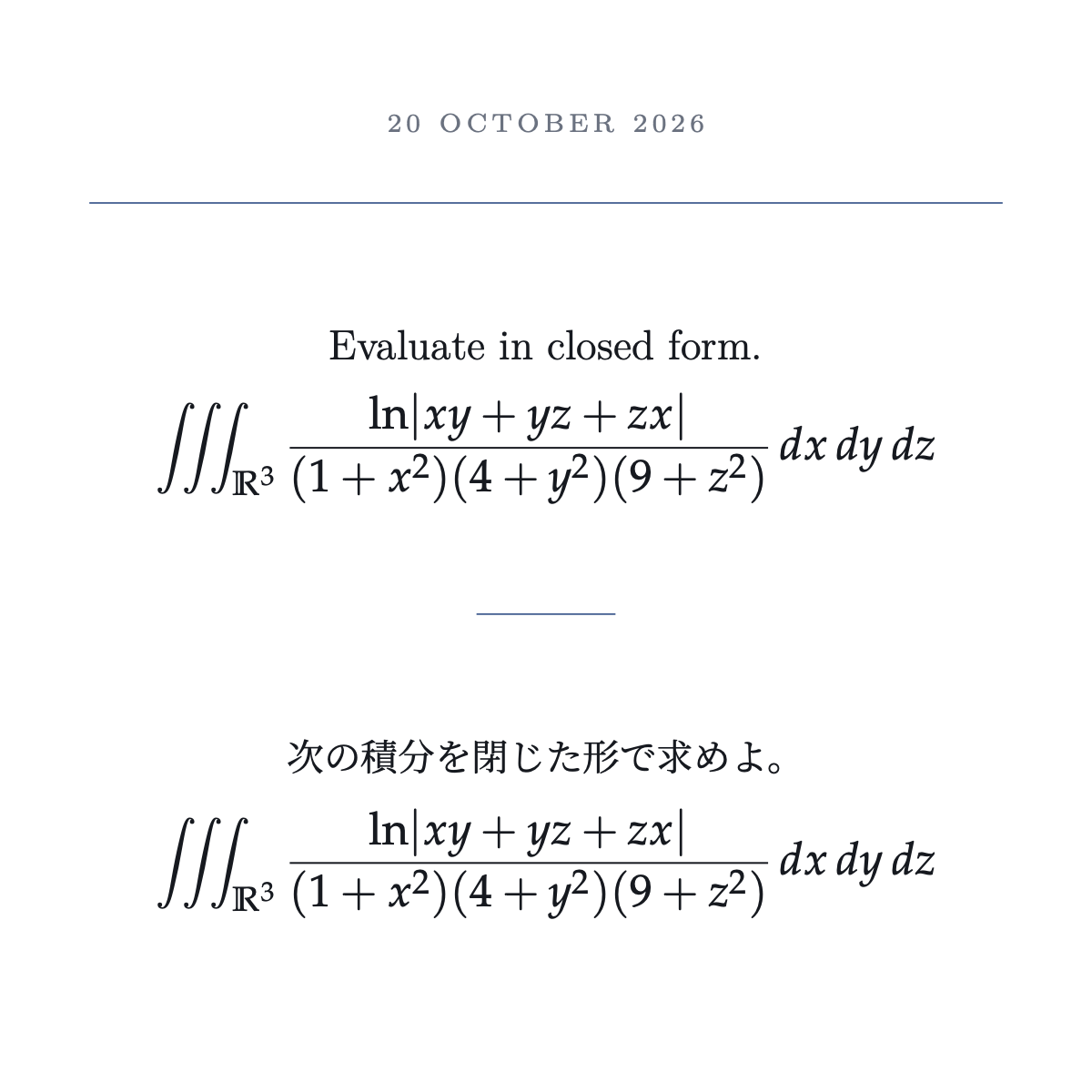
Evaluate in closed form.
\[\iiint_{\mathbb{R}^{3}}\frac{\ln\lvert xy+yz+zx\rvert}{(1+x^{2})(4+y^{2})(9+z^{2})}\,dx\,dy\,dz\]Show the solution
Call the integral \(I\). Integrating one variable at a time is possible but unpleasant: the \(z\)-integral of \(\ln\lvert a+bz\rvert/(9+z^{2})\) with \(a=xy\), \(b=x+y\) already leaves \(\tfrac{\pi}{6}\ln\bigl(x^{2}y^{2}+9(x+y)^{2}\bigr)\) in the remaining two variables, and the double integral of that has no obvious structure. The clean route is to read the three weights as probability densities.
Step 1: Cauchy densities. For \(c>0\) let \(\rho_{c}(t)=\dfrac{c}{\pi(t^{2}+c^{2})}\), the density of the Cauchy law of scale \(c\), written \(\mathrm{C}(c)\). Then
\[\frac{1}{(1+x^{2})(4+y^{2})(9+z^{2})}=\pi\cdot\frac{\pi}{2}\cdot\frac{\pi}{3}\,\rho_{1}(x)\rho_{2}(y)\rho_{3}(z),\]so \(I=\dfrac{\pi^{3}}{6}\,\mathbb{E}\ln\lvert XY+YZ+ZX\rvert\), where \(X\sim\mathrm{C}(1)\), \(Y\sim\mathrm{C}(2)\), \(Z\sim\mathrm{C}(3)\) are independent. We use three facts.
Fact A: \(\mathbb{E}\ln\lvert W\rvert=\ln c\) for \(W\sim\mathrm{C}(c)\). Writing \(W=cU\) with \(U\sim\mathrm{C}(1)\), we get \(\mathbb{E}\ln\lvert W\rvert=\ln c+\frac{1}{\pi}\int_{\mathbb{R}}\frac{\ln\lvert u\rvert}{1+u^{2}}\,du\). The last integral converges absolutely, and it vanishes: the substitution \(u\mapsto1/u\) maps \((0,1)\) to \((1,\infty)\), preserves \(du/(1+u^{2})\) and changes the sign of \(\ln u\). In particular \(\ln\lvert W\rvert\) is integrable.
Fact B: if \(W\sim\mathrm{C}(c)\) then \(1/W\sim\mathrm{C}(1/c)\). The density of \(V=1/W\) is \(\rho_{c}(1/v)\,v^{-2}=\dfrac{c}{\pi(1+c^{2}v^{2})}=\dfrac{1/c}{\pi(v^{2}+c^{-2})}=\rho_{1/c}(v)\).
Fact C: independent \(\mathrm{C}(a)\) and \(\mathrm{C}(b)\) add to \(\mathrm{C}(a+b)\). The characteristic function of \(\mathrm{C}(c)\) is \(\int e^{itw}\rho_{c}(w)\,dw=e^{-c\lvert t\rvert}\) (Fourier inversion of the elementary identity \(\int e^{-c\lvert s\rvert}e^{-isw}\,ds=2c/(c^{2}+w^{2})\)). Characteristic functions of independent summands multiply, and \(e^{-a\lvert t\rvert}e^{-b\lvert t\rvert}=e^{-(a+b)\lvert t\rvert}\).
Step 2: factor the polynomial. Almost surely \(X,Y,Z\neq0\), and then
\[XY+YZ+ZX=XYZ\Bigl(\frac{1}{X}+\frac{1}{Y}+\frac{1}{Z}\Bigr),\qquad \ln\lvert XY+YZ+ZX\rvert=\ln\lvert X\rvert+\ln\lvert Y\rvert+\ln\lvert Z\rvert+\ln\Bigl\lvert\frac{1}{X}+\frac{1}{Y}+\frac{1}{Z}\Bigr\rvert .\]By Fact B, \(1/X,1/Y,1/Z\) are independent with laws \(\mathrm{C}(1),\mathrm{C}(\tfrac12),\mathrm{C}(\tfrac13)\), so by Fact C their sum is \(\mathrm{C}(\tfrac{11}{6})\). Each of the four terms on the right is integrable by Fact A, hence so is the left side, which justifies both the original integral (absolutely convergent) and taking expectations term by term.
Step 3: add up. By Fact A,
\[\mathbb{E}\ln\lvert XY+YZ+ZX\rvert=\ln1+\ln2+\ln3+\ln\frac{11}{6}=\ln 11,\qquad I=\frac{\pi^{3}}{6}\ln 11\approx 12.3916340465 .\]The constants \(1,2,3\) enter only through \(abc\cdot(\tfrac1a+\tfrac1b+\tfrac1c)=ab+bc+ca\), which is why the answer is the logarithm of \(1\cdot2+2\cdot3+3\cdot1=11\).
Check. The inner formula \(\int\ln\lvert a+bz\rvert\,dz/(9+z^{2})=\tfrac{\pi}{6}\ln(a^{2}+9b^{2})\) was confirmed by Gauss-Legendre quadrature at random \((a,b)\) to \(3\times10^{-15}\). The full integral was then computed numerically from the raw integrand in the two remaining variables (100-node Gauss-Legendre, \(x=\tan u\) with panels graded towards \(u=0\) and \(u=\pm\pi/2\), and a \(\sinh\) substitution centred on the near-singular curve in \(y\)), giving \(12.39163404646152\), which agrees with \(\tfrac{\pi^{3}}{6}\ln11\) to \(3\times10^{-14}\).
Competition problem
Letters, recipients and the shape of a random map
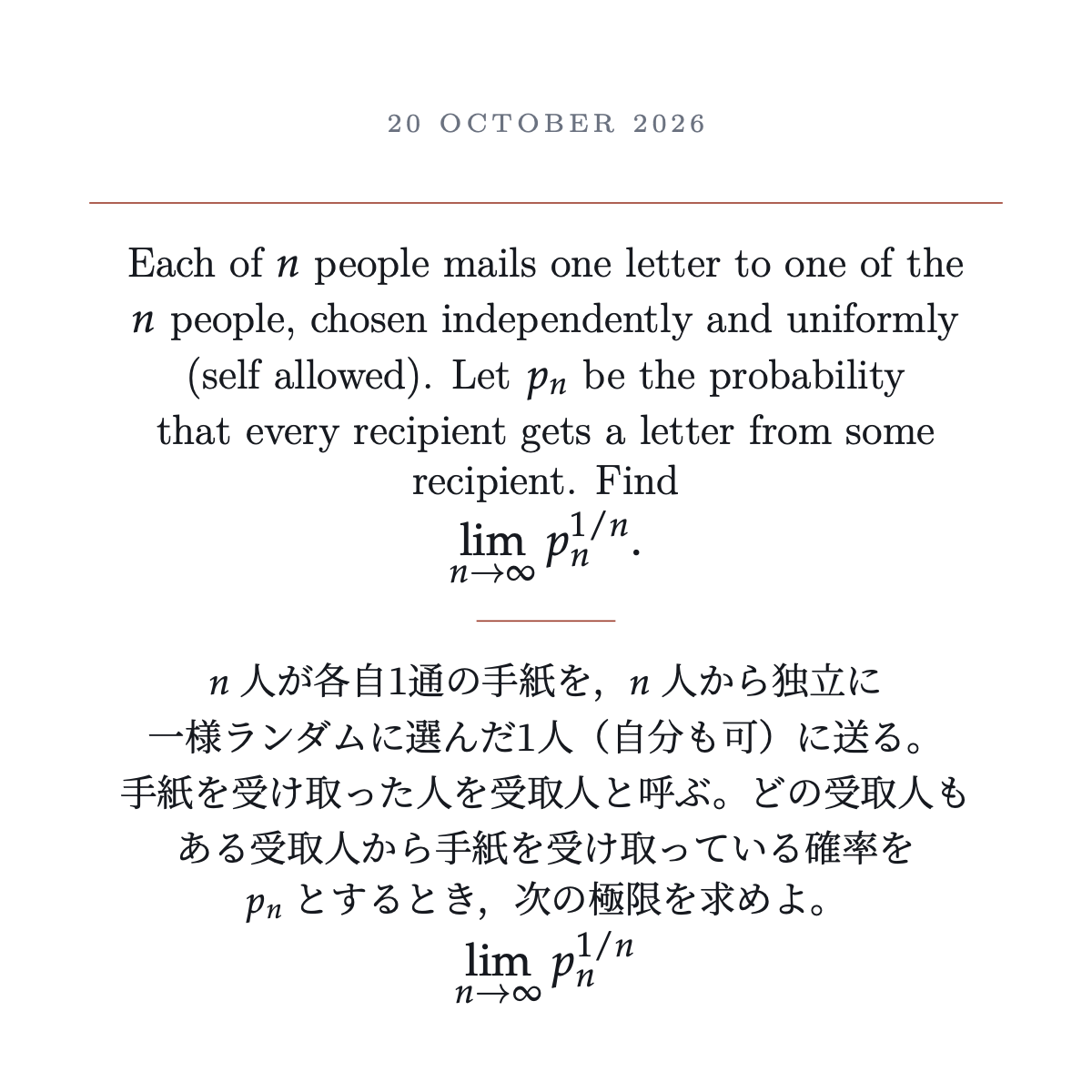
Each of \(n\) people mails one letter to one of the \(n\) people, chosen independently and uniformly (self allowed). Let \(p_{n}\) be the probability that every recipient gets a letter from some recipient. Find
\[\lim_{n\to\infty}p_{n}^{1/n}.\]Show the solution
Let \(S=\{1,\dots,n\}\) and let \(f(x)\) be the person to whom \(x\) writes, so \(f\) is a uniformly random map \(S\to S\) and \(p_{n}=a_{n}/n^{n}\), where \(a_{n}\) counts the good maps. The recipients form the image \(R=f(S)\). Since \(p_{n}\to0\) exponentially fast, the question is about the exact exponential rate, and a direct inclusion-exclusion over who receives what gives an alternating sum with no visible dominant term. The way in is to identify the good maps structurally.
Step 1: what the condition means. The condition says \(R\subseteq f(R)\). Always \(f(R)\subseteq f(S)=R\), so it says \(f(R)=R\); as \(R\) is finite, \(f\) permutes \(R\). Call \(x\) cyclic if \(f^{m}(x)=x\) for some \(m\ge1\), and let \(C\) be the set of cyclic points. Every cyclic point is a value of \(f\), so \(C\subseteq R\) always, and \(f\) always permutes \(C\). If \(f\) permutes \(R\), every point of \(R\) is cyclic, so \(R=C\). Conversely, if \(R=C\) then \(f\) permutes \(R\). Hence \(f\) is good exactly when \(f(S)\subseteq C\): every non-cyclic person writes directly to a cyclic one.
Step 2: an exact count. Fix \(k=\lvert C\rvert\). A good map is built by choosing the \(k\)-set \(C\), a permutation of \(C\), and for each of the other \(n-k\) people a target in \(C\). Every map so built is good, its cyclic set is exactly \(C\) (a point outside \(C\) is sent into \(C\) and stays there, so it never returns), and every good map arises once. Therefore
\[a_{n}=\sum_{k=1}^{n}\binom{n}{k}k!\,k^{\,n-k},\qquad p_{n}=\sum_{k=1}^{n}T_{k},\quad T_{k}=\frac{n!}{(n-k)!}\cdot\frac{k^{\,n-k}}{n^{n}} .\]This gives \(a_{n}=1,4,21,148,1305,13806,170401\) for \(n=1,\dots,7\).
Step 3: the size of each term. For \(m\ge1\), comparing \(\ln m!=\sum_{j\le m}\ln j\) with \(\int_{1}^{m}\ln t\,dt\) gives \(e(m/e)^{m}\le m!\le e\,m\,(m/e)^{m}\). Applying this to \(n!\) and \((n-k)!\) for \(1\le k\le n-1\) and writing \(x=k/n\),
\[T_{k}=c_{n,k}\,e^{\,n\,g(x)},\qquad g(x)=-x+(1-x)\ln\frac{x}{1-x},\qquad \frac{1}{n}\le c_{n,k}\le n,\]because \((n/e)^{n}((n-k)/e)^{-(n-k)}k^{n-k}n^{-n}=e^{-k}\bigl(k/(n-k)\bigr)^{n-k}\). For \(k=n\), \(T_{n}=n!/n^{n}\le e\,n\,e^{-n}\), which is the same bound with \(g(1)=-1\).
Step 4: maximising \(g\). Differentiating, \(g'(x)=\dfrac{1}{x}-1-\ln\dfrac{x}{1-x}=t+\ln t\) with \(t=(1-x)/x\). As \(x\) increases, \(t\) decreases, and \(t+\ln t\) is increasing in \(t\), so \(g'\) is strictly decreasing, from \(+\infty\) at \(0^{+}\) to \(-\infty\) at \(1^{-}\). Thus \(g\) has a unique maximum on \((0,1]\), where \(t+\ln t=0\), that is \(te^{t}=1\): \(t=\Omega\approx0.5671433\), the omega constant, and \(x^{*}=1/(1+\Omega)\). There \(\ln(x^{*}/(1-x^{*}))=\ln(1/\Omega)=\Omega\), so
\[g(x^{*})=-\frac{1}{1+\Omega}+\frac{\Omega}{1+\Omega}\cdot\Omega=\frac{\Omega^{2}-1}{1+\Omega}=\Omega-1 .\]Step 5: squeeze. Summing at most \(n\) terms, \(p_{n}\le e\,n^{2}e^{n(\Omega-1)}\). For the lower bound take \(k_{n}=\lceil nx^{*}\rceil\), which lies in \([1,n-1]\) for large \(n\); since \(g\) is smooth near \(x^{*}\) and \(\lvert k_{n}/n-x^{*}\rvert\le1/n\), we have \(n\,g(k_{n}/n)=n(\Omega-1)+O(1)\), so \(p_{n}\ge T_{k_{n}}\ge n^{-1}e^{\,n(\Omega-1)+O(1)}\). Taking \(n\)-th roots,
\[\lim_{n\to\infty}p_{n}^{1/n}=e^{\Omega-1}=\frac{1}{e\,\Omega}\approx0.6486534,\]where the last form uses \(e^{\Omega}=1/\Omega\).
Check. Brute force over all \(n^{n}\) maps for \(n\le7\) reproduced \(1,4,21,148,1305,13806,170401\) exactly. Evaluating the exact sum gives \(p_{n}^{1/n}=0.66689\) at \(n=100\), \(0.65120\) at \(n=1000\), \(0.648694\) at \(n=10^{5}\) and \(0.648658\) at \(n=10^{6}\), approaching \(e^{\Omega-1}=0.6486534\) at the rate \(O(\ln n/n)\) predicted by the polynomial factors in Step 5.