Daily Mathematics / Solutions
Solutions for 15 October 2026
Two cards went out that day: a hard definite integral and an original Putnam-style problem. Try each one first; the solutions are folded away below.
Integral
A product of two logarithms over [-1, 1]
![Card: A product of two logarithms over [-1, 1]](/daily-mathematics/2026-10-15/integral.png)
Evaluate in closed form.
\[\int_{-1}^{1}\ln\Bigl(1+\sqrt{\tfrac{2}{1-x}}\Bigr)\ln\Bigl(1+\sqrt{\tfrac{2}{1+x}}\Bigr)\,dx\]Show the solution
Write \(I\) for the integral. We show that \(I=2\pi-4\ln2-\tfrac{\pi^2}{6}\approx1.8656625\).
Why the obvious route stalls. The substitution \(x=\cos2\theta\) turns \(I\) into \(2\int_0^{\pi/2}\ln(1+\csc\theta)\ln(1+\sec\theta)\sin2\theta\,d\theta\). This looks elementary, but the two logarithms tie \(\sin\theta\) to \(\cos\theta\), and expanding either factor in a series produces dilogarithms at awkward arguments that do not recombine. The way through is to recognise each factor as an integral of a generating function, so that the product can be handled by orthogonality.
Step 1: each factor is a generating-function integral. For \(-1<x<1\) put \(G(x)=\int_0^1\frac{dt}{\sqrt{1-2xt+t^2}}\). Since \(\ln\bigl(t-x+\sqrt{1-2xt+t^2}\bigr)\) is an antiderivative, \(G(x)=\ln\bigl(1-x+\sqrt{2-2x}\bigr)-\ln(1-x)\). Writing \(1-x=2u^2\) with \(u=\sqrt{(1-x)/2}\) gives \(G(x)=\ln\frac{2u^2+2u}{2u^2}=\ln\bigl(1+\tfrac1u\bigr)=\ln\Bigl(1+\sqrt{\tfrac{2}{1-x}}\Bigr)\). So the integrand is exactly \(G(x)\,G(-x)\).
Step 2: Legendre expansion. The Legendre polynomials have the generating function \(\frac{1}{\sqrt{1-2xt+t^2}}=\sum_{n\ge0}P_n(x)t^n\) for \(|x|\le1\), \(|t|<1\). Integrating over \(0\le t\le r<1\) and letting \(r\to1\) gives \(G(x)=\sum_{n\ge0}\frac{P_n(x)}{n+1}\) for \(-1<x<1\) (Abel's theorem; the series converges because \(P_n(x)=O(n^{-1/2})\) for fixed interior \(x\)). The same series also converges in \(L^2[-1,1]\), since \(\int_{-1}^1P_n^2=\frac{2}{2n+1}\) and \(\sum_n\frac{1}{(n+1)^2}\cdot\frac{2}{2n+1}<\infty\), and an \(L^2\) limit agrees almost everywhere with the pointwise limit. Using \(P_n(-x)=(-1)^nP_n(x)\) we get \(G(-x)=\sum_{n\ge0}\frac{(-1)^nP_n(x)}{n+1}\), and orthogonality \(\int_{-1}^1P_mP_n=\frac{2\delta_{mn}}{2n+1}\) turns the inner product of the two series into \[I=\sum_{n\ge0}\frac{(-1)^n}{(n+1)^2}\cdot\frac{2}{2n+1}.\]
Step 3: partial fractions. One checks \(\frac{1}{(2n+1)(n+1)^2}=\frac{4}{2n+1}-\frac{2}{n+1}-\frac{1}{(n+1)^2}\) (at \(n=0\): \(4-2-1=1\)). Each of the three alternating series converges on its own, with \(\sum_{n\ge0}\frac{(-1)^n}{2n+1}=\frac{\pi}{4}\) (Leibniz), \(\sum_{n\ge0}\frac{(-1)^n}{n+1}=\ln2\) and \(\sum_{n\ge0}\frac{(-1)^n}{(n+1)^2}=\frac{\pi^2}{12}\). Therefore \[I=2\Bigl(\pi-2\ln2-\frac{\pi^2}{12}\Bigr)=2\pi-4\ln2-\frac{\pi^2}{6}.\]
A companion. The same argument without the sign gives \(\int_{-1}^1G(x)^2\,dx=2\sum_{n\ge0}\frac{1}{(2n+1)(n+1)^2}=8\ln2-\frac{\pi^2}{3}\).
Check. We evaluated \(I\) numerically with 100-node composite Gauss–Legendre quadrature after \(x=\cos2\theta\), folding the symmetric integrand onto \([0,\pi/4]\) and setting \(\theta=\tfrac{\pi}{4}w^3\) to tame the logarithmic endpoints, with 40 and 200 panels. Both agree with \(2\pi-4\ln2-\pi^2/6=1.8656625180915\ldots\) to about \(10^{-15}\); the companion value was confirmed the same way.
Competition problem
The sparsest real matrix annihilated by an irreducible quadratic
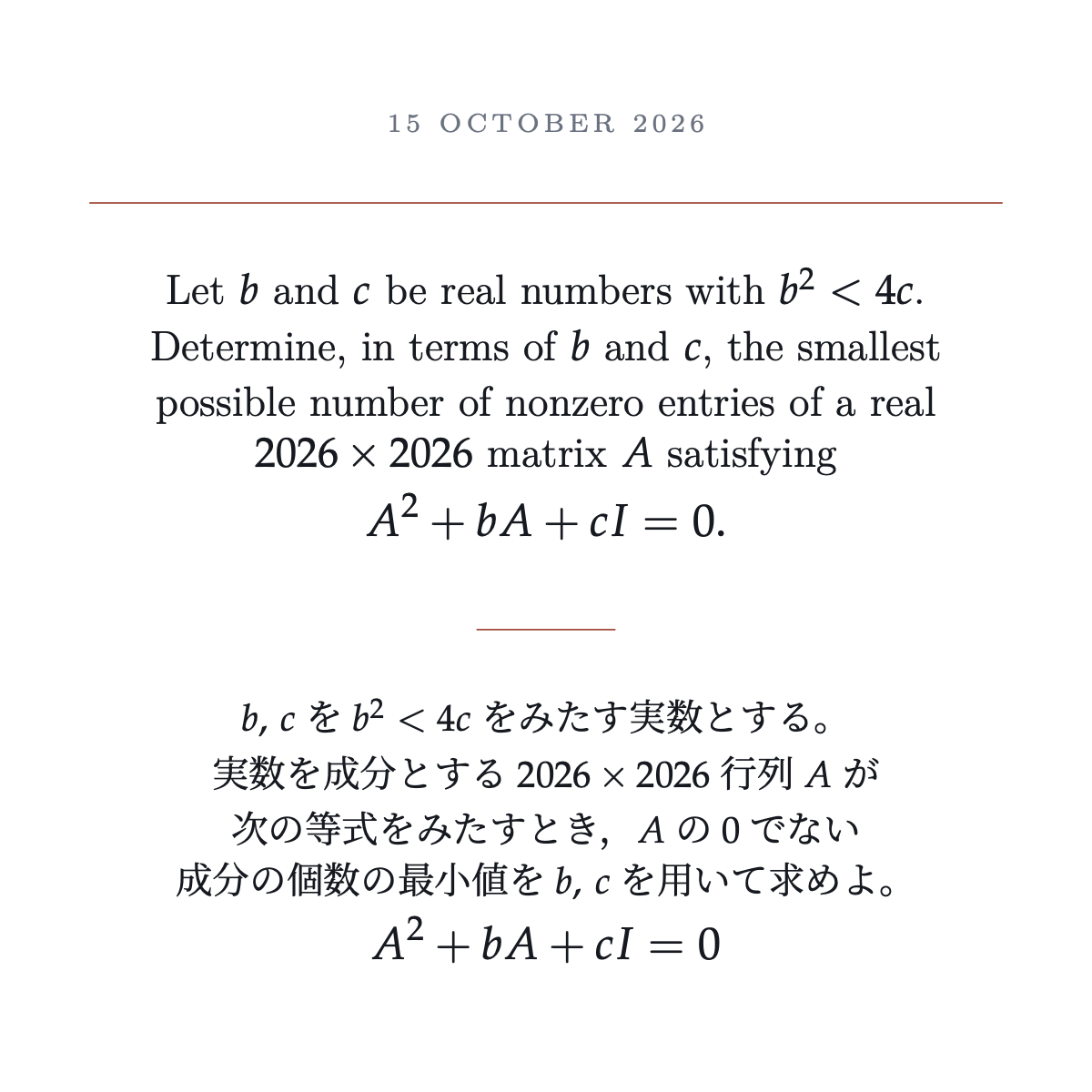
Let \(b\) and \(c\) be real numbers with \(b^2<4c\). Determine, in terms of \(b\) and \(c\), the smallest possible number of nonzero entries of a real \(2026\times2026\) matrix \(A\) satisfying
\[A^2+bA+cI=0.\]Show the solution
Let \(n=2026\) and \(p(x)=x^2+bx+c\). We show that the minimum is \(2026\) when \(b=0\) and \(3039=\tfrac32\cdot2026\) when \(b\neq0\); it does not depend on \(c\). Since \(b^2<4c\), the quadratic \(p\) has no real root, and \(c>b^2/4\ge0\).
Why the first idea is not enough. The sparsest invertible matrices are monomial (one nonzero entry in each row and column). If \(A\) is monomial, so is \(A^2\), while \(-bA-cI\) has nonzero entries both on the diagonal and at the off-diagonal positions of \(A\). For \(b\neq0\) these cannot match unless \(A\) is diagonal, and a diagonal \(A\) would have a real eigenvalue. So for \(b\neq0\) one needs more than \(n\) entries, and the question is how many more.
Step 1: every row is nonzero. From \(A(A+bI)=-cI\) with \(c\neq0\), \(A\) is invertible, so each row has at least one nonzero entry and \(A\) has at least \(n\) nonzero entries.
Step 2: the case \(b=0\). The block \(B=\begin{pmatrix}0&-c\\1&0\end{pmatrix}\) satisfies \(B^2=-cI\). The block-diagonal matrix with \(1013\) copies of \(B\) satisfies \(A^2+cI=0\) and has exactly \(2026\) nonzero entries, so the minimum is \(2026\).
Step 3: a lonely row forces its partner (\(b\neq0\)). Call row \(i\) lonely if it has exactly one nonzero entry, say \(a\) in column \(j\), so that \(e_i^{T}A=a\,e_j^{T}\). If \(j=i\), then \(e_i^{T}p(A)=p(a)\,e_i^{T}\neq0\), a contradiction; so \(j\neq i\). Row \(i\) of \(A^2\) is \(e_i^{T}A\cdot A=a\cdot(\text{row }j\text{ of }A)\), while row \(i\) of \(-bA-cI\) is \(-ab\,e_j^{T}-c\,e_i^{T}\). Hence \[\text{row }j\text{ of }A=-b\,e_j^{T}-\tfrac{c}{a}\,e_i^{T},\] which has exactly two nonzero entries because \(b\neq0\) and \(c\neq0\). Call \(j\) the partner of \(i\).
Step 4: counting. The partner map is injective: if two different lonely rows \(i,i'\) had the same partner \(j\), row \(j\) would contain nonzero entries in columns \(i\), \(i'\) and \(j\), three distinct columns, contrary to Step 3. Partners have exactly two entries, so they are not lonely. Let \(L\) be the number of lonely rows, \(T\) the number of rows with exactly two nonzero entries and \(R\) the number of the remaining rows, so \(L+T+R=n\) and \(L\le T\). The number of nonzero entries is at least \[L+2T+3R\ \ge\ \tfrac32(L+T)+\tfrac32R=\tfrac32n,\] where the first inequality uses \(T\ge L\). Thus at least \(3039\) entries are needed.
Step 5: the bound is attained. The companion block \(C=\begin{pmatrix}0&-c\\1&-b\end{pmatrix}\) has characteristic polynomial \(x^2+bx+c\), so \(p(C)=0\) by Cayley–Hamilton, and it has exactly three nonzero entries. The block-diagonal matrix with \(1013\) copies of \(C\) satisfies \(A^2+bA+cI=0\) with \(3\cdot1013=3039\) nonzero entries.
Check. The argument uses only that \(p\) has no root in the field, so we tested it over finite fields by exhaustive search: over \(\mathbb{F}_2\) with \(p=x^2+x+1\), all \(2^{16}\) matrices of size 4 give minimum \(6\) (and size 2 gives \(3\)); over \(\mathbb{F}_5\) with \(x^2+x+1\) the minimum for size 2 is \(3\), and the \(b=0\) analogues \(x^2+2\) over \(\mathbb{F}_5\) and \(x^2+1\) over \(\mathbb{F}_3\) give \(2\). The real block constructions were verified for several pairs \((b,c)\) at full size \(2026\), with residual exactly \(0\).