Daily Mathematics / Solutions
Solutions for 13 October 2026
Two cards went out that day: a hard definite integral and an original Putnam-style problem. Try each one first; the solutions are folded away below.
Integral
A one-minus-cosine integral against a hyperbolic sine
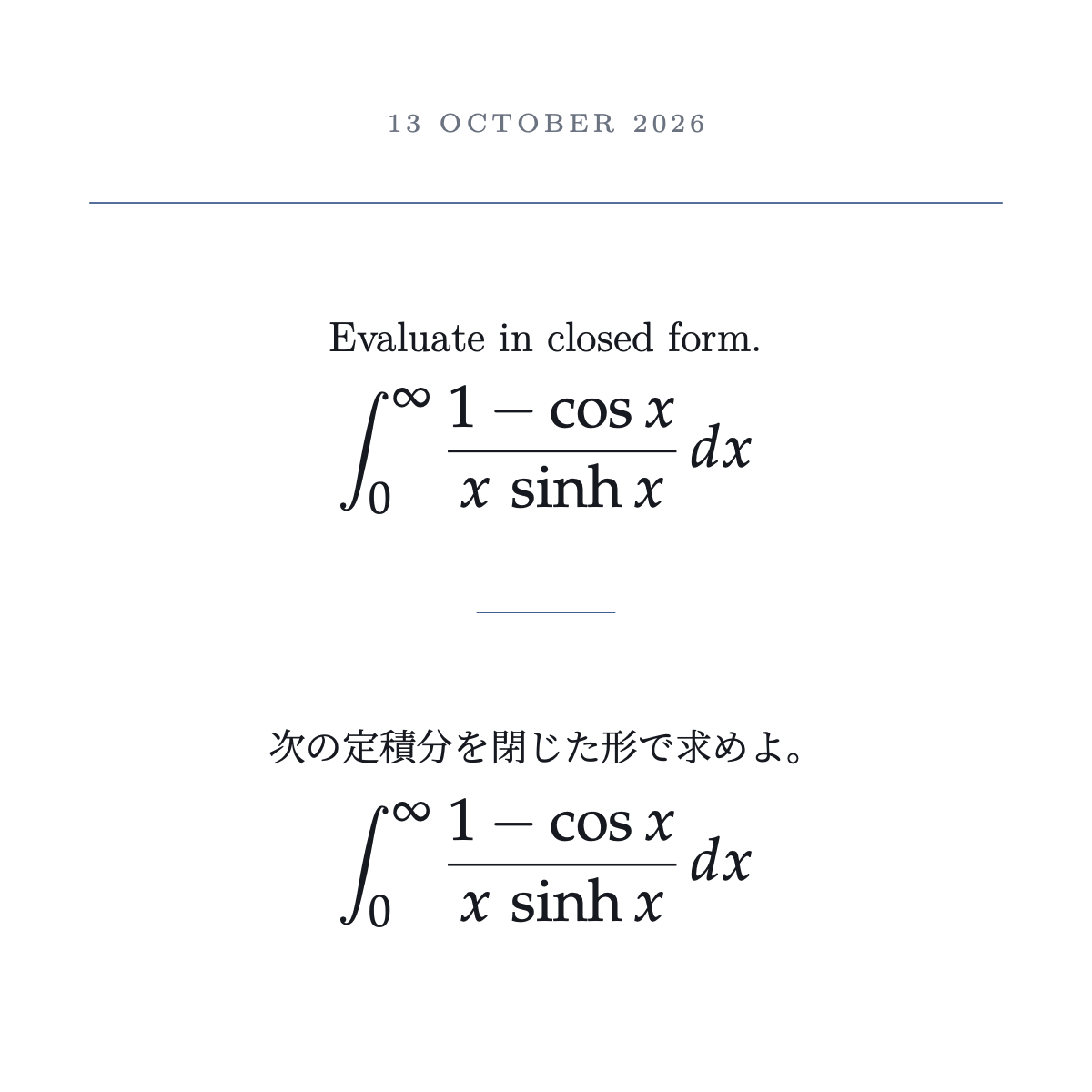
Evaluate in closed form.
\[\int_{0}^{\infty}\frac{1-\cos x}{x\,\sinh x}\,dx\]Show the solution
Write \(I\) for the integral. We show \(I=\ln\cosh\frac{\pi}{2}\).
Why the direct route stalls. The integrand is continuous on \((0,\infty)\), tends to \(\tfrac12\) as \(x\to0^{+}\) and is \(O(e^{-x}/x)\) at infinity, so \(I\) converges absolutely. The tempting move is to expand \(1-\cos x\) in powers of \(x\): the terms become \(\int_0^\infty x^{2m-1}/\sinh x\,dx\), which grow like \((2m-1)!\), and the resulting series in \(m\) diverges. The expansion that works is the one of \(1/\sinh x\), because it turns the hyperbolic factor into exponentials, and against \(e^{-cx}\) the factor \((1-\cos x)/x\) has an elementary Laplace transform.
Step 1: expand the hyperbolic factor. For \(x>0\), \[\frac{1}{\sinh x}=\frac{2e^{-x}}{1-e^{-2x}}=2\sum_{k\ge0}e^{-(2k+1)x}.\] Every term is nonnegative and so is \((1-\cos x)/x\), so by monotone convergence we may integrate term by term: \[I=2\sum_{k\ge0}F(2k+1),\qquad F(c)=\int_0^\infty\frac{1-\cos x}{x}\,e^{-cx}\,dx\quad(c>0).\]
Step 2: the Laplace transform \(F\). Since \(0\le(1-\cos x)/x\le\min(x/2,\,2/x)\), differentiation under the integral sign is justified on every half-line \(c\ge c_0>0\), and \[F'(c)=-\int_0^\infty(1-\cos x)e^{-cx}\,dx=-\Bigl(\frac1c-\frac{c}{c^{2}+1}\Bigr).\] By dominated convergence \(F(c)\to0\) as \(c\to\infty\). Hence \[F(c)=\int_c^\infty\Bigl(\frac1t-\frac{t}{t^{2}+1}\Bigr)dt=\Bigl[\ln t-\tfrac12\ln(t^{2}+1)\Bigr]_c^\infty=\tfrac12\ln\Bigl(1+\frac{1}{c^{2}}\Bigr).\]
Step 3: sum the logarithms. Steps 1 and 2 give \[I=\sum_{k\ge0}\ln\Bigl(1+\frac{1}{(2k+1)^{2}}\Bigr)=\ln\prod_{k\ge0}\Bigl(1+\frac{1}{(2k+1)^{2}}\Bigr),\] the product converging absolutely. The Weierstrass product of the cosine, \(\cos\frac{\pi z}{2}=\prod_{k\ge0}\bigl(1-\frac{z^{2}}{(2k+1)^{2}}\bigr)\), holds for all complex \(z\); at \(z=i\) it reads \(\cosh\frac{\pi}{2}=\prod_{k\ge0}\bigl(1+\frac{1}{(2k+1)^{2}}\bigr)\). Therefore \[I=\ln\cosh\frac{\pi}{2}=\ln\frac{e^{\pi/2}+e^{-\pi/2}}{2}\approx0.9199554002.\]
A second route. A rectangular contour of height \(\pi\) gives \(\int_0^\infty\frac{\sin ax}{\sinh x}\,dx=\frac{\pi}{2}\tanh\frac{\pi a}{2}\). Integrating in \(a\) from \(0\) to \(1\) and using \(\int_0^1\sin ax\,da=(1-\cos x)/x\) gives the same value, since \(\int_0^1\frac{\pi}{2}\tanh\frac{\pi a}{2}\,da=\ln\cosh\frac{\pi}{2}\).
Check. Composite Gauss-Legendre quadrature (100 nodes, 40 and 200 panels on \([0,80]\), with \(1-\cos x\) written as \(2\sin^{2}(x/2)\) to avoid cancellation near \(0\)) agrees with \(\ln\cosh\frac{\pi}{2}\) to within \(6\times10^{-16}\), and the partial sums of the series in Step 3 converge to the same value.
Competition problem
The determinant of a binary disjointness matrix
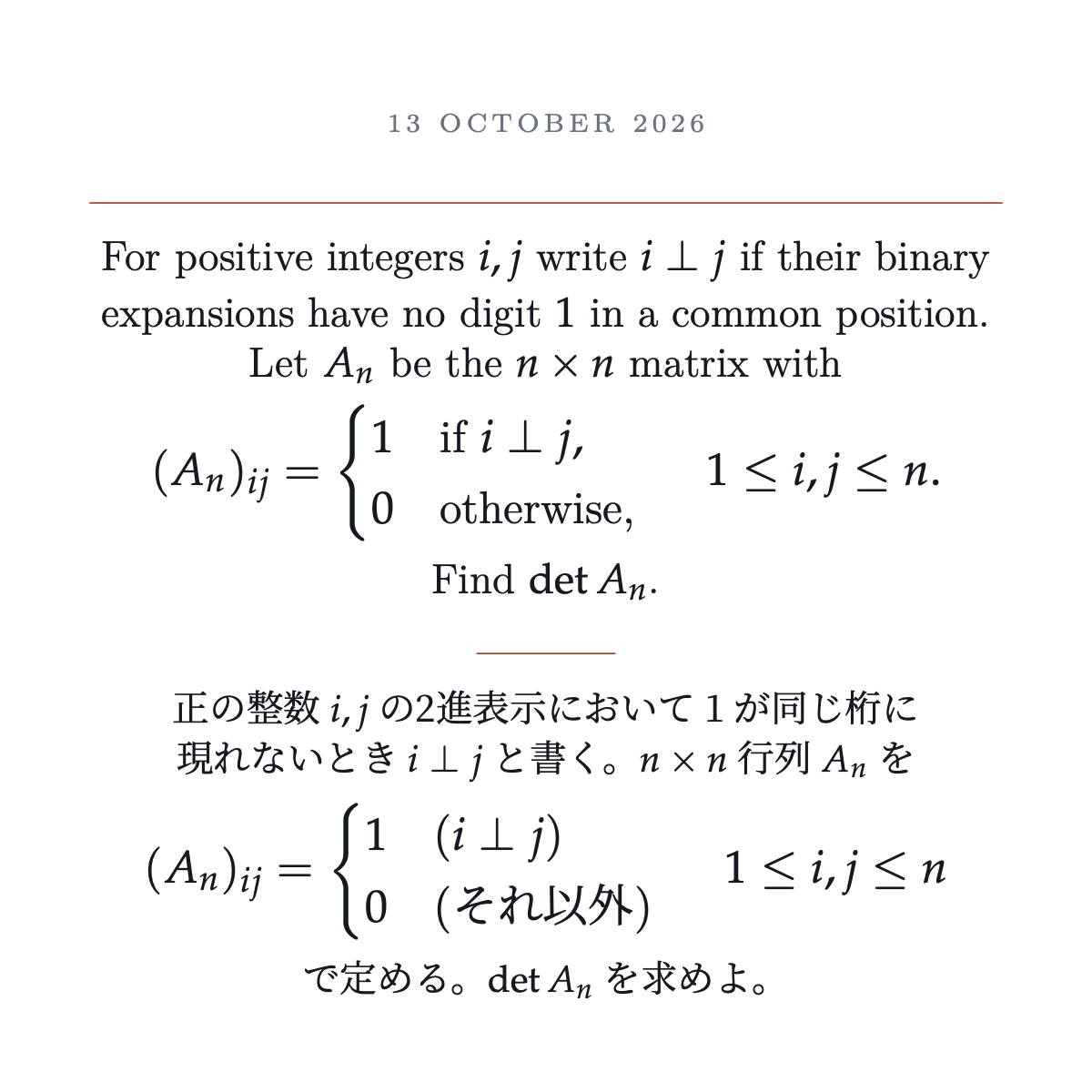
For positive integers \(i,j\) write \(i\perp j\) if their binary expansions have no digit \(1\) in a common position. Let \(A_n\) be the \(n\times n\) matrix with
\[(A_n)_{ij}=\begin{cases}1 & \text{if } i\perp j,\\ 0 & \text{otherwise,}\end{cases}\qquad 1\le i,j\le n.\]Find \(\det A_n\).
Show the solution
We show that \(\det A_n=0\) for odd \(n\) and \(\det A_n=(-1)^{n/2}\) for even \(n\); so the values for \(n=1,2,3,4,\dots\) run \(0,-1,0,1,0,-1,0,1,\dots\). Throughout, \(s(m)\) denotes the number of \(1\)s in the binary expansion of \(m\), and we also allow the index \(0\), which is \(\perp\) to everything.
Why the direct route stalls. Small cases suggest the answer quickly, and the odd case even has a one-line proof: an odd \(i\) is never \(\perp\) an odd \(j\), so the \((n+1)/2\) odd rows live in the \((n-1)/2\) even columns and are dependent. For even \(n\), however, row-reducing \(A_n\) directly gets tangled, because the condition \(i\perp j\) is a product over binary digits while the index set \(\{1,\dots,n\}\) is neither a power of \(2\) nor starts at \(0\). The fix is to put row and column \(0\) back, so that \(A_n\) becomes a cofactor of a leading block of a Kronecker power.
Step 1: Kronecker structure. Fix \(r\) with \(2^{r}>n\) and let \(B\) be the \(2^{r}\times2^{r}\) matrix with rows and columns indexed by \(0,1,\dots,2^{r}-1\) and \(B_{ij}=[\,i\perp j\,]\). Writing \(i=\sum_t i_t2^{t}\) and \(j=\sum_t j_t2^{t}\) with digits \(i_t,j_t\in\{0,1\}\), we have \([\,i\perp j\,]=\prod_t K_{i_tj_t}\) with \(K=\begin{pmatrix}1&1\\1&0\end{pmatrix}\) (rows and columns indexed by \(0,1\)). So \(B=K^{\otimes r}\) in the natural order of indices.
Step 2: an LU factorisation. \(K=L_0U_0\) with \(L_0=\begin{pmatrix}1&0\\1&1\end{pmatrix}\) and \(U_0=\begin{pmatrix}1&1\\0&-1\end{pmatrix}\), hence \(B=LU\) with \(L=L_0^{\otimes r}\), \(U=U_0^{\otimes r}\). Now \(L_{ij}=\prod_t(L_0)_{i_tj_t}\) is nonzero only if \(j_t\le i_t\) for every digit, which forces \(j\le i\), and \(L_{ii}=1\); likewise \(U_{ij}\neq0\) forces \(i\le j\), and \(U_{ii}=\prod_t(U_0)_{i_ti_t}=(-1)^{s(i)}\). So \(L\) is unit lower triangular and \(U\) is upper triangular.
Step 3: leading blocks. For \(m\le2^{r}\) let \(B_m,L_m,U_m\) be the leading \(m\times m\) blocks (indices \(0,\dots,m-1\)). Since \((LU)_{ij}=\sum_{k\le\min(i,j)}L_{ik}U_{kj}\), we get \(B_m=L_mU_m\). Therefore \(\det B_m=\prod_{i=0}^{m-1}(-1)^{s(i)}=\pm1\) and \(B_m^{-1}=U_m^{-1}L_m^{-1}\). The inverse of the leading block of a triangular matrix is the leading block of its inverse, and \(U^{-1}=(U_0^{-1})^{\otimes r}=U_0^{\otimes r}\) (as \(U_0^{2}=I\)), \(L^{-1}=(L_0^{-1})^{\otimes r}\) with \(L_0^{-1}=\begin{pmatrix}1&0\\-1&1\end{pmatrix}\).
Step 4: \(A_n\) as a cofactor. \(A_n\) is \(B_{n+1}\) with row \(0\) and column \(0\) deleted, so by the adjugate formula \(\det A_n=\det B_{n+1}\cdot(B_{n+1}^{-1})_{00}\). Using Step 3, \[(B_{n+1}^{-1})_{00}=\sum_{k=0}^{n}(U^{-1})_{0k}(L^{-1})_{k0}=\sum_{k=0}^{n}\prod_t(U_0)_{0\,k_t}\prod_t(L_0^{-1})_{k_t\,0}=\sum_{k=0}^{n}(-1)^{s(k)}.\]
Step 5: the Thue-Morse sum. Since \(s(2c+1)=s(2c)+1\), the terms for \(k=2c\) and \(k=2c+1\) cancel. If \(n\) is odd, \(\{0,\dots,n\}\) splits into such pairs, the sum is \(0\), and \(\det A_n=0\). If \(n\) is even, only \(k=n\) survives, so \(\det A_n=(-1)^{\sum_{i=0}^{n}s(i)}\cdot(-1)^{s(n)}=(-1)^{\sum_{i=0}^{n-1}s(i)}\). Grouping \(0,\dots,n-1\) into the \(n/2\) pairs \((2c,2c+1)\), each pair contributes \(s(2c)+s(2c+1)=2s(c)+1\), which is odd, so the exponent has the parity of \(n/2\) and \(\det A_n=(-1)^{n/2}\).
Check. Exact rational-arithmetic determinants of \(A_n\) agree with the formula for every \(n\) from \(1\) to \(96\); the factorisation \(B=LU\) and the cofactor identity of Step 4 were also checked numerically for \(2^{r}=32\) and every \(n\le30\).