Daily Mathematics / Solutions
Solutions for 12 October 2026
Two cards went out that day: a hard definite integral and an original Putnam-style problem. Try each one first; the solutions are folded away below.
Integral
A periodic logarithm against the Fejér weight sin²x/x²
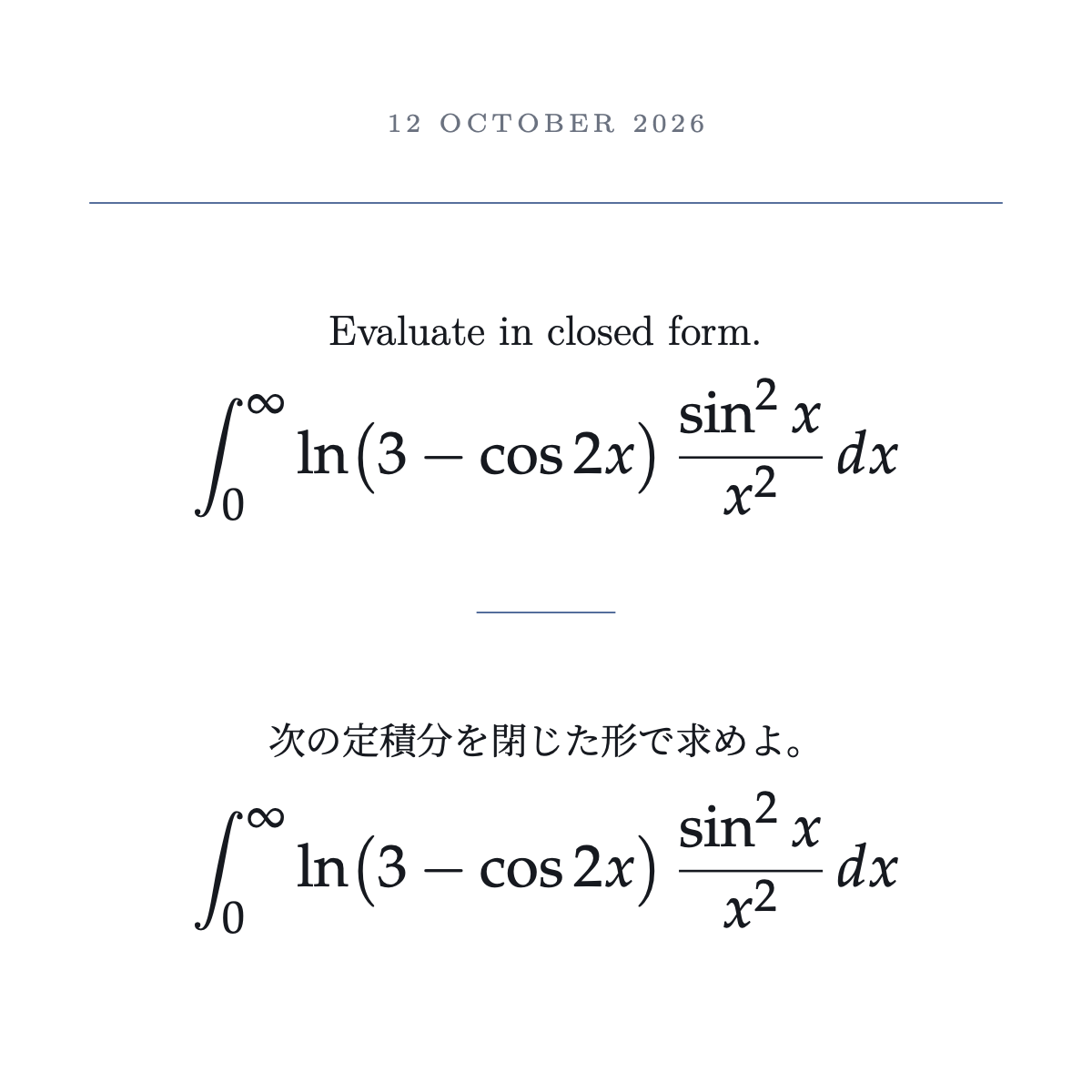
Evaluate in closed form.
\[\int_{0}^{\infty}\ln\bigl(3-\cos 2x\bigr)\,\frac{\sin^{2}x}{x^{2}}\,dx\]Show the solution
Write \(I\) for the integral and \(f(x)=\ln(3-\cos 2x)\). We show \(I=\pi\ln\bigl(1+\tfrac{1}{\sqrt2}\bigr)\).
Why the direct route stalls. The integral converges absolutely (the integrand is \(O(x^{-2})\) and bounded near \(0\)), but \(f\) has no useful antiderivative against \(x^{-2}\), and integrating by parts only trades \(\sin^2x/x^2\) for \(\sin 2x/x\) times something worse. The point is that \(f\) is periodic with period \(\pi\), and so is \(\sin^{2}x\): all the non-periodic behaviour sits in the single factor \(x^{-2}\), which can be summed over the period lattice.
Step 1: fold onto one period (Lobachevsky's device). The integrand is even, so \(I=\tfrac12\int_{-\infty}^{\infty}f(x)\sin^{2}x\,x^{-2}\,dx\). Cut the line into the intervals \([k\pi,(k+1)\pi]\), \(k\in\mathbb Z\), and shift each back to \([0,\pi]\) by \(x\mapsto x+k\pi\). Since \(f\) and \(\sin^{2}\) have period \(\pi\), \[I=\frac12\int_{0}^{\pi}f(x)\sin^{2}x\sum_{k\in\mathbb Z}\frac{1}{(x+k\pi)^{2}}\,dx,\] where the interchange of sum and integral is justified by monotone convergence after splitting \(f=f^{+}-f^{-}\) (each piece is nonnegative and bounded). The partial-fraction expansion of the cosecant square, \(\sum_{k\in\mathbb Z}(x+k\pi)^{-2}=\csc^{2}x\), cancels \(\sin^{2}x\) exactly, so \[I=\frac12\int_{0}^{\pi}f(x)\,dx=\int_{0}^{\pi/2}\ln(3-\cos 2x)\,dx,\] the last step because \(f(\pi-x)=f(x)\).
Step 2: a log of a quadratic form. Since \(\cos 2x=\cos^{2}x-\sin^{2}x\) and \(3=3\cos^{2}x+3\sin^{2}x\), we get \(3-\cos 2x=2\cos^{2}x+4\sin^{2}x=2(\cos^{2}x+2\sin^{2}x)\). Hence \[I=\frac{\pi}{2}\ln 2+J(1,\sqrt2),\qquad J(a,b)=\int_{0}^{\pi/2}\ln\bigl(a^{2}\cos^{2}x+b^{2}\sin^{2}x\bigr)\,dx\quad(a,b>0).\]
Step 3: evaluate \(J\) by differentiating in a parameter. Fix \(a\) and differentiate in \(b\): \[\frac{\partial J}{\partial b}=\int_{0}^{\pi/2}\frac{2b\sin^{2}x}{a^{2}\cos^{2}x+b^{2}\sin^{2}x}\,dx=\int_{0}^{\infty}\frac{2b\,t^{2}}{(a^{2}+b^{2}t^{2})(1+t^{2})}\,dt\] with \(t=\tan x\). Partial fractions give \(\frac{2b}{b^{2}-a^{2}}\int_{0}^{\infty}\bigl(\frac{1}{1+t^{2}}-\frac{a^{2}}{a^{2}+b^{2}t^{2}}\bigr)dt=\frac{2b}{b^{2}-a^{2}}\bigl(\frac{\pi}{2}-\frac{a\pi}{2b}\bigr)=\frac{\pi}{a+b}\) (for \(b\neq a\), and by continuity at \(b=a\)). At \(b=a\) the integrand is constant: \(J(a,a)=\pi\ln a\). Integrating from \(a\) to \(b\), \[J(a,b)=\pi\ln a+\pi\ln\frac{a+b}{2a}=\pi\ln\frac{a+b}{2}.\]
Step 4: assemble. With \(a=1,\ b=\sqrt2\), \[I=\frac{\pi}{2}\ln 2+\pi\ln\frac{1+\sqrt2}{2}=\pi\ln\frac{1+\sqrt2}{\sqrt2}=\pi\ln\Bigl(1+\frac{1}{\sqrt2}\Bigr).\]
Check. The integral was computed independently of Step 1: composite Gauss-Legendre (60 nodes, 4000 panels) on \([0,1000\pi]\), plus the tail beyond \(1000\pi\) summed period by period with the trigamma function. The result \(1.6801237408968885\) agrees with \(\pi\ln(1+1/\sqrt2)=1.6801237408968794\) to \(10^{-14}\); the reduced integral \(\int_0^{\pi/2}\ln(3-\cos 2x)\,dx\) agrees to \(10^{-15}\).
Competition problem
Three terms in the expansion of an integral of an n-norm
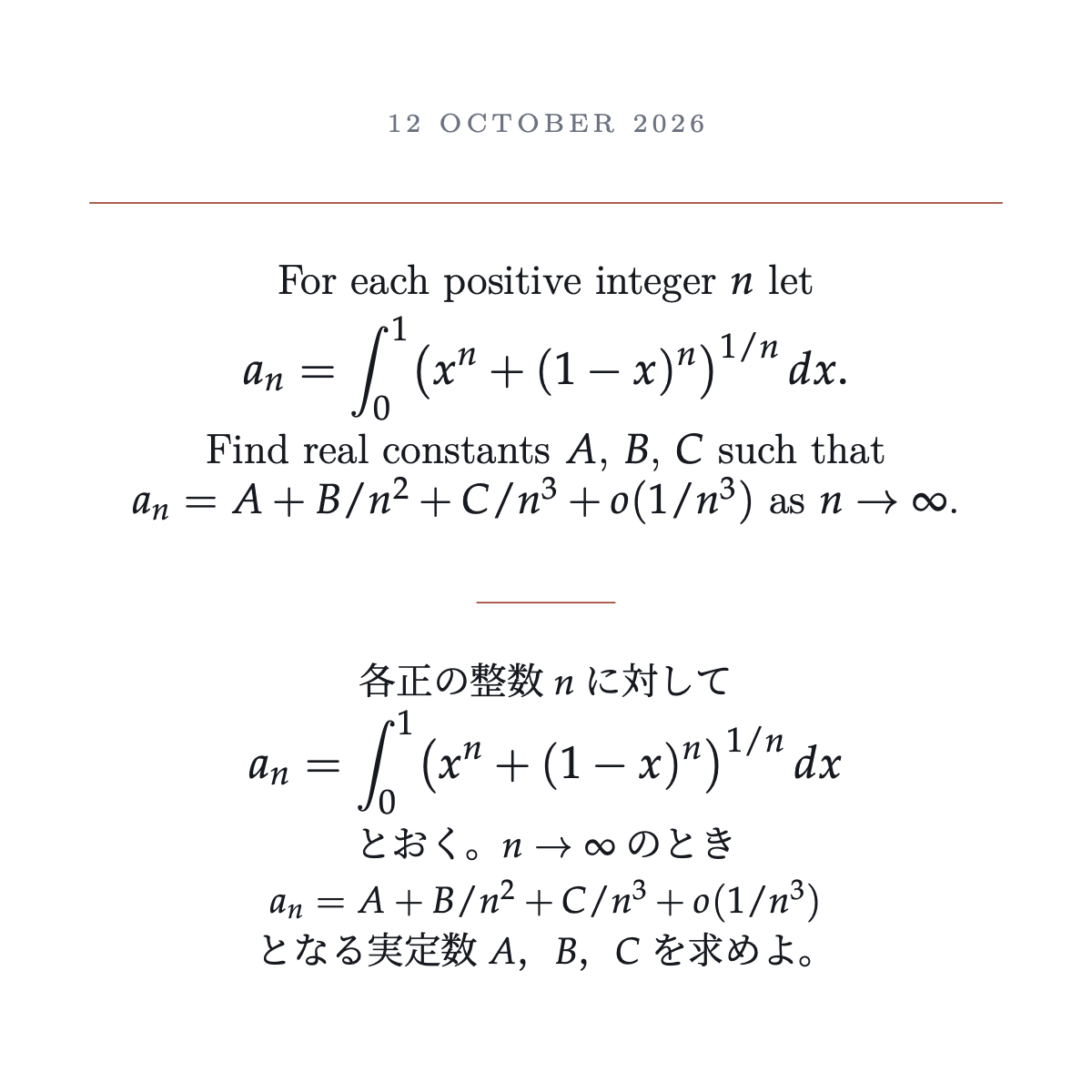
For each positive integer \(n\) let
\[a_n=\int_0^1\bigl(x^n+(1-x)^n\bigr)^{1/n}\,dx.\]Find real constants \(A\), \(B\), \(C\) such that \(a_n=A+B/n^2+C/n^3+o(1/n^3)\) as \(n\to\infty\).
Show the solution
We show \(A=\tfrac34\), \(B=\tfrac{\pi^{2}}{48}\), \(C=\tfrac{\zeta(3)}{8}\); in fact the error is \(O(n^{-4})\).
Why the obvious route stalls. The integrand tends to \(\max(x,1-x)\), which gives \(A=\tfrac34\) at once, and a Laplace-type localisation near the kink \(x=\tfrac12\) recovers the \(n^{-2}\) term. But at order \(n^{-3}\) that localisation has to track simultaneously the curvature of \(\ln\frac{1-x}{x}\), the slow variation of \(\max(x,1-x)\) and the next term of \((1+y)^{1/n}\), all with error bounds. A change of variables that makes \(n\) appear only through the exponent \(1/n\) removes all of this.
Step 1: a rational weight. The integrand is symmetric under \(x\mapsto1-x\), so \(a_n=2\int_{0}^{1/2}(x^n+(1-x)^n)^{1/n}dx\). Put \(t=x/(1-x)\in[0,1]\): then \(x=\frac{t}{1+t}\), \(1-x=\frac{1}{1+t}\), \(dx=\frac{dt}{(1+t)^{2}}\), and \((x^n+(1-x)^n)^{1/n}=\frac{(1+t^n)^{1/n}}{1+t}\). Hence \[a_n=2\int_{0}^{1}\frac{(1+t^n)^{1/n}}{(1+t)^{3}}\,dt.\] Since \(2\int_0^1(1+t)^{-3}dt=1-\tfrac14=\tfrac34\), we get \(A=\tfrac34\) and \(a_n-\tfrac34=2\int_0^1\frac{(1+t^n)^{1/n}-1}{(1+t)^{3}}dt\).
Step 2: push \(n\) into exponents. Substitute \(s=t^{n}\), so \(dt=\frac{1}{n}s^{1/n-1}ds\), and write \(\varepsilon=1/n\), \(L=\ln(1+s)\in[0,\ln2]\), \(v=\ln s\le0\). With \(h(y)=\frac{e^{y}}{(1+e^{y})^{3}}\) this becomes \[a_n-\tfrac34=2\varepsilon\int_{0}^{1}\bigl(e^{\varepsilon L}-1\bigr)\,h(\varepsilon v)\,\frac{ds}{s}.\]
Step 3: uniform expansions. On \(y\le0\) the function \(h\) and all its derivatives are bounded (each is \(e^{y}\) times a polynomial in \((1+e^{y})^{-1}\) and \(e^y\)). Also \(h(0)=\tfrac18\) and \(h'(0)=\tfrac18-\tfrac3{16}=-\tfrac1{16}\). By Taylor's theorem, \(h(\varepsilon v)=\tfrac18-\tfrac{\varepsilon v}{16}+O(\varepsilon^{2}v^{2})\) uniformly, and since \(\varepsilon L\le\ln2\), \(e^{\varepsilon L}-1=\varepsilon L+\tfrac12\varepsilon^{2}L^{2}+O(\varepsilon^{3}L^{3})\). Multiplying, \[\bigl(e^{\varepsilon L}-1\bigr)h(\varepsilon v)=\frac{\varepsilon L}{8}+\varepsilon^{2}\Bigl(\frac{L^{2}}{16}-\frac{Lv}{16}\Bigr)+E,\qquad |E|\le K\varepsilon^{3}\bigl(L^{3}+L^{2}|v|+Lv^{2}\bigr).\] Because \(L\le s\), the error satisfies \(\int_0^1|E|\,\frac{ds}{s}\le K\varepsilon^{3}\int_0^1(1+|\ln s|+\ln^{2}s)\,ds=O(\varepsilon^{3})\). This is the only delicate point: \(v=\ln s\) is unbounded, and it is the factor \(L/s\le1\) that keeps the remainder integrable.
Step 4: three polylogarithmic constants. From \(\ln(1+s)=\sum_{k\ge1}(-1)^{k+1}s^{k}/k\) and \(\int_0^1s^{k-1}\ln s\,ds=-1/k^{2}\): \[\int_0^1\frac{L}{s}\,ds=\sum_{k\ge1}\frac{(-1)^{k+1}}{k^{2}}=\frac{\pi^{2}}{12},\qquad \int_0^1\frac{L\ln s}{s}\,ds=-\sum_{k\ge1}\frac{(-1)^{k+1}}{k^{3}}=-\frac34\zeta(3).\] For the last one, integrate by parts (the boundary terms vanish): \(\int_0^1\frac{\ln^{2}(1+s)}{s}ds=-2\int_0^1\frac{\ln s\,\ln(1+s)}{1+s}ds\). Expanding \(\frac{\ln(1+s)}{1+s}=\sum_{k\ge1}(-1)^{k+1}H_k s^{k}\) and integrating termwise gives \(2\sum_{k\ge1}(-1)^{k+1}\frac{H_k}{(k+1)^{2}}\), and this alternating Euler sum equals \(\frac{\zeta(3)}{8}\), so \(\int_0^1\frac{\ln^{2}(1+s)}{s}ds=\frac{\zeta(3)}{4}\).
Step 5: assemble. \[a_n-\frac34=2\varepsilon\Bigl[\frac{\varepsilon}{8}\cdot\frac{\pi^{2}}{12}+\frac{\varepsilon^{2}}{16}\Bigl(\frac{\zeta(3)}{4}+\frac{3\zeta(3)}{4}\Bigr)\Bigr]+O(\varepsilon^{4})=\frac{\pi^{2}}{48n^{2}}+\frac{\zeta(3)}{8n^{3}}+O\Bigl(\frac{1}{n^{4}}\Bigr).\]
Check. The original integral and the transformed one were computed by composite Gauss-Legendre quadrature and agree to \(10^{-16}\) for \(n=5,20\). The quantity \(n^{3}\bigl(a_n-\tfrac34-\tfrac{\pi^{2}}{48n^{2}}\bigr)\) equals \(0.149218,\ 0.149744,\ 0.150002,\ 0.150130,\ 0.150194\) for \(n=100,200,400,800,1600\); the gap to \(\zeta(3)/8=0.1502571\) halves each time, as an \(O(1/n)\) error should, and Richardson extrapolation of the last two values gives \(0.1502573\).