Daily Mathematics / Solutions
Solutions for 8 October 2026
Two cards went out that day: a hard definite integral and an original Putnam-style problem. Try each one first; the solutions are folded away below.
Integral
A double integral with an arccos of a square root
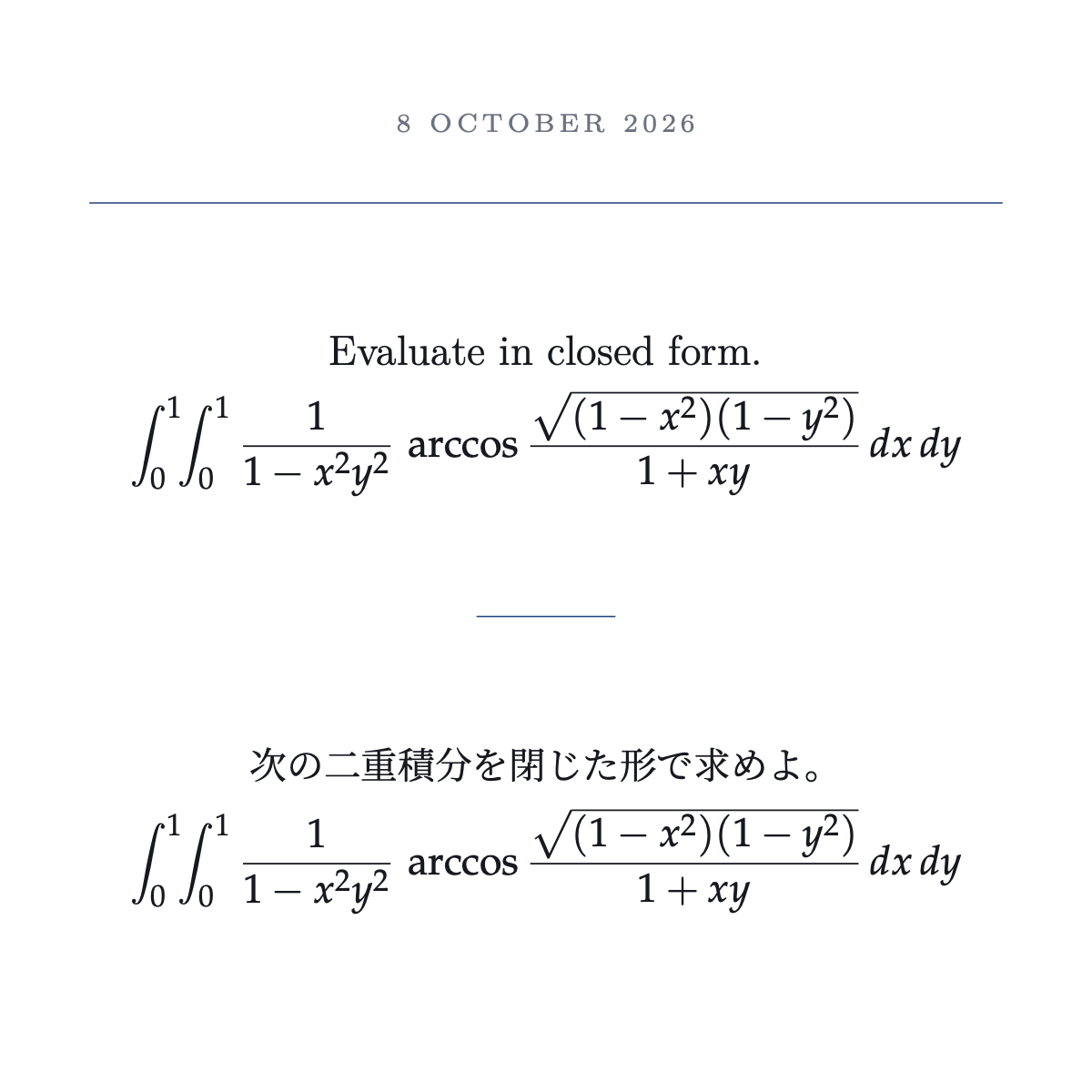
Evaluate in closed form.
\[\int_{0}^{1}\!\!\int_{0}^{1}\frac{1}{1-x^{2}y^{2}}\,\arccos\frac{\sqrt{(1-x^{2})(1-y^{2})}}{1+xy}\,dx\,dy\]Show the solution
We show that the integral equals \(\pi^{3}/24\).
Why the direct route stalls. Integrating in \(y\) with \(x\) fixed gives nothing elementary: the arccos of an algebraic function is divided by \(1-x^{2}y^{2}\), and the integrand blows up logarithmically at the corner \((1,1)\). The integrand has to be recognised as a function of a single combined variable before anything can be integrated.
Step 1: name the angle. For \(0\le x,y<1\) put \(t=\frac{x+y}{1+xy}\in[0,1)\). A direct expansion gives
\[1-t^{2}=\frac{(1+xy)^{2}-(x+y)^{2}}{(1+xy)^{2}}=\frac{(1-x^{2})(1-y^{2})}{(1+xy)^{2}},\]so the argument of the arccos is \(\sqrt{1-t^{2}}\in(0,1]\), and therefore \(\arccos\sqrt{1-t^{2}}=\arcsin t\). The integral is
\[I=\int_{0}^{1}\!\!\int_{0}^{1}\frac{1}{1-x^{2}y^{2}}\arcsin\frac{x+y}{1+xy}\,dx\,dy .\]Step 2: the hyperbolic addition formula. The fraction \(\frac{x+y}{1+xy}\) is the addition formula for \(\tanh\). Put \(x=\tanh a\), \(y=\tanh b\) with \(a,b\in[0,\infty)\). Then \(\frac{x+y}{1+xy}=\tanh(a+b)\), \(dx=\operatorname{sech}^{2}a\,da\), \(dy=\operatorname{sech}^{2}b\,db\), and
\[1-x^{2}y^{2}=\frac{\cosh^{2}a\cosh^{2}b-\sinh^{2}a\sinh^{2}b}{\cosh^{2}a\cosh^{2}b}=\frac{\cosh(a+b)\cosh(a-b)}{\cosh^{2}a\cosh^{2}b},\]using the identity \(\cosh(a+b)\cosh(a-b)=\cosh^{2}a\cosh^{2}b-\sinh^{2}a\sinh^{2}b\). Hence
\[\frac{dx\,dy}{1-x^{2}y^{2}}=\frac{da\,db}{\cosh(a+b)\cosh(a-b)}.\]Let \(g(s)=\arcsin(\tanh s)\), the Gudermannian function. Since \(\frac{d}{ds}\arcsin(\tanh s)=\frac{\operatorname{sech}^{2}s}{\sqrt{1-\tanh^{2}s}}=\operatorname{sech}s\), we have \(g(0)=0\), \(g'(s)=\operatorname{sech}s\), \(g(s)\to\pi/2\) as \(s\to\infty\), and \(g(s)=\int_{0}^{s}\operatorname{sech}u\,du\). So
\[I=\int_{0}^{\infty}\!\!\int_{0}^{\infty}\frac{g(a+b)}{\cosh(a+b)\cosh(a-b)}\,da\,db .\]Step 3: sum and difference coordinates. Put \(s=a+b\), \(d=a-b\), so \(da\,db=\tfrac12\,ds\,dd\) and the quadrant \(a,b\ge0\) becomes \(|d|\le s\). The inner integral is \(\int_{-s}^{s}\operatorname{sech}d\,dd=2g(s)\). Therefore
\[I=\int_{0}^{\infty}\frac{g(s)}{\cosh s}\cdot\frac12\cdot2g(s)\,ds=\int_{0}^{\infty}g(s)^{2}\,g'(s)\,ds=\Bigl[\tfrac13g(s)^{3}\Bigr]_{0}^{\infty}=\frac13\Bigl(\frac{\pi}{2}\Bigr)^{3}=\frac{\pi^{3}}{24}.\]Every integrand is nonnegative, so Tonelli's theorem justifies each change of variables and the order of integration, including the logarithmic singularity at the corner.
Remark. The same computation proves, for any reasonable \(F\), the identity \(\int_0^1\!\int_0^1\frac{F\left(\frac{x+y}{1+xy}\right)}{1-x^2y^2}\,dx\,dy=\int_0^{\pi/2}\theta\,F(\sin\theta)\,d\theta\). Equivalently, Calabi's substitution \(x=\frac{\sin u}{\cos v}\), \(y=\frac{\sin v}{\cos u}\) maps the triangle \(u,v\ge0\), \(u+v\le\pi/2\) onto the unit square with Jacobian \(1-x^2y^2\), and turns the arccos into exactly \(u+v\).
Check. A two-dimensional Gauss-Legendre rule (40 to 80 nodes per panel, with panels graded geometrically towards the corner \((1,1)\)) gives \(1.2919281950124926\), agreeing with \(\pi^{3}/24=1.2919281950124923\ldots\) to \(4\times10^{-16}\).
Competition problem
A Pólya urn and the ratio two to one
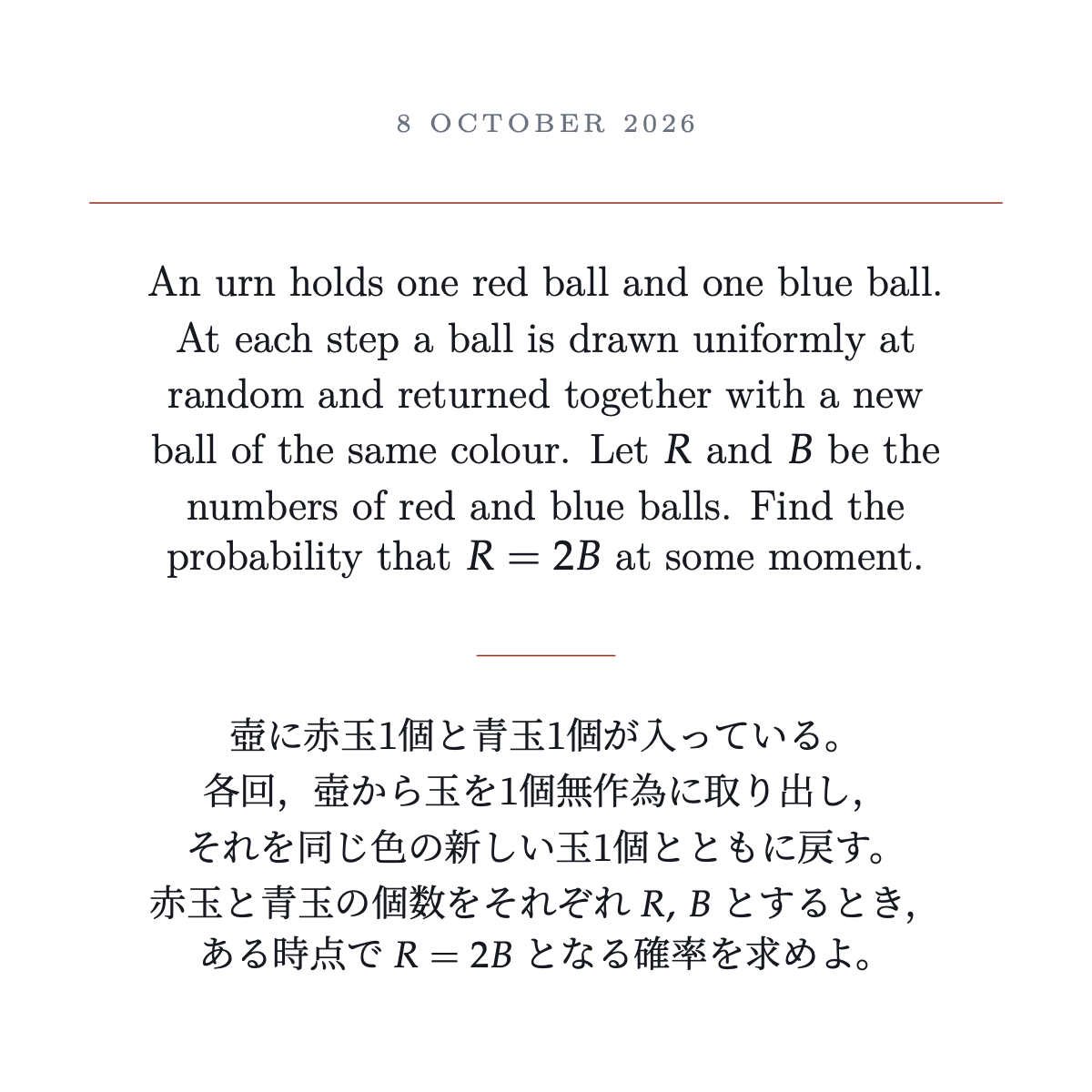
An urn holds one red ball and one blue ball. At each step a ball is drawn uniformly at random and returned together with a new ball of the same colour. Let \(R\) and \(B\) be the numbers of red and blue balls. Find the probability that \(R=2B\) at some moment.
Show the solution
We show that the probability is \(\dfrac{\pi}{3\sqrt3}\approx0.6046\).
Why the direct route stalls. The obvious approach is a recursion on states: if \(f(r,b)\) is the probability of eventually reaching \(R=2B\) from \(R=r\), \(B=b\), then \(f(r,b)=\frac{r}{r+b}f(r+1,b)+\frac{b}{r+b}f(r,b+1)\). But the lattice is infinite, there is no boundary condition at infinity, and summing first-passage probabilities over the targets \((2m,m)\) gives an unwieldy series. The urn has to be replaced by a simpler random object first.
Step 1: the urn is a coin with a random bias. Fix a sequence of \(n\) draws containing \(r\) reds and \(b\) blues, \(r+b=n\). Before the \(k\)-th draw the urn holds \(k+1\) balls, so the denominators of the successive probabilities are \(2,3,\dots,n+1\). The \(i\)-th red draw happens when there are \(i\) red balls, and the \(j\)-th blue draw when there are \(j\) blue balls, whatever the order. Hence the sequence has probability
\[\frac{r!\,b!}{(n+1)!}=\int_{0}^{1}p^{r}(1-p)^{b}\,dp,\]the second equality being Euler's Beta integral. So, for every \(n\), the first \(n\) draws have the same law as in the following experiment: choose \(p\) uniformly in \([0,1]\), then draw independently, red with probability \(p\). The event \(E\) that \(R=2B\) at some moment is the increasing union of the events \(E_n\) that this happens within the first \(n\) draws, each of which depends only on those draws. By monotone convergence,
\[\Pr(E)=\lim_{n\to\infty}\int_{0}^{1}\Pr\nolimits_{p}(E_n)\,dp=\int_{0}^{1}h(p)\,dp,\qquad h(p)=\Pr\nolimits_{p}(E).\]Step 2: a walk that climbs one step at a time. After the draws, \(R=1+\#\text{red}\) and \(B=1+\#\text{blue}\). Let \(W=\#\text{red}-2\,\#\text{blue}=R-2B+1\). Then \(W\) starts at \(0\) (where \(R\ne2B\)) and moves by \(+1\) with probability \(p\) and by \(-2\) with probability \(1-p\), and \(R=2B\) exactly when \(W=1\). Because \(W\) goes up only one unit at a time, \(E\) is the event that \(W\) ever reaches level \(1\), and by the strong Markov property the probability of ever climbing \(k\) levels above the current position is \(h^{k}\).
Step 3: the climbing probability. The mean step is \(3p-2\). If \(p>2/3\), the strong law of large numbers gives \(W\to+\infty\), so \(h(p)=1\). If \(p<2/3\), then \(W\to-\infty\) almost surely, so \(\sup W\) is finite and \(h^{k}=\Pr_p(\sup W\ge k)\to0\), which forces \(h<1\). Conditioning on the first draw (after a blue draw the walk must climb three levels),
\[h=p+(1-p)h^{3},\qquad\text{i.e.}\qquad (h-1)\bigl((1-p)h^{2}+(1-p)h-p\bigr)=0 .\]Since \(h\ne1\), \(h\) is the nonnegative root of the quadratic. Its discriminant is \((1-p)^{2}+4p(1-p)=(1-p)(1+3p)\), so
\[h(p)=\frac12\left(\sqrt{\frac{1+3p}{1-p}}-1\right)\qquad(0\le p<2/3).\](This root is less than \(1\) exactly when \(p<2/3\), as it must be. The single value \(p=2/3\) has measure zero.)
Step 4: average over \(p\).
\[\Pr(E)=\int_{0}^{2/3}h(p)\,dp+\frac13=\frac12\int_{0}^{2/3}\sqrt{\frac{1+3p}{1-p}}\,dp-\frac13+\frac13=\frac{J}{2}.\]Put \(q=1-p\), so \(J=\int_{1/3}^{1}\sqrt{\frac{4-3q}{q}}\,dq\), and then \(q=\frac43\sin^{2}\theta\). Then \(\sqrt{(4-3q)/q}=\sqrt3\cot\theta\), \(dq=\frac83\sin\theta\cos\theta\,d\theta\), and \(\theta\) runs from \(\pi/6\) to \(\pi/3\):
\[J=\frac{8}{\sqrt3}\int_{\pi/6}^{\pi/3}\cos^{2}\theta\,d\theta=\frac{8}{\sqrt3}\Bigl[\frac{\theta}{2}+\frac{\sin2\theta}{4}\Bigr]_{\pi/6}^{\pi/3}=\frac{8}{\sqrt3}\cdot\frac{\pi}{12}=\frac{2\pi}{3\sqrt3},\]because \(\sin\frac{2\pi}{3}=\sin\frac{\pi}{3}\). Hence \(\Pr(E)=\dfrac{\pi}{3\sqrt3}=\dfrac{\pi\sqrt3}{9}\).
Check. An exact rational dynamic program on the urn itself agrees exactly with the Beta-mixture computation for every horizon up to 30 draws. A floating-point dynamic program on the urn up to 64000 draws gives hitting probabilities whose gap to the limit shrinks like \(1/n\), and Richardson extrapolation of the values at 16000 and 64000 draws gives \(0.6045997874\), within \(7\times10^{-10}\) of \(\pi/(3\sqrt3)=0.6045997880\ldots\)