The short answer
- Mood: the most reliable effect, and it is acute. Single immersions consistently lift positive affect and lower tension, fatigue and confusion for minutes to hours. Whether daily practice changes baseline mood is much less certain: the largest trial found a small quality-of-life gain at 30 days that had faded by 90.
- Anxiety: a two-phase stimulus. The first 30 to 90 seconds are anxiogenic by design: a gasp, hyperventilation, tachycardia. The calm comes afterwards: a delayed drop in stress at about 12 hours, lower worry scores in an uncontrolled study, and vagal slowing when the cold is applied to the face or neck.
- Attention: people feel it more than tests show it. Participants report feeling alert and attentive, and brain imaging shows attention networks coupling more tightly. Objective data are thin, and during longer or colder exposures attention and executive function are reliably worse.
- Dose: the useful range is short. In the only large shower trial, 30, 60 and 90 seconds gave the same result. What drives the catecholamine surge is how fast the skin cools, not how long you stay in.
| Outcome | Acute (minutes to hours) | Repeated practice (weeks) | Confidence |
|---|---|---|---|
| Mood and affect | A consistent lift across a lab bath, the sea and winter swimmers3,4,9 | Small SF-36 mental gain at 30 days, gone by 90;5 a pooled mood RCT was null2 | Moderate acute; low chronic |
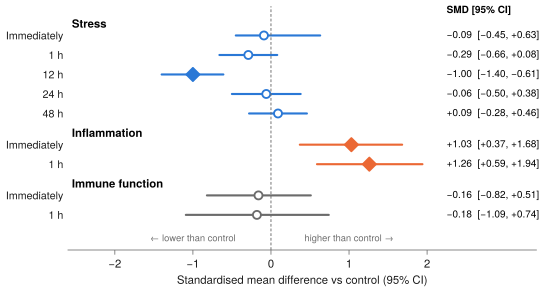
| Anxiety and stress | Cold shock is anxiogenic; stress SMD −1.00 at 12 hours only2 | Worry fell after the first session and stayed down, with no control arm;7 trial anxiety not significant5 | Low |
| Attention | Subjective alertness up; attention-network coupling up3 | Trail Making faster, Stroop unchanged, practice not excluded7 | Low; impaired during cooling8 |
| Energy | The most-reported benefit in the shower trial, by self-report5 | Not measured separately | Low to moderate |
| Sleep | Not measured acutely | Better sleep quality in one small RCT;2 PSQI 7.85 to 5.75, uncontrolled7 | Low |
Section oneWhat the stimulus actually is
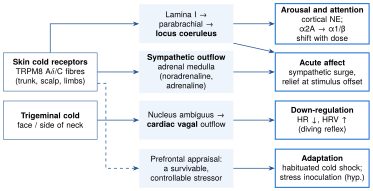
A cold shower is a short, intense thermal input across a large area of skin. Cutaneous cold receptors, the TRPM8-expressing Aδ and C fibres that respond most strongly between about 25 and 10 °C, fire hard at the moment of contact and then adapt. The body's early response is set by how fast skin temperature changes, not by how cold the core becomes. That is why a brief exposure can have large autonomic effects with no meaningful cooling of the core.
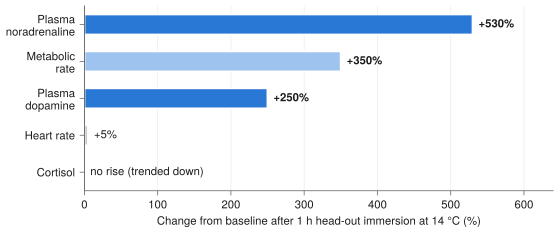
The best physiological dose–response data come from Šrámek and colleagues,1 who immersed young men to the neck for an hour at 32, 20 and 14 °C. At 20 °C, metabolic rate rose by 93% but the catecholamines barely moved. At 14 °C the picture changed completely: plasma noradrenaline rose 5.3-fold and dopamine 2.5-fold, while cortisol did not rise at all. The cold response is sympathetic, not an HPA-axis stress response: an arousal signal without the glucocorticoid signal that usually travels with it.
Reading the famous numbers correctly
The widely quoted "250% dopamine" comes from a one-hour immersion at 14 °C, and it measured plasma dopamine, not brain dopamine. A one-minute shower is a far smaller dose. Plasma dopamine does not cross the blood–brain barrier in meaningful amounts, and I could find no study showing the sustained mesolimbic dopamine lift that circulates online. The noradrenaline signal is the more relevant one centrally, because the same afferent volley that drives sympathetic outflow also drives the locus coeruleus.
Section twoFour pathways from skin to state
Noradrenergic arousal through the locus coeruleus
Cold afferents project through spinal lamina I to the lateral parabrachial nucleus, which drives both thermoregulatory sympathetic outflow and the locus coeruleus. A sudden volley from a large area of skin therefore produces a burst of cortical noradrenaline. Shevchuk's 2008 depression hypothesis rests on exactly this: because cold receptors are so dense in the skin, a cold shower sends an overwhelming volume of impulses to the brain.10
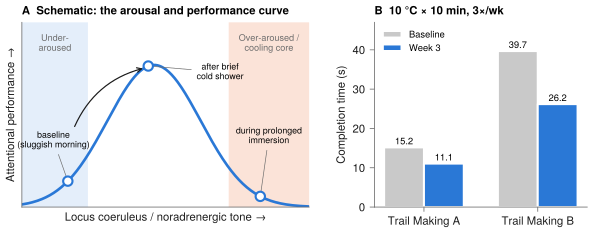
Prefrontal noradrenaline follows an inverted U. Moderate release acts through high-affinity α2A receptors on pyramidal-cell spines, strengthening delay-period firing and focus. Heavy release recruits the lower-affinity α1 and β receptors, which degrade prefrontal working memory and hand control to posterior and subcortical circuits. I find this dose dependence the single most useful lens for the attention data further down.
Vagal braking through the diving reflex
Cold on the face and the side of the neck activates trigeminal afferents that drive cardiac vagal outflow, producing bradycardia and higher heart-rate variability. In a randomised within-participant trial of 61 people, brief cold on the lateral neck lowered heart rate and raised RMSSD most strongly, more than the cheek and more than a forearm control.11 Face cold and trunk cold therefore pull the autonomic system in opposite directions, which turns out to matter a great deal for anxiety.
Hormetic inflammation
The pooled data show that cold immersion acutely raises inflammatory markers: a standardised difference of +1.03 immediately and +1.26 at one hour.2 That is a classic hormetic signature, and it sits awkwardly beside the chronic anti-inflammatory claims. In Kox and colleagues' endotoxin study,12 people trained in meditation, cold exposure and cyclic hyperventilation showed higher adrenaline, earlier and higher IL-10, lower TNF-α, IL-6 and IL-8, and fewer flu-like symptoms. The adrenaline surge came mainly from the breathing, though, so cold is not isolated as the cause. Given the links between inflammation and depression the route is plausible, but no human mood data connect the two.
Habituation and control
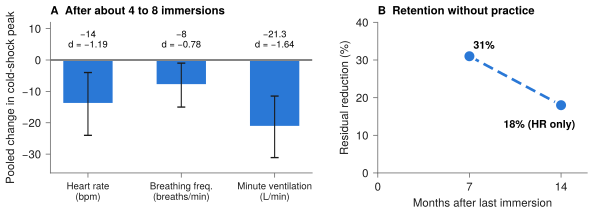
The cold-shock response habituates quickly. A 2024 meta-analysis of 13 papers found that after roughly four to eight immersions, the peak heart rate fell by 14 beats per minute, breathing frequency by 8 breaths per minute and minute ventilation by 21 litres per minute, with part of the effect retained for more than a year.6 That central habituation is well documented. Whether it transfers to psychological stressors, the idea of stress inoculation, is still a hypothesis. I find it an attractive one, because it resembles interoceptive exposure therapy for panic, where patients deliberately provoke a racing heart and breathlessness until those sensations stop predicting catastrophe.
Section threeMood
This is where the evidence is most consistent, and nearly all of it is acute.
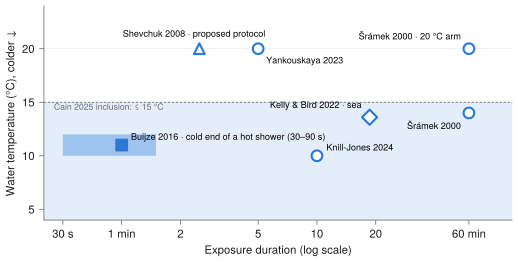
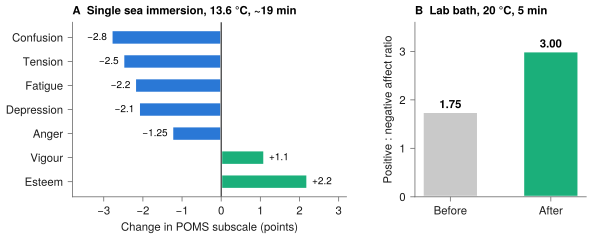
Lab immersion. Yankouskaya and colleagues immersed 33 adults to the neck for five minutes at 20 °C, a mild dose.3 Positive affect on the PANAS rose by 7 points and negative affect fell by 4.7. Participants rated themselves more active, alert, attentive, proud and inspired, and less nervous and distressed. In resting-state fMRI, the rise in positive affect tracked increased coupling between the medial prefrontal hub of the default-mode network and salience-network nodes in the rostral prefrontal cortex and anterior cingulate, and between frontoparietal and dorsal-attention regions.
Sea immersion. Kelly and Bird had 42 novice undergraduates sit in the sea at 13.6 °C for about 19 minutes, with 22 controls.4 Total mood disturbance on the POMS fell from 51 to 36, a large effect, while controls moved by about 2 points. Because the immersion group sat still, the authors attribute the change to the cold rather than to exercise.
Regular practitioners. Fifteen winter swimmers immersed at 4 °C showed lower tension-anxiety, anger and fatigue afterwards, lasting to 24 hours, and started with lower depression-dejection scores than matched non-swimmers.9 Self-selection is the obvious confound. A widely cited BMJ case report described a young woman with long-standing major depression who, over a programme of weekly open-water swimming, had a sustained fall in symptoms and had come off medication by the one-year follow-up.13
Controlled chronic data. This is where the signal weakens. In the Dutch shower trial of 3,018 people, SF-36 mental-component scores were slightly higher at 30 days and no longer different at 90, and anxiety scores never differed.5 The 2025 meta-analysis found only one randomised trial with a mood outcome, and it was null.2
My reading
The acute lift is real and reproducible across very different doses, from 20 °C for five minutes to 13.6 °C for nineteen. The simplest account is relief plus arousal: a sympathetic surge that is felt as invigoration, then the rebound when the aversive stimulus stops. Nothing so far shows that doing this daily changes baseline mood. I would not read that as evidence against it, because the trials were not designed to detect such a change and none enrolled depressed participants.
Section fourAnxiety and stress
Cold water is an anxiogenic stimulus that may have anxiolytic after-effects, so timing is everything.
The acute phase, the first minute and a half. The cold-shock response brings an involuntary gasp, hyperventilation, tachycardia and a rise in blood pressure. It peaks within the first minute and declines over two to three. Below about 15 °C, breath-hold capacity falls from the usual 60 to 90 seconds to a few seconds. Subjectively it closely mimics a panic attack, which for someone with panic disorder makes it either the problem or the therapy, depending on context and framing.
The delayed phase, hours later. The 2025 meta-analysis of 11 randomised trials and 3,177 people is the best quantitative source. Stress was not lower immediately, at one hour, at 24 hours or at 48 hours, but it was clearly lower at 12 hours: SMD −1.00, 95% CI −1.40 to −0.61.2 I read a single significant time point among five cautiously. It may be real, a rebound once the sympathetic surge settles or better sleep in between, or it may simply be what testing several time points produces.
Worry and panic. In Knill-Jones and colleagues' study of 13 young adults, with ten minutes at 10 °C three times a week for four weeks, Penn State Worry Questionnaire scores fell after the first immersion and stayed lower, although there was no control arm.7 In panic disorder, cold facial immersion lowered heart rate more, and was more anxiolytic, in patients than in healthy controls.14 That fits the vagal pathway above.
Two different cold tools
Whole-body cold, a shower, is sympathetic activation followed by a relief rebound. It suits low arousal, flatness and morning inertia. As a stimulus that panic-prone people are sensitive to, it works like interoceptive exposure: useful when approached deliberately with a slow exhale, unhelpful if it feeds avoidance.
Face or neck cold, a cold pack, a splash or a basin, is a vagal brake. Heart rate falls and heart-rate variability rises within seconds. It suits an acute spike of anxiety, exactly when whole-body cold would add fuel.
Section fiveAttention
This is the domain with the widest gap between what people report and what tests show.
Subjective and network-level. After a five-minute bath at 20 °C, participants felt more alert and attentive, and fMRI showed increased coupling between the frontoparietal control network and the dorsal attention network, the two systems most closely tied to top-down control of attention.3 That is what a moderate locus-coeruleus boost in the α2A range would predict.
Objective performance during the cold. A systematic review of 18 studies found cognitive impairment in 15. Attention, processing speed and executive function were hit hardest, and the impairment scaled with the fall in core temperature. The data favoured a distraction account, discomfort consuming attentional resources, over an arousal benefit.8 In the same vein, service members immersed at 1.3 °C did worse on a divergent-thinking task the colder their skin became, while the size of their cold-shock heart-rate peak predicted nothing.15
After repeated brief exposure. Trail Making A and B times fell from 15.2 to 11.1 seconds and from 39.7 to 26.2 seconds over three weeks of ten-minute sessions at 10 °C, while the Stroop did not change. With no control group, practice effects on Trail Making cannot be separated from any effect of the cold.7
What would predict a benefit
Mechanistically, I expect a cold shower to help attention most when baseline arousal is low: a slow morning, the post-lunch dip, sleep inertia. It should help least, or backfire, when catecholaminergic tone is already high, with anxiety, with sleep deprivation and hyperarousal, or at the peak of a stimulant dose. Any benefit belongs to the window after rewarming, not to the exposure itself. No study has tested this interaction directly, and it is the experiment I would most like to see run.
Section sixA protocol that follows the evidence
Dose. Finish a normal warm shower with 30 to 90 seconds at the coldest setting. In the shower trial, 30, 60 and 90 seconds gave the same result (p = 0.98 between arms), and 64% of participants chose to keep going after the study ended.5 Going longer mostly adds discomfort and cooling, which are the factors tied to cognitive impairment.
Temperature. Most controlled data use water at or below 15 °C. The mood study at 20 °C shows that affective effects do not need extreme cold, but the catecholamine surge climbs steeply below about 15 °C.1
Breathing. Through the first 30 seconds, make each exhale slow and longer than the inhale. That limits cold-shock hyperventilation, and the low carbon dioxide behind the light-headedness, and it turns the exposure into deliberate interoceptive practice.
Timing. Morning, or just before a block of focused work, to use the arousal. The evidence on evenings is mixed: one small trial found better sleep, but a noradrenergic surge right before bed points the wrong way for falling asleep, so I would leave a buffer.
Progression. Expect the gasp to fade noticeably within four to eight exposures.6 That fading is habituation, and it does not mean the stimulus has stopped working.
For acute anxiety, reach for face or neck cold, a cold compress on the side of the neck or a basin splash, rather than a whole-body shower.11
Section sevenSafety and interactions
Who should be cautious
- Cardiovascular disease, arrhythmia or uncontrolled hypertension. Cold shock raises heart rate and blood pressure within seconds. Combining face immersion with breath-holding, the so-called autonomic conflict, can trigger arrhythmias even in healthy people.
- Sympathomimetic medication, including amphetamines, methylphenidate, SNRIs and decongestants. Their pressor and heart-rate effects add to cold shock, so keep exposures brief and avoid pairing them with peak drug levels if blood pressure is borderline. Beta-blockers blunt the response and can mask what you are feeling.
- Bipolar spectrum. No study has looked at this. The mechanistic concern is that a daily noradrenergic surge plus shorter sleep is the kind of arousal input that could matter during a hypomanic phase. It is reasonable to track mood and sleep when starting, and to raise it with the treating psychiatrist.
- Raynaud's phenomenon, cold urticaria and pregnancy are the standard contraindications to deliberate cold exposure.
- Open water is a different class of risk. Cold shock is a major contributor to drowning. A shower cannot drown you; a lake can. Never immerse alone.
Section eightHow good is the evidence?
- Blinding is impossible, and expectancy is strong in this field. The most-reported benefit in the largest trial was self-rated energy.5
- Samples are small and healthy. Apart from the one trial of 3,018 people, most studies had fewer than about 60 participants. The 2025 meta-analysis was restricted to healthy adults, and the clinical evidence is mostly case reports and small uncontrolled studies.2,16
- Protocols vary widely: 7 to 20 °C, 30 seconds to 2 hours, showers, baths and the sea. In 5 of the 11 meta-analysed trials, cold was confounded with recovery after exercise.2
- The mechanisms are stronger than the outcomes. Catecholamine release, vagal reflexes and habituation are established physiology. That they add up to a durable psychiatric benefit is still a well-reasoned hypothesis.
A 30 to 90 second cold finish to a shower is a cheap, low-risk and reliable way to change your state for the next few hours: more aroused, more positive and, for many people, calmer later in the day. I do not think the evidence yet supports calling it a treatment for mood or anxiety disorders, and it belongs alongside treatment rather than in place of it. The questions I most want answered are how baseline arousal changes the effect on attention, and what a properly controlled trial in clinical depression would show.
Sources
- Šrámek P, Šimečková M, Janský L, Šavlíková J, Vybíral S. Human physiological responses to immersion into water of different temperatures. Eur J Appl Physiol 81:436–442, 2000.
- Cain T, Brinsley J, Bennett H, et al. Effects of cold-water immersion on health and wellbeing: a systematic review and meta-analysis. PLOS ONE 20:e0317615, 2025.
- Yankouskaya A, Williamson R, Stacey C, Totman JJ, Massey H. Short-term head-out whole-body cold-water immersion facilitates positive affect and increases interaction between large-scale brain networks. Biology 12:211, 2023.
- Kelly JS, Bird E. Improved mood following a single immersion in cold water. Lifestyle Medicine 3:e53, 2022.
- Buijze GA, Sierevelt IN, van der Heijden BCJM, Dijkgraaf MG, Frings-Dresen MHW. The effect of cold showering on health and work: a randomized controlled trial. PLOS ONE 11:e0161749, 2016.
- Barwood MJ, et al. Habituation of the cold shock response: a systematic review and meta-analysis. J Therm Biol, 2024.
- Knill-Jones J, Shadwell G, Hurst HT, Mawhinney C, Sinclair JK, Allan R. Influence of acute and chronic therapeutic cooling on cognitive performance and well-being. Physiol Behav, 2024.
- Falla M, Micarelli A, Hüfner K, Strapazzon G. The effect of cold exposure on cognitive performance in healthy adults: a systematic review. Int J Environ Res Public Health 18:9725, 2021.
- Teległów A, Września K, Blecharz J. Hormonal and psychological responses to a single cold-water immersion in regularly winter-swimming males. Appl Sci 15:7107, 2025.
- Shevchuk NA. Adapted cold shower as a potential treatment for depression. Med Hypotheses 70:995–1001, 2008.
- Jungmann M, Vencatachellum S, Van Ryckeghem D, Vögele C. Effects of cold stimulation on cardiac-vagal activation in healthy participants: randomized controlled trial. JMIR Form Res 2:e10257, 2018.
- Kox M, van Eijk LT, Zwaag J, et al. Voluntary activation of the sympathetic nervous system and attenuation of the innate immune response in humans. PNAS 111:7379–7384, 2014.
- van Tulleken C, Tipton M, Massey H, Harper CM. Open water swimming as a treatment for major depressive disorder. BMJ Case Rep bcr-2018-225007, 2018.
- Kyriakoulis P, et al. Cold facial immersion in panic disorder, 2021; as reviewed in reference 16.
- Smith MK, Weller R, Duong T, et al. Divergent thinking in groups during cold-water immersion is impaired by cold stress not the cold shock response. Front Psychol 16:1512011, 2025.
- Carona C, Marques M. Beyond the cold baths: contemporary applications of cold-water immersion in the treatment of clinical depression and anxiety. BJPsych Advances 30(5), 2024.
What I checked. For references 1 to 6, 8 to 11, 15 and 16 I worked from the published article’s abstract or full text. The numbers from reference 7 come from a detailed published summary of that paper rather than the paper itself. The retention figures in Figure 5 are as reported in the meta-analysis in reference 6. The details of references 12 and 13 are from their published abstracts and I did not check them against the full texts. Reference 14 is cited through the review in reference 16, not read directly. Where a source contained an apparent error, the asymmetric confidence interval in reference 2, I reproduce it as printed and say so.
Scope. This review has not been peer reviewed, and no original data were collected. It is a research review, not clinical advice.